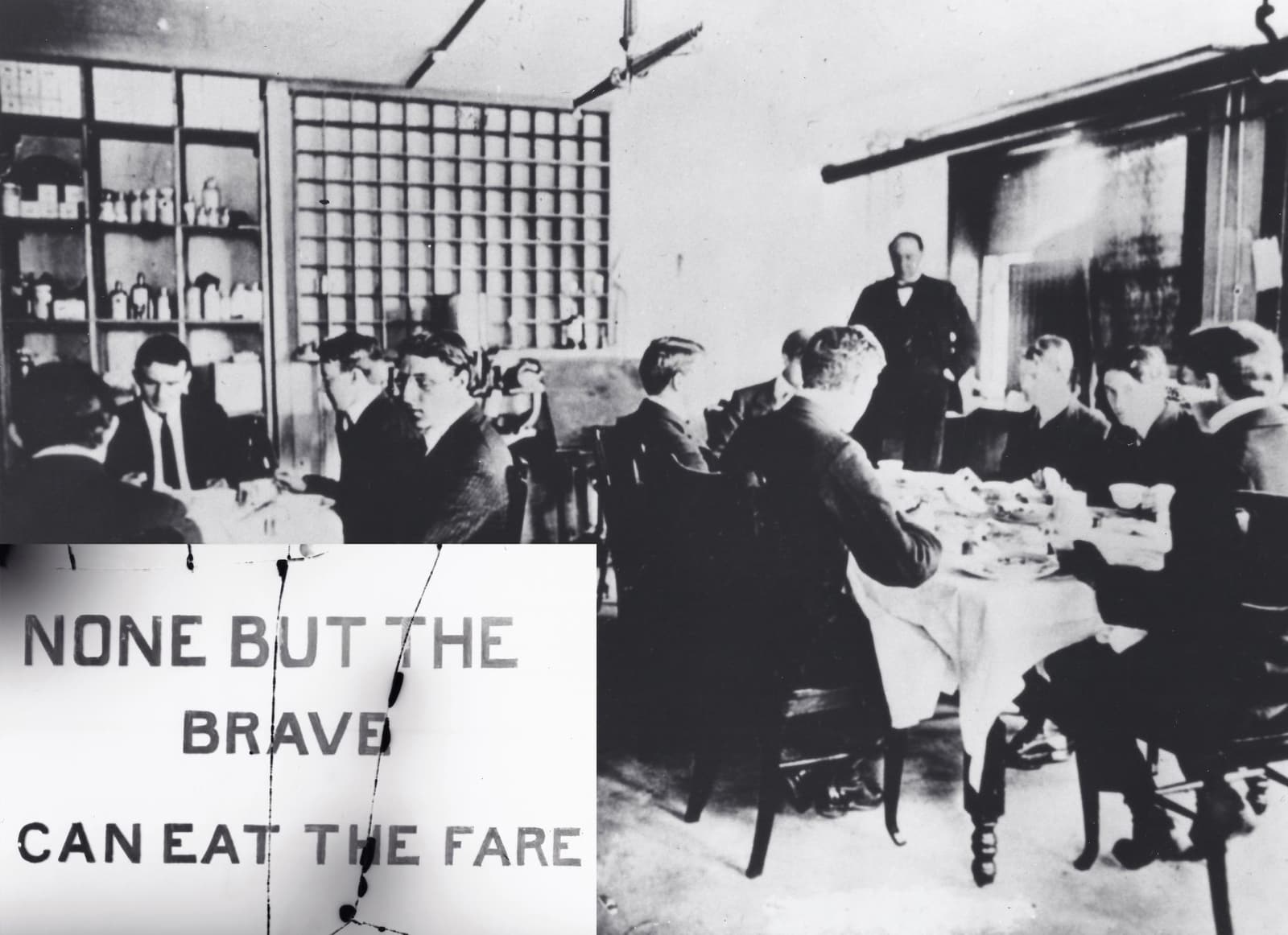
Harvey Wiley's Poison Squad is easy to remember as a strange dinner-club stunt: a government chemist feeds young men borax, salicylic acid, benzoate, formaldehyde, and other suspect preservatives, then watches what happens. That memory is not wrong, but it is too small. The real microhistory is about how a hidden food-safety problem became visible enough for law. Wiley did not invent concern about adulterated food. He built a bridge between laboratory chemistry, consumer fear, newspaper drama, women's reform networks, and Congress at a moment when industrial food had outrun the older household ability to judge food by sight, smell, and local reputation.[1][2][3]
The dining room mattered because the marketplace was already a laboratory, only without consent, measurement, or labels. FDA's centennial profile of Wiley describes an American food supply in which honey could be diluted with glucose syrup, olive oil could be substituted with cottonseed oil, and infant soothing syrups could contain morphine.[2] James Harvey Young's FDA history frames the larger shift: urbanization, national transport, synthetic chemistry, and processed food made city consumers dependent on distant producers whose substitutions were hard to see.[3] The Poison Squad compressed that national uncertainty into a table where the dose, menu, symptoms, and public narrative could be followed.
That is why Wiley's story should not be reduced to one heroic chemist versus one villainous industry. He was a physician and chemist, a former Purdue professor, and from 1883 the chief chemist in the Department of Agriculture's Bureau of Chemistry.[1][2] But his power came from making several worlds overlap. He could talk to Congress in the language of evidence, to consumers in the language of fraud, to reformers in the language of household protection, and to reporters in a form vivid enough to survive the morning paper. The Poison Squad was one part of that translation machine.
The problem before the table
By the late nineteenth century, adulteration was not merely a matter of cheating shoppers. It was a public-health problem produced by scale. A village buyer might know the dairy, baker, butcher, or grocer. A city buyer increasingly bought sealed, canned, bottled, colored, sweetened, preserved, and branded goods that had moved through industrial channels before reaching the kitchen. FDA's historical account notes that the first broad federal food-and-drug bill had appeared in 1879, but the struggle for an omnibus law dragged on for decades.[3]
The obstacle was not only ignorance. It was proof, jurisdiction, and political will. Food processors could argue that preservatives made food cheaper, more stable, and more widely available. Critics could argue that undisclosed additives concealed spoilage, diluted real ingredients, and exposed consumers to chronic risk. Between those positions sat a practical question: what evidence would persuade a Congress that had repeatedly failed to enact a national food-and-drug law?
Wiley's answer was imperfect but politically brilliant. In 1902, Congress appropriated $5,000 for him to study the effects of diets containing food preservatives on human volunteers.[1][2] The volunteers were healthy young men, recruited into a controlled dining arrangement that journalists soon turned into the Poison Squad. They were not random Americans, and by modern human-subject standards the work has obvious ethical and design limits. The CDC review of Deborah Blum's book notes that the studies' ethics and design flaws deserve more attention than the popular legend sometimes gives them.[5] Still, the studies did something ordinary laboratory reports often failed to do: they made chemical preservatives feel like a public experiment already being run on everyone.
Why Wiley needed volunteers
The volunteers gave Wiley more than bodies. They gave him a stage on which chemistry could become legible. A preservative hidden in a jar of ketchup or a bottle of milk was hard to dramatize. A dining room of government workers eating measured meals under a chemist's watch was easy to follow. The press could turn a technical dispute about borax or benzoate into a question that any household understood: if these substances were safe, why did a special squad have to test them under supervision?
The method also exposed the political weakness of the pre-1906 food system. Without a national law, the government could investigate and publicize, but it lacked the authority to police adulterated and misbranded foods moving in interstate commerce with anything like modern reach. Wiley's Bureau of Chemistry had scientific authority before it had regulatory authority. The Poison Squad was therefore a forcing device. It asked the public to notice that federal scientists could identify problems faster than federal law could correct them.[1][4]
The details of the campaign were broader than the table. FDA's consumer profile emphasizes that women organized in groups such as the Federated Women's Clubs, giving Wiley's cause political weight beyond the laboratory.[2] That matters because food safety entered politics partly through the household. Reformers did not have to argue that food adulteration was abstractly immoral. They could argue that a parent buying milk, flour, candy, meat, ketchup, or medicine needed truthful labels and enforceable standards because the domestic buyer could no longer inspect the industrial chain directly.
This coalition dimension keeps Wiley from becoming a lone-genius mascot. FDA's historical materials point to muckraking journalists such as Samuel Hopkins Adams, Upton Sinclair's meatpacking exposé, state and local food officials, professional groups, canners who supported reform, and consumer advocates as parts of the same pressure system.[2][3][4] Wiley supplied a scientific and administrative center of gravity. The law arrived because many forms of evidence and outrage finally converged.
1906: what the law actually changed
On June 30, 1906, President Theodore Roosevelt signed the Food and Drugs Act, often called the Wiley Act, after years in which food-and-drug bills had repeatedly stalled.[2][4] The statute did not create the modern FDA as we know it. It did not require premarket approval of foods and drugs. It did not make every additive illegal. Its core move was narrower and still transformative: it prohibited the interstate transport of unlawful adulterated or misbranded foods and drugs, and it gave the Bureau of Chemistry an enforcement role.[4]
That is the key to the microhistory. Wiley's Poison Squad did not produce a modern safety regime in one leap. It helped shift the public baseline. Before, food fraud and chemical preservation could be framed as buyer-beware commerce, state-by-state nuisance, or a technical fight among chemists. After the 1906 act, adulteration and misbranding became federal enforcement problems when products crossed state lines.[4]
The act's label logic mattered. FDA's enforcement history explains that the 1906 law rested more on product labeling and post-market action than on premarket approval.[4] Drug strength, quality, and purity were tied to recognized standards such as the United States Pharmacopoeia and National Formulary, unless variations were plainly stated. Foods were treated differently, but the law prohibited adding ingredients that substituted for the food, concealed damage, posed a health hazard, or made a product filthy or decomposed. Labels could not be false or misleading, and the presence and amount of eleven dangerous ingredients, including alcohol, heroin, and cocaine, had to be disclosed.[4]
Seen from 2026, that can look limited. It was limited. But limitation should not be confused with insignificance. The act changed the legal status of truth on the package. It made some deceptions actionable, created a route for seizure and prosecution, and gave federal scientists a practical role in turning laboratory findings into cases.[4] It also revealed, almost immediately, that food safety is not settled by passing a law once.
The victory was followed by a fight over enforcement
Wiley's post-1906 career shows the difference between winning a statute and controlling a regulatory system. FDA's biography notes that enforcement was assigned to the Bureau of Chemistry, and that the first food-and-drug inspectors joined laboratory scientists in a new inspection program.[1] The same account gives useful scale: between 1906 and 1912, the Bureau's staff grew from 110 to 146, and appropriations rose from $155,000 in 1906 to $963,780 in 1912.[1] Those numbers show institutional growth, but not uncontested power.
Preservatives remained controversial. FDA's enforcement history says Wiley generally considered many chemical additives unnecessary adulterants, a position that brought him into conflict with Secretary of Agriculture James Wilson and, at times, Roosevelt himself.[4] His authority was weakened when Wilson created a Board of Food and Drug Inspection in 1907 and when a Referee Board of Consulting Scientific Experts was created in 1908 to advise on food-additive safety questions.[4] In other words, the same state that empowered Wiley also surrounded him with new decision points.
That bureaucratic tension is part of the lesson. Public health does not move from science to law in a straight line. Evidence must be interpreted. Industry contests definitions. Courts test statutory language. Administrators decide whether a substance is an adulterant, a useful preservative, a labeling issue, or a tolerable risk. The Poison Squad had made food preservatives publicly memorable, but memory did not decide every enforcement case. The early FDA world had to invent its own operating habits under pressure.[1][4]
Wiley left government in 1912 and continued consumer-protection work at Good Housekeeping, where he linked laboratory testing, public advice, and the magazine's seal to a broader consumer movement.[1][2] That second act is not a footnote. It shows that Wiley understood regulation and public trust as connected but not identical. The law could seize a mislabeled product; public communication could teach consumers to expect more from labels in the first place.
What the Poison Squad still teaches
The Poison Squad should make modern readers uncomfortable in two ways at once. First, it is a reminder that the early food-safety movement sometimes used human experimentation in ways that would not pass today's ethical review. Healthy volunteers, press attention, and patriotic slogans do not erase the limits of consent, representativeness, dosing, or long-term follow-up.[5] The point is not to copy Wiley's method.
Second, it is a reminder that unregulated markets can run experiments too, only less visibly. Wiley's great insight was that Americans were already being exposed to undisclosed preservatives, substitutions, and drug ingredients without enough information or recourse. His dining room was ethically fraught, but it made the larger involuntary experiment harder to ignore. That is the paradox at the center of the story: a small, visible, supervised experiment helped expose a much larger hidden one.
The lasting public-health contribution was therefore not one chemical verdict. It was a change in evidence culture. Wiley helped make the food label, the inspection sample, the laboratory assay, the enforcement case, and the consumer complaint part of the same system. He also showed that technical facts need allies: journalists, reform clubs, professional organizations, sympathetic businesses, and political timing all mattered.[2][3][5]
That is why the famous photograph of Wiley at the table still works. It does not show the birth of perfect food safety. It shows the moment when dinner became evidence. The men around the table are not a model for modern trials. They are a historical signal that the ordinary act of eating had become entangled with chemistry, commerce, law, and trust. Wiley's real achievement was to make that entanglement public enough that the federal government could no longer pretend food safety was only a private bargain between seller and buyer.
Sources
- U.S. Food and Drug Administration, "Harvey Wiley" - FDA leadership biography covering Wiley's Bureau of Chemistry role, the 1902 appropriation for preservative studies, the Poison Squad, enforcement growth, and his 1912 resignation.
- U.S. Food and Drug Administration, "Harvey W. Wiley: Pioneer Consumer Advocate" - FDA Consumer centennial profile on marketplace adulteration, the 1902 volunteer group, women's reform networks, and the June 30, 1906 act.
- James Harvey Young, "The Long Struggle for the Law," U.S. Food and Drug Administration - historical essay on the social, industrial, political, and legislative path to the 1906 Food and Drugs Act.
- U.S. Food and Drug Administration, "Part I: The 1906 Food and Drugs Act and Its Enforcement" - FDA history of the Wiley Act's enforcement structure, labeling basis, prohibited adulteration categories, dangerous-ingredient disclosure, and early administrative conflicts.
- Michael C. Bazaco, "The Poison Squad: One Chemist's Single-Minded Crusade for Food Safety at the Turn of the Twentieth Century," Emerging Infectious Diseases 26(7), 2020 - CDC-hosted review of Deborah Blum's history, including the public-health importance and ethical/design caveats of the studies.
- Wikimedia Commons, "File:Harvey Wiley & Poison Squad (FDA012 & FDA004) (7030346087).jpg" - archival FDA photograph used as the article cover image.