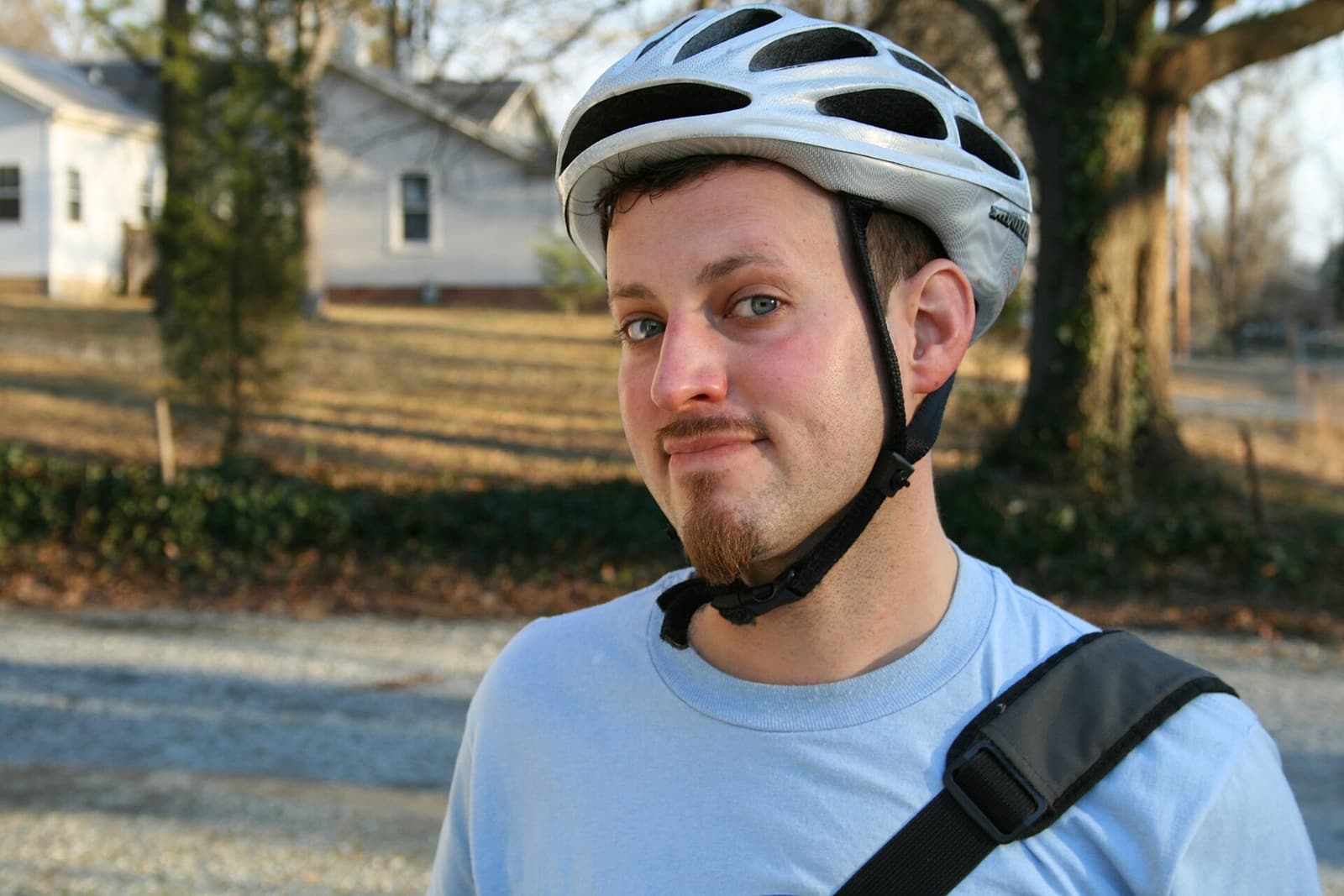
Bicycle helmets attract two bad arguments because they sit exactly where personal habit meets public infrastructure. One argument treats the helmet as a magic answer: wear one and the safety problem is solved. The other treats it as moral theater: if streets are dangerous, a helmet can only distract from the real work. The evidence supports a narrower and more useful claim. Helmets reduce the chance that a crash becomes a head or brain injury, but they do not prevent the crash, slow the vehicle, redesign the intersection, or make a hostile street forgiving.[1][4][5]
That distinction matters because cycling is not one exposure. A child wobbling in a park, a commuter mixing with trucks at dusk, a mountain biker on loose gravel, and an adult rolling through a protected lane are not carrying the same risk. The helmet is a last-line device. It acts after balance, visibility, pavement, speed, road geometry, and driver behavior have already had their say. Good public health does not ask one layer to do every job.
Myth: helmets do nothing meaningful
The strongest evidence against this myth is not a slogan from a safety campaign. It is crash-injury evidence. The Cochrane review by Thompson, Rivara, and Thompson concluded that bicycle helmets reduce bicycle-related head and facial injuries across age groups and crash types, including crashes involving motor vehicles.[1] Its summary states that the reduction in head or brain injury was about two-thirds or more.[1] The exact estimate should not be treated as a universal constant for every street, rider, helmet design, and crash energy, but the direction is hard to dismiss: when a cyclist's head hits something, an impact-attenuating shell and foam liner can matter.
Helmet-law evidence points the same way, though with more policy noise. Alena Hoye's 2018 systematic review and meta-analysis examined 21 studies of mandatory bicycle helmet legislation and found a 20% reduction in head injuries among crash-involved cyclists, with a larger 55% reduction for serious head injury.[2] Those figures are not the same as individual helmet efficacy. Laws change behavior, enforcement, exposure, reporting, and sometimes who chooses to ride. Still, they make the same basic point from a different angle: higher helmet use is associated with fewer head injuries in the injury data.[2][3]
The practical public-health reading is simple. A helmet cannot guarantee a good outcome. It can reduce the probability of a bad one. That makes it a sensible default, especially for children, new riders, higher-speed riding, poor weather, mixed traffic, and any route where a fall or side impact is plausible. The myth that helmets are useless fails because it asks for perfect protection before accepting partial protection.
Myth: helmets solve bicycle safety
The opposite myth fails for the same reason. A helmet is not crash prevention. NHTSA's 2023 traffic-safety facts reported 1,166 U.S. pedalcyclist fatalities in motor-vehicle traffic crashes, 81% of them in urban areas, and 28% at intersections.[4] Those numbers describe a street-system problem before they describe a shopping decision. A helmet can help when the crash reaches the body. It does not decide whether the road has a protected lane, whether turning vehicles are separated in time, whether the posted speed matches human injury tolerance, or whether the rider has to merge across fast traffic to continue straight.
FHWA's Safe System primer is useful because it refuses to place all blame or all responsibility on the road user. It starts from two premises: people make mistakes, and people are vulnerable to crash forces.[5] For bicyclists and pedestrians, that means safety has to be built in layers: safe speeds, safe roads, safe vehicles, safe road users, and post-crash care. The helmet belongs mostly in the safe-road-user and injury-mitigation layer. It is valuable there. It is inadequate everywhere else.
This is why the best helmet argument is not anti-infrastructure. It is pro-redundancy. Public health improves when failures do not line up. If a rider misjudges a curb, the helmet is useful. If a driver opens a door into a bike lane, lower traffic speed and door-zone design matter first, then the helmet may matter. If a truck turns across a cyclist's path, no reasonable helmet policy should be asked to compensate for intersection geometry, blind spots, and speed. The more severe the energy exchange, the more absurd it becomes to treat the helmet as the primary control.
Myth: the policy question is just mandate or don't mandate
Helmet mandates are real policy tools, but they are not the whole policy question. CDC's MV PICCS page treats child bicycle helmet laws as one intervention among many, emphasizing implementation, communication, access, and correct replacement after a crash or damage.[3] That is a better frame than a culture-war argument about whether helmets are virtue or oppression. A law can raise use; it can also fail if helmets are unaffordable, badly fitted, weakly understood, or enforced in ways that discourage riding without improving street safety.
The 2018 meta-analysis is careful on this point. It found evidence of head-injury reduction from mandatory helmet legislation, but it also says that improved bicycle infrastructure should supplement mandates if the goal is both safety and more cycling.[2] That sentence should be the center of the debate. If a city wants fewer serious injuries and more everyday riders, the policy package cannot stop at helmets. It needs protected space, lower speeds where bicycles mix with vehicles, intersection design that makes turning conflicts less lethal, night visibility, sober road use, and a culture in which drivers expect bicycles to be present.[2][4][5]
There is also a measurement lesson. Helmet use is visible, so it can become the easiest thing to notice after a crash. Street design is less personal but often more causal. If investigation stops at "was the cyclist wearing a helmet?", the system has learned too little. The better question stack is: did the rider have a reasonable route, did vehicle speed leave survivable margins, did the intersection create predictable conflicts, did lighting and sightlines work, did the cyclist have a correctly fitted helmet, and did emergency response preserve the remaining chance of recovery?[4][5]
The evidence-balanced habit
For an individual rider, the evidence-balanced habit is straightforward: wear a certified, correctly fitted bicycle helmet; replace it after a crash or visible damage; do not let the helmet license faster or less predictable riding; and treat it as one layer rather than the whole plan.[1][3] For parents, that logic is even stronger because children fall often, have less traffic judgment, and benefit from making helmet use boring early.
For institutions, the evidence-balanced habit is different. Schools and pediatric clinics can normalize helmets without implying that children are responsible for bad road design. Cities can distribute helmets and still fund protected bike lanes. State safety offices can support child helmet laws and still measure whether cycling exposure falls, whether enforcement is equitable, and whether high-injury corridors are being redesigned.[2][3][5]
The cleanest conclusion is deliberately unsatisfying to both extremes. Bicycle helmets work, but only at the point in the sequence where a crash has already broken through. Safer cycling starts earlier. It starts with routes that reduce conflict, speeds that respect human injury tolerance, and systems that assume ordinary mistakes will happen. The helmet is not the whole answer. It is the layer you want in place when the better layers fail.
Sources
- Cochrane, "Wearing a helmet dramatically reduces the risk of head and facial injuries for bicyclists involved in a crash, even if it involves a motor vehicle" - review summary and citation for Thompson, Rivara, and Thompson's helmet injury review.
- Alena Hoye, "Recommend or mandate? A systematic review and meta-analysis of the effects of mandatory bicycle helmet legislation" (Accident Analysis & Prevention, 2018) - PubMed abstract with head-injury and serious-head-injury estimates.
- CDC, "MV PICCS Intervention: Bicycle Helmet Laws for Children" - public-health implementation summary for child helmet laws, helmet access, replacement, and education.
- NHTSA National Center for Statistics and Analysis, Bicyclists and Other Cyclists: 2023 Data (Traffic Safety Facts, DOT HS 813 739) - U.S. fatality, urban, intersection, and safety-reminder data.
- Federal Highway Administration, "Safe System Approach for Pedestrians and Bicyclists: Primer on Safe System Approach for Pedestrians and Bicyclists" - framework for safe speeds, roads, users, vehicles, and post-crash care.
- Wikimedia Commons, "File:2009-03-07 Man with bicycle helmet.jpg" - source page for the lead documentary photograph.