
As of 2026-03-28 UTC, the most useful way to watch the American Heart Association's 66-second "Hands-Only CPR Instructional Video," published on May 20, 2020, is as an anti-hesitation script rather than as a miniature medical course.[1] The clip is designed for a very specific emergency: a teen or adult who suddenly collapses outside the hospital. In that setting, the AHA keeps the first minute brutally simple. Call 911. Get over the chest. Push hard and fast. Keep going.[1][2]
That compression of the message is not a concession to short attention spans. It is the core clinical strategy. The AHA's written CPR guidance says immediate CPR can double or triple the chance of survival after cardiac arrest, and NHLBI's cardiac-arrest material puts the same sequence in public-health language: bystanders should call 911, provide CPR, and use an automated external defibrillator when available.[2][4] A 66-second video cannot teach everything about resuscitation, but it can remove the long pause in which a witness wonders whether action belongs only to professionals.
The video's simplicity also has a boundary, and the AHA is explicit about it in its written materials. Hands-Only CPR is the fast public drill for adults and teens in sudden collapse. Conventional CPR with breaths still matters for infants and children, and for victims of drowning, drug overdose, collapse due to breathing problems, or prolonged cardiac arrest.[3][5] That boundary is part of why the video works. It is not pretending to be universal. It is narrowing the emergency so that a bystander has a higher chance of doing the first useful thing.
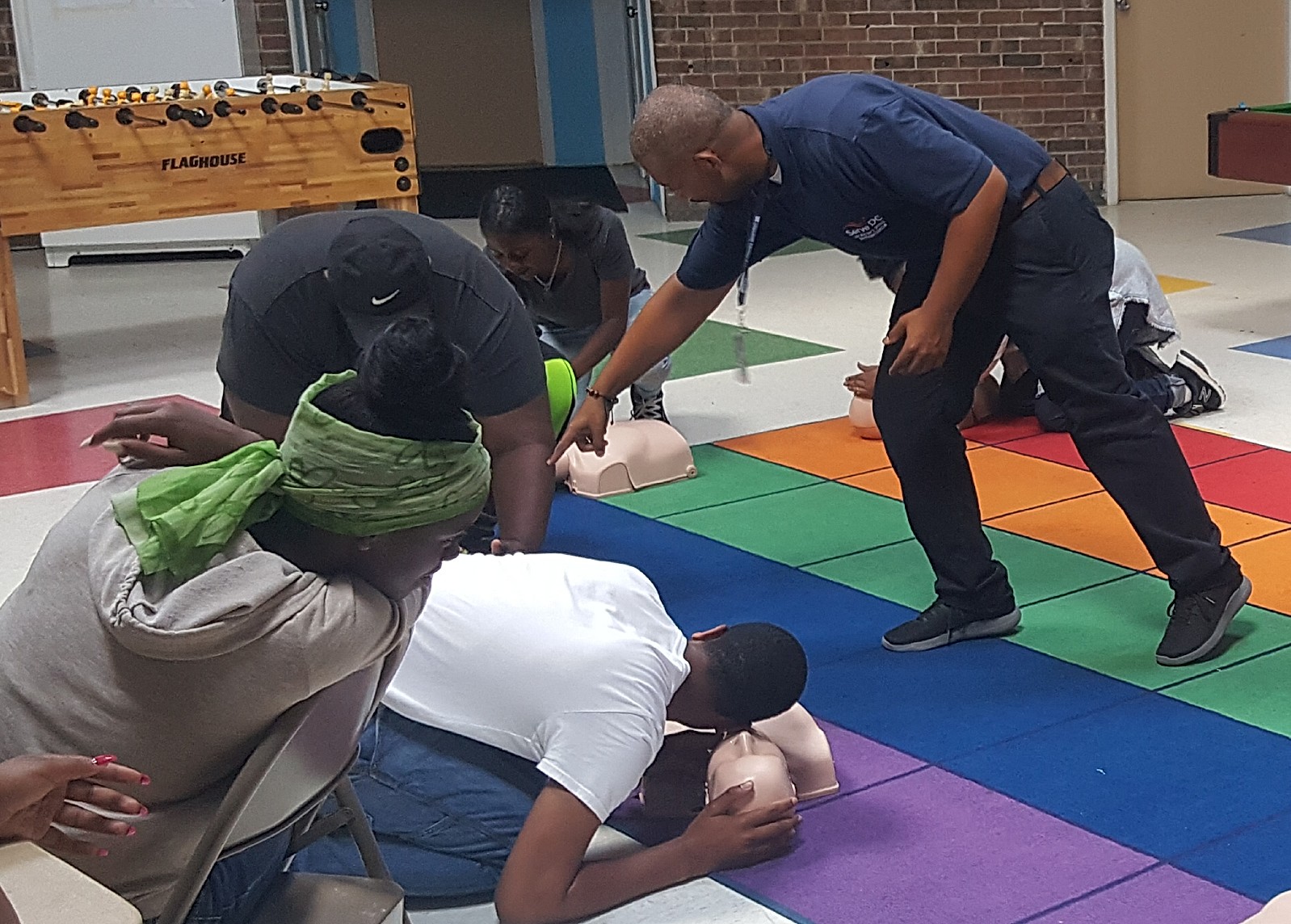
Image context: the cover uses a real CPR/AED training photograph from Wikimedia Commons. That image fits this article because the video is about procedural muscle memory in ordinary public settings: hand placement, body position, AED readiness, and the discipline of acting before professional help arrives.[6]
At 0:01, the video reduces the first judgment to one decisive pattern
The opening line is the whole operating boundary: "If you see a teen or adult suddenly collapse."[1] That wording matters because cardiac emergencies often fail at recognition before they fail at technique. A witness wastes time translating the scene into certainty. Is the person fainting, sleeping, intoxicated, or in real arrest? The AHA video does not ask the public to settle every differential diagnosis on the sidewalk. It gives them a narrower trigger: sudden adult collapse should move them into emergency mode.[1][2]
That is consistent with NHLBI's public guidance. On its defibrillator page, the institute says you do not need to spend time trying to find a pulse; call 911, start CPR, and get an AED.[4] For a trained clinician, pulse checks and rhythm distinctions matter. For a shocked bystander in a gym, office, airport, or living room, the danger is delay. The video's opening therefore does two things at once. It lowers the cognitive bar for action, and it quietly acknowledges that the first error in out-of-hospital cardiac arrest is often not poor compression depth but waiting.
The line also explains why the video is short. A longer instructional sequence can increase knowledge, but it can also restore the sense that intervention belongs to certified insiders. The AHA is trying to produce a different public reflex. When collapse is sudden and the victim is a teen or adult, a witness should feel allowed to start the chain.[1][3]
Around 0:12, the instruction to call 911 is as important as the compression command
At roughly 0:12, the speaker says to send someone to call 911, or call 911 yourself if you are alone.[1] That can sound like boilerplate, but it is the video's most important systems point. CPR is not the whole rescue. It is the bridge that keeps blood moving while the rest of the rescue architecture comes toward the patient. Emergency dispatch, EMS arrival, and defibrillation are what make the bridge worth building.[4]
NHLBI states that a person in cardiac arrest has a better chance of surviving if first responders arrive quickly, and that bystanders should combine 911 activation, CPR, and AED use.[4] The AHA's public pages make the same structure legible in simpler terms: hands-only CPR is the immediate action a witness can provide while higher-energy interventions are still absent.[2][3] In practice, that means the witness is not performing a complete cure. The witness is preventing total circulatory standstill from continuing uninterrupted.
The instruction to "send someone" also solves a common social problem in public emergencies: diffusion of responsibility. Once a crowd forms, everyone can assume that someone else has already called. The video's language assigns the task rather than hoping the group will self-organize.[1] That is a small rhetorical choice with real operational value. A resuscitation scene fails when simultaneous jobs are left unassigned.
Around 0:18, hand placement turns panic into mechanics
The video then strips body movement down to a geometry anyone can copy: get directly over the victim, put the heel of one hand in the center of the chest, place the other hand on top, and begin compressions.[1] The power of that sequence is not elegance. It is that it converts panic into posture. A person who feels medically unqualified can still understand "center of the chest" and "directly over the victim."
The written AHA CPR page adds the technical layer that the video leaves mostly implicit: in adult cardiac arrest, chest compressions should be delivered at 100 to 120 per minute and to a depth of at least 2 inches (5 cm) for an average adult while avoiding excessive depth.[2] That written supplementation matters. The video is the gateway; the page is where the AHA restores detail. Together they show a deliberate division of labor between motivational clarity and formal instruction.[1][2]
There is also a deeper point in the hand-position sequence. CPR succeeds socially when a witness can picture the action before needing it. The AHA is not teaching a theory of circulation in this moment. It is making a body rehearse a move. That is why the camera and narration do not clutter the frame with advanced contingencies. The first task is to get a bystander's hands into the right place without bargaining with fear for too long.
Around 0:30, rhythm matters because compressions are buying time, not correcting the electrical cause
At about 0:30, the video reaches its most famous detail: compress at 100 to 120 beats per minute, roughly the tempo of "Stayin' Alive."[1] Popular culture sometimes makes that cue feel gimmicky. In fact, it is doing serious physiological work. The AHA's international hands-only page says that in the first few minutes after a teen or adult suddenly collapses, the lungs and blood still contain enough oxygen to keep vital organs viable as long as high-quality chest compressions keep blood moving with minimal interruption.[3]
That sentence clarifies what CPR can and cannot do. Compressions do not usually reverse the underlying electrical problem. They do not replace defibrillation. They buy perfusion time for the heart and brain while the victim remains in a state that still needs an AED, EMS, or both.[3][4] Read that way, the beat cue is not a motivational flourish. It is a public mnemonic for maintaining a salvageable circulation window.
This is also where the title of the article matters. Hands-only CPR is a bridge. If the witness imagines it as the finish line, the whole event becomes misread. NHLBI's pages keep the frame wide enough to prevent that mistake: call 911, start CPR, and get an AED.[4] The AHA video chooses to occupy only the middle of that sequence because the middle is the part bystanders can most immediately control.[1]
What the video leaves off-screen on purpose
The most responsible way to praise this video is to notice what it omits. There is no long discussion of rescue breaths. There is no pediatric branch. There is no extended instruction on drowning, overdose, or respiratory collapse. That absence is not carelessness. It is the design logic of public simplification. AHA's written comparison of hands-only CPR versus full CPR training says hands-only is for adults and teens, while conventional CPR training covers the broader set of cardiac-arrest victims, including children, infants, and those whose collapse is driven by breathing failure or prolonged unresponsiveness.[5]
That written boundary keeps the short video from being over-read. It is not a substitute for full CPR instruction. It is the lowest-friction entry point that maximizes the chance a witness will do something useful in the most common adult-collapse scenario.[2][3][5] In that sense, the clip should be judged by a public-health standard, not by whether it contains every branch of the resuscitation algorithm. Its job is to get the right first move into more hands.
That is why the video's closing line, "don't be afraid to try it," is more important than it sounds.[1] Fear in cardiac arrest scenes rarely takes the form of indifference. It takes the form of reverence, the belief that touching the chest of a collapsed stranger is a professional act that ordinary people should not begin. The AHA is trying to reverse that hierarchy for the first minute. Later, the professionals and machines matter enormously. At the moment of collapse, what matters first is whether someone nearby will start the bridge.
Sources
- American Heart Association, "Hands-Only CPR Instructional Video," YouTube, published May 20, 2020.
- American Heart Association, "What is CPR" - public guidance on hands-only CPR, compression rate, depth, and survival impact.
- American Heart Association International, "Learn Hands-Only CPR" - boundary cases, oxygen-in-the-first-minutes explanation, and bystander-action rationale.
- National Heart, Lung, and Blood Institute (NHLBI), "Defibrillators - Who Needs a Defibrillator?" - public action sequence for calling 9-1-1, starting CPR, and getting an AED.
- American Heart Association, "Hands-Only CPR vs. CPR Training" (2024 PDF comparison of adult/teen use versus full CPR-with-breaths training contexts).
- Wikimedia Commons, "File: CPR, First Aid and AED.jpg" - 2016 CPR/AED training photograph by TinasBabyInc.