


As of 2026-03-28 UTC, the most useful way to watch CDC's hand-hygiene video series is as one connected program rather than four isolated training clips.[5] Taken together, Engage, Educate, Execute, and Evaluate describe a full operating loop for safer care: build the conditions for clean hands, teach the timing model, normalize correction inside teams, and use measurement to change the next round of behavior.[1][2][3][4][5]
That systems framing matters because hand hygiene usually fails in hospitals for reasons more structural than rhetorical. CDC's clinical safety page states the basic obligation plainly: hand hygiene protects both healthcare personnel and patients, and it includes cleaning hands with soap and water or with alcohol-based hand sanitizer, depending on the situation.[6] WHO's guidance adds the harder part. Safe practice depends on what happens at the point of care and on whether staff can act at the exact moments when contact, contamination, or transition risk changes.[7][8][9] Read beside those documents, the CDC series stops looking like a cleanliness campaign and starts looking like an implementation brief.
That is also why the collection format matters. Plenty of educational hand-hygiene videos stop at technique, as if the central problem were only whether a worker remembers the rubbing steps. CDC sequences the problem differently. The series begins with infrastructure, moves into timing and method, then into social correction, and only then into data.[1][2][3][4][5] In other words, it treats compliance as something a clinical unit has to design, rehearse, and maintain.
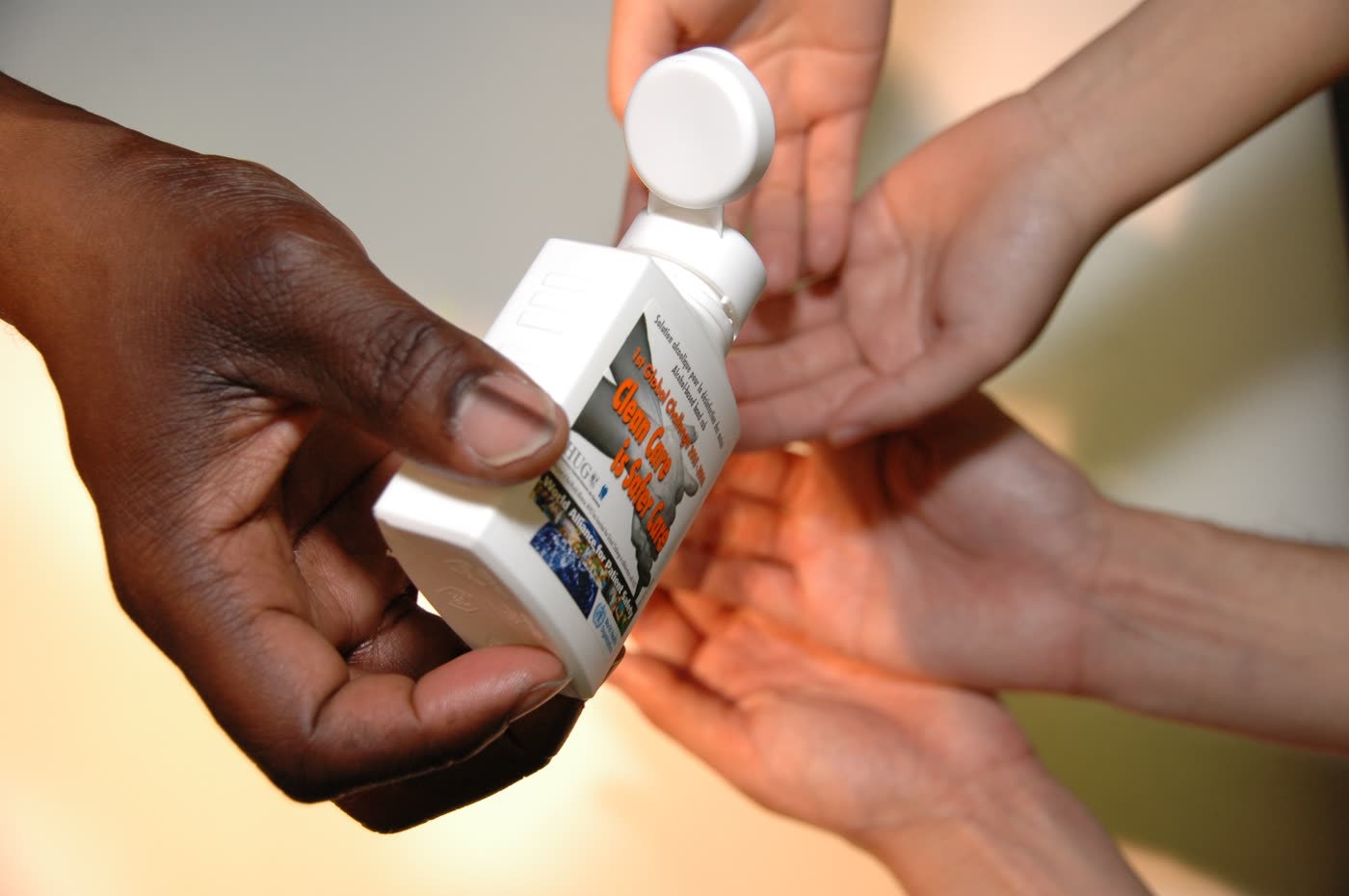
Image context: the cover uses a WHO documentary photograph of a handwashing poster and sanitizer station in a care setting. That image fits this article because the CDC series is fundamentally about point-of-care design: visible reminders matter, but they only work when they sit beside reachable supplies and a shared workflow.[8]
Video 1: Engage makes hand hygiene an infrastructure problem before it becomes a behavior problem
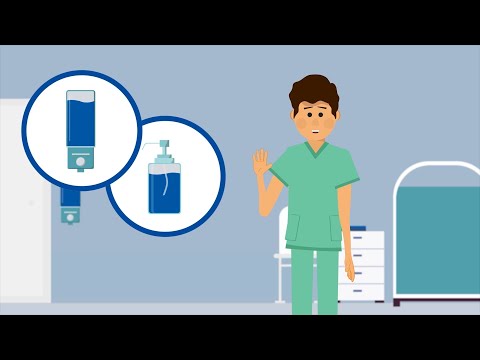
CDC opens the series in the right place. The description for Engage: The Foundation of a Hand Hygiene Program says a successful program starts with accessible and functional supplies for hand cleaning, staff awareness of when to clean their hands, aspirational goals, and accountability.[1] That is already a strong editorial choice. It refuses the easy story that noncompliance is mostly a matter of careless individuals.
What the first video understands is that hand hygiene starts as a placement problem. If sanitizer is missing, broken, empty, or badly positioned, the unit has already pushed the worker toward delay and workaround before any educational message begins to matter.[1][5][8] WHO's hand-hygiene materials make the same point in institutional language: improvement has to happen at the point of care, where the moment of decision and the tool for action meet.[7][8] The CDC clip translates that principle into managerial terms. A unit needs reachable supplies, a visible shared aim, and a baseline expectation that clean hands count in every encounter.[1][5]
That is why the video's tone is useful. It does not shame. It frames the program as something staff can enter together. The best reading of Engage is that it turns hand hygiene from an abstract virtue into a piece of ward infrastructure. Once that shift happens, the rest of the series makes more sense: knowledge, accountability, and measurement are not separate from the environment. They are ways of keeping the environment behaviorally alive.
Video 2: Educate turns technique into a timing model instead of a memorized ritual
The second video moves from infrastructure into craft. CDC's description says Educate: Developing Knowledge and Skill in Hand Hygiene explains when and how hands should be cleaned through the workday, including before touching a patient, before an aseptic task, after patient contact, after contact with contaminated surfaces or body fluids, and immediately after glove removal.[2] That list matters because it reframes hand hygiene as a sequence of clinical transitions, not as a generic command to clean hands often.
This is where the CDC series most clearly meets WHO's My 5 Moments for Hand Hygiene model.[2][7][9] The deep insight in that model is that risk changes with contact boundaries: before touching the patient, before a clean or aseptic task, after body-fluid exposure risk, after touching the patient, and after touching the patient's surroundings.[7][9] A worker is not being asked to perform a vague ritual of purity. The worker is being asked to notice exactly when one zone of risk becomes another.
That distinction is what makes Educate stronger than a simple demonstration video. Technique still matters. CDC's clinical safety guidance explicitly distinguishes situations that call for soap and water from those where alcohol-based hand sanitizer is appropriate.[6] But the larger lesson is cognitive. Training has to help staff perceive the right moment under pressure. If the unit teaches only the rubbing steps, it may produce technically correct motions disconnected from actual transitions in care. Educate is valuable because it ties motion back to clinical timing.[2][6][9]
Video 3: Execute treats correction as a team skill, not as a punitive interruption
The third clip is where the series becomes more ambitious. CDC describes Execute: Mindfulness and Team Accountability with Hand Hygiene as a guide to approaching someone who has not properly cleaned their hands while keeping the feedback timely, individualized, and non-punitive.[3] That is a harder subject than technique, because it touches hierarchy, embarrassment, and the daily politics of clinical work.
Most hospitals know how to print a poster. Far fewer know how to make interruption socially legitimate. Execute is useful because it treats that legitimacy as part of patient safety rather than as an optional soft skill.[3][5] A unit that cannot tolerate small corrective interventions is quietly deciding to tolerate preventable drift. The CDC video therefore asks for two things at once: self-awareness from the person who might miss a moment, and a disciplined, non-humiliating style of intervention from the colleague who sees the lapse.[3]
That matters because hand hygiene is unusually exposed to social friction. The act itself is quick, but the missed moment is often witnessed by peers, patients, or trainees. A punitive culture can drive the problem underground; a lax culture can turn every lapse into background noise. CDC's middle path is the practical one. Feedback should be immediate enough to matter and specific enough to be usable, yet calm enough that people keep participating in the program.[3] In that sense, Execute is the bridge between education and improvement: it teaches the unit how to preserve the timing model in real human interaction.
Video 4: Evaluate argues that data should change the next action, not merely decorate a dashboard
The last clip closes the loop. CDC says Evaluate: Using Hand Hygiene Data for Action reviews observation and auditing methods, including overt direct observation and covert observation, so facilities can improve adherence with credible data.[4] The emphasis on "for action" is the video's key phrase. Measurement is not presented as an ornamental score.
This is where many hand-hygiene programs become administratively busy and clinically thin. It is easy to collect numbers that flatter leadership or frighten staff without changing the unit's actual obstacles. CDC's framing is more sober. Different observation methods reveal different parts of the problem, and the point of monitoring is to support continuous quality improvement.[4][5] That means asking what the data should change: supply placement, onboarding, reminders, peer-feedback habits, or the design of a specific workflow.
The video also helps correct a familiar mistake in quality programs: confusing surveillance with learning. Covert observation may reveal behavior that overt auditing misses, but the data still become clinically useful only when the unit turns them into a next step.[4] WHO's guidance is compatible with that logic; improvement depends on implementation tools, system change, training, evaluation, and reminders working together rather than as isolated compliance theater.[7][8][9] Evaluate is therefore the right ending for the collection. It shows that a program matures when it can observe itself without reducing safety work to punishment or paperwork.
What the four videos reveal together
Viewed in order, the CDC series makes a larger argument than any single clip can carry. Hand hygiene is not one habit sitting inside one worker. It is a small but dense institutional system. Supplies have to be available where care happens.[1][8] Staff have to share a timing grammar for risk transitions.[2][7][9] Teams have to make correction socially workable.[3] Data have to trigger the next improvement rather than merely certify that a program exists.[4][5]
That is why the series feels more serious than its short runtimes suggest. CDC is not trying to win a slogan battle. It is translating decades of infection-prevention logic into an operating sequence that a ward can actually run.[5][6][7][8][9] The result is a useful reminder for any reader returning to hand hygiene after years of hearing only the headline message. Clean hands matter, but durable performance comes from design. The poster, the dispenser, the timing model, the peer correction, and the feedback loop all have to hold together in the same clinical world.
Sources
- Centers for Disease Control and Prevention (CDC), "Engage: The Foundation of a Hand Hygiene Program," YouTube video, published April 27, 2023.
- Centers for Disease Control and Prevention (CDC), "Educate: Developing Knowledge and Skill in Hand Hygiene," YouTube video, published April 27, 2023.
- Centers for Disease Control and Prevention (CDC), "Execute: Mindfulness and Team Accountability with Hand Hygiene," YouTube video, published April 27, 2023.
- Centers for Disease Control and Prevention (CDC), "Evaluate: Using Hand Hygiene Data for Action," YouTube video, published April 27, 2023.
- Centers for Disease Control and Prevention, "Clean Hands in Healthcare Training" (March 8, 2024).
- Centers for Disease Control and Prevention, "Clinical Safety: Hand Hygiene for Healthcare Workers" (February 27, 2024).
- World Health Organization, WHO Guidelines on Hand Hygiene in Health Care (2009).
- World Health Organization, "Hand hygiene" (infection prevention and control overview and implementation resources).
- World Health Organization, "Five moments for hand hygiene."