The Goiania cesium-137 accident is often remembered through its strangest detail: a powder that glowed blue in the dark. That image is vivid, but it can make the disaster look like a freak encounter with mystery. The stronger reconstruction is more ordinary and more useful. A radiotherapy source was left unsecured, removed as scrap, ruptured, admired, carried through homes and junkyards, and recognized only after illness had already started to map the exposure pathway.
In September 1987, a cesium-137 teletherapy unit from the former Instituto Goiano de Radioterapia had been abandoned in a partly demolished clinic in Goiania, Brazil. The official IAEA report says the institute had moved around the end of 1985, taking a cobalt-60 unit but leaving the cesium-137 unit in place without the required notification to the licensing authority.[1] By 13 September 1987, two men entered the insecure premises, removed the source assembly from the radiation head, took it home, and tried to dismantle it.[1]
That sequence matters because it keeps the event inside public health rather than spectacle. The first failure was custody. The second was recognition. The third was dispersion. The fourth was the belated conversion of private illness into a public emergency.
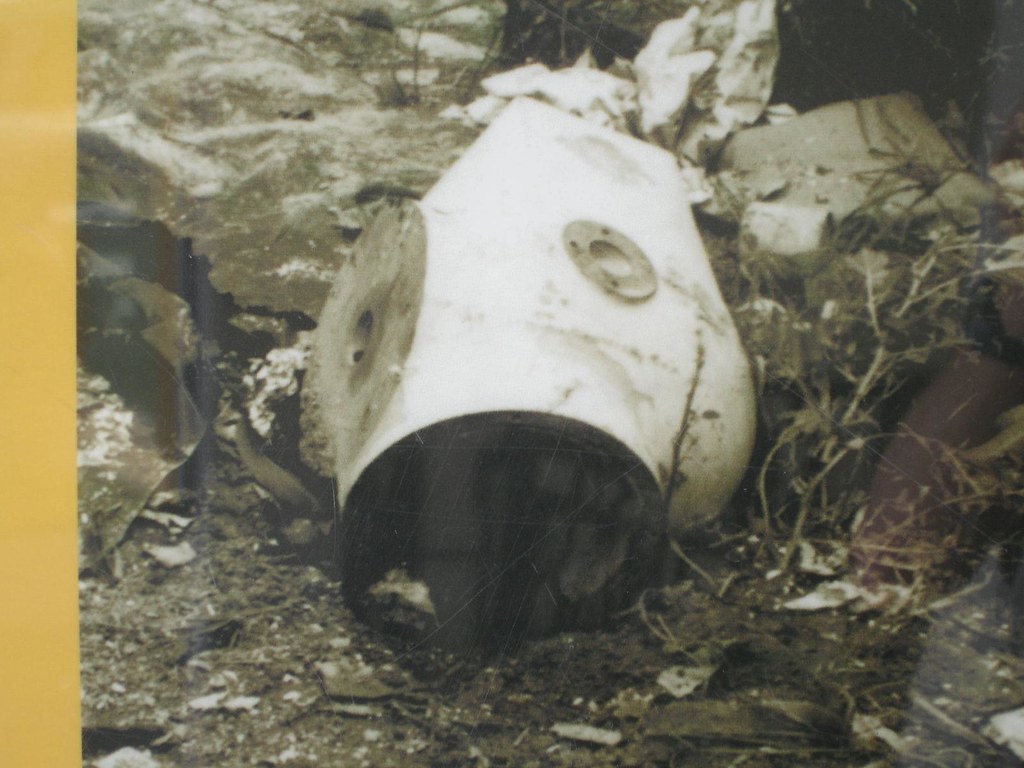
Image context: the cover uses a real IAEA archival photograph of the radioactive source assembly involved in the accident. It is the right image because it shows the object at the center of the chain: a medical source that should have remained sealed, controlled, and legible to authorities, but instead passed through ordinary scrap channels before anyone understood the danger.[5]
The source was dangerous because it was concentrated and dispersible
Cesium-137 is not an exotic idea in medicine. CDC describes it as a fission product used in medical radiation therapy devices, sterilization, calibration equipment, and industrial gauges.[2] The danger in Goiania came from form and context. The source was a highly active medical source. The IAEA report identifies it as 50.9 TBq, or 1375 Ci, at the time of the accident.[1] It was also cesium chloride, a salt the report describes as highly soluble and readily dispersible.[1]
Those two facts belong together. A sealed source inside a functioning device is a controlled hazard. A ruptured capsule of soluble powder in a house, junkyard, bus, clinic, and hospital entrance becomes an exposure pathway. CDC's current cesium-137 guidance draws the same boundary in plain language: large concentrated sources are designed to stay sealed, and if opened accidentally or intentionally, the material can be dispersed.[2]
That is why the blue glow is historically dangerous as a memory hook. It explains fascination, not mechanism. The Goias health department's public account says fragments of cesium-137 were spread after the equipment was violated, especially in places where the material was handled or where parts of the radiotherapy device were taken.[3] The glow made people approach. The chemical form made contamination travel.
Recognition came after the exposure chain had already moved
After the source capsule was ruptured, the remnants were sold to a junkyard owner. The IAEA report describes how he noticed the blue glow and how, over several days, relatives, neighbors, and acquaintances came to see the material. Fragments about the size of grains of rice were distributed to several families.[1] The disaster therefore did not expand like a single explosion. It expanded socially: curiosity, gift, scrap value, household contact, contaminated hands, contaminated rooms.
The first symptoms did not clarify the cause. The report says several people developed gastrointestinal symptoms, but these were not initially recognized as radiation injury.[1] That delay is one of the central public-health lessons. A rare exposure pathway can pass through ordinary clinical categories before anyone knows what question to ask. Vomiting, diarrhea, skin injury, and malaise did not automatically point local care toward a ruptured radiotherapy source.
The break in the chain came from pattern recognition inside the affected household network. One irradiated person connected the illness cluster with the source capsule and took the remnants to the public health department. A local physicist then used monitoring equipment, recognized the scale of the accident, and began urgent evacuations while authorities were alerted.[1]
The timeline is harsh. The source was removed on 13 September 1987. The contamination was not properly recognized until late September. By then, the material had passed through multiple sites, and the response had to reconstruct not only who was sick, but where the source had been, what had been touched, what had been carried away, and which homes had become exposure sites.[1][3]
The stadium turned fear into triage
Once the accident was recognized, Goiania faced a second kind of crisis: uncertainty at public scale. The IAEA report says a stadium was designated as a temporary holding area where contaminated and injured people could be identified. Medical triage found 20 people needing hospital treatment; 14 were sent to the Marcilio Dias Naval Hospital in Rio de Janeiro, while six were treated in Goiania.[1]
Mass monitoring became the instrument that turned rumor into categories. In total, about 112,000 people were monitored, and 249 were found to be contaminated internally or externally.[1] The same report notes that 129 people had internal contamination and were referred for medical care.[1] These figures matter because they show the scale mismatch at the heart of the event. A small capsule produced a citywide queue.
The numbers also protect the reconstruction from two opposite mistakes. It would be wrong to say everyone in Goiania was physically contaminated. It would also be wrong to say the event was small because only a subset had measurable contamination. Public health had to manage both the radiological cases and the social field around them: fear, stigma, contaminated objects, uncertain sites, and the need to test people who had good reason to worry.
The human toll was concentrated but severe. Four people died within four weeks of hospital admission, with post-mortem findings associated with acute radiation syndrome and complications.[1] CDC's cesium-137 page explains the relevant injury boundary: external exposure to large amounts can cause burns, acute radiation sickness, and death, while internal exposure can distribute radioactive material into soft tissues and raise cancer risk.[2] Goiania turned both boundaries into clinical work.
Treatment was also contamination control
The medical response was not simply a matter of admitting patients and waiting. Cesium-137 complicated care because patients could be both injured and contaminated. The IAEA report describes skin decontamination, radiation injuries, contaminated excreta, cytogenetic dose assessment, whole-body counting, urine and fecal sampling, and the use of Prussian Blue to promote decorporation of cesium.[1]
This is the point at which Goiania stops being only an accident story and becomes a systems story. In an ordinary poisoning, the patient may be the unit of care. In a radiological contamination event, the patient, clothing, waste, urine, feces, room surfaces, instruments, and staff workflow can all become part of the health-physics problem. Care has to protect the patient and the caregivers while also keeping contamination from spreading through the hospital.
The IAEA report notes that Prussian Blue was given to patients in both hospitals to increase elimination of cesium, and that monitoring was used to evaluate its effect.[1] That detail should not be read as a miracle-drug story. Its importance is operational. Treatment required measurement. Measurement required equipment. Equipment had to be moved, staffed, calibrated, and interpreted under public pressure.
Goiania therefore exposed a preparedness boundary that still matters: a city may have hospitals, ambulances, and physicians, yet still lack ready familiarity with low-frequency radiological contamination. The response had to build a temporary architecture quickly: stadium screening, hospital isolation, whole-body counting, bioassay, waste handling, public communication, and environmental survey.[1]
Homes became part of the contaminated landscape
The environmental response was as important as the medical one. The IAEA report says initial surveys were done on foot and by car, and more than 67 square kilometres of urban Goiania were monitored. The main contaminated foci covered roughly 1 square kilometre.[1] That distinction is important: the response had to search widely because contaminated material had moved through normal urban life, but the highest-risk areas were specific and traceable.
The airborne survey later became part of the technical record. A 2023 Brazilian Journal of Radiation Sciences article describes how the city's urban area, nearby dwelling centers, and the two creeks crossing the city were surveyed in two days after authorities needed a rapid picture of dispersion. It found one additional contamination point not yet identified by ground crews and helped show that attention could concentrate on known high-activity points under CNEN control.[4]
Buildings were not neutral containers. The report says 159 houses were monitored and 42 required decontamination in the executive summary, while later technical sections describe significant contamination in 85 houses and evacuation of 41.[1] Those differences reflect different action categories, not a simple contradiction. Some places needed surveying; some needed cleaning; some needed evacuation; some were too contaminated to salvage.
Decontamination was physical and invasive. Surfaces were vacuumed, washed, stripped, covered, or removed. Soil was scraped. Some houses were demolished. The waste problem grew out of the response itself. The final stored radioactive waste volume was about 3,500 cubic metres, more than 275 lorry loads, with thousands of drums and boxes required for packaging.[1]
That waste figure is the best antidote to treating the accident as a single lost capsule. The capsule was small. The system required to contain its consequences was not. Once soluble cesium chloride entered homes, soil, tools, clothes, paper, furniture, vehicles, and hospital waste streams, public health had to become logistics.
The lasting lesson was custody before emergency
The lasting lesson is practical rather than ceremonial. Emergency response matters. Yet the best emergency response is the one made unnecessary by secure source management, clear ownership, inspection, removal authority, and public recognition of dangerous devices.
The Goias health department's account preserves the local shape of the error: an abandoned radiotherapy device, valuable lead, a scrapyard sale, distribution of fragments to relatives and friends, and contamination in the places where the material was handled or carried.[3] CDC's cesium-137 guidance supplies the contemporary mechanism: these sources are safe only when sealed and controlled; if opened, the material can disperse and injure.[2]
That is the core reconstruction. Goiania was not a nuclear-power accident. It was not a bomb. It was not a mystery substance appearing from nowhere. It was a medical source whose custody failed, whose risk was invisible to the people handling it, and whose dispersible form made ordinary social movement dangerous.
The accident still matters because modern health systems continue to use sealed radioactive sources in medicine and industry. The lesson is not fear of radiation therapy. The lesson is that the benefits of radioactive sources depend on boring controls: inventory, licensing, decommissioning, physical security, warning labels people can understand, and response teams that can turn fear into measured action. Goiania shows what happens when a source leaves that system. The city did not merely discover radiation. It discovered how much public health depends on knowing where dangerous things are before they glow.
Sources
- International Atomic Energy Agency, The Radiological Accident in Goiania (1988) - official review of the accident sequence, medical response, monitoring, decontamination, waste handling, and lessons.
- Centers for Disease Control and Prevention, "Cesium-137" (August 28, 2025) - properties, uses, sealed-source boundary, exposure routes, and health risks.
- Secretaria de Estado da Saude de Goias, "Cesio 137 Goiania" - local public-health account of the abandoned radiotherapy device, soluble cesium chloride, scrap movement, and contaminated sites.
- Paulo Barretto and Evaldo Simoes da Fonseca, "The Cs-137 radiological accident in Goiania, Brazil: Conditions and results of the airborne radiometric survey," Brazilian Journal of Radiation Sciences (2023) - airborne survey operations, contamination extent, and response implications.
- IAEA Imagebank, Flickr photo "02010019" - source photograph of the radioactive source involved in the 1987 Goiania accident, used as the article image.