Robert Koch's 1882 tuberculosis paper is usually remembered through one clean sentence: he found the bacillus that causes TB. That sentence is true, but it is too small. Read closely, the paper is not only an announcement of a microbe. It is a demonstration of how a disease becomes legible to medicine, public hygiene, and later policy.
The article's force comes from sequence. Koch first frames tuberculosis as a problem large enough to justify state attention. He then turns a nearly invisible organism into a repeatable visual object through staining. After that, he pushes the claim beyond the microscope by linking the organism to diseased tissue, culture, and animal infection. Only at the end does the paper become openly public-health minded: if tuberculosis is infectious, then sputum, disinfection, diagnosis, and organized prevention become practical targets rather than vague anxieties.[1][2]
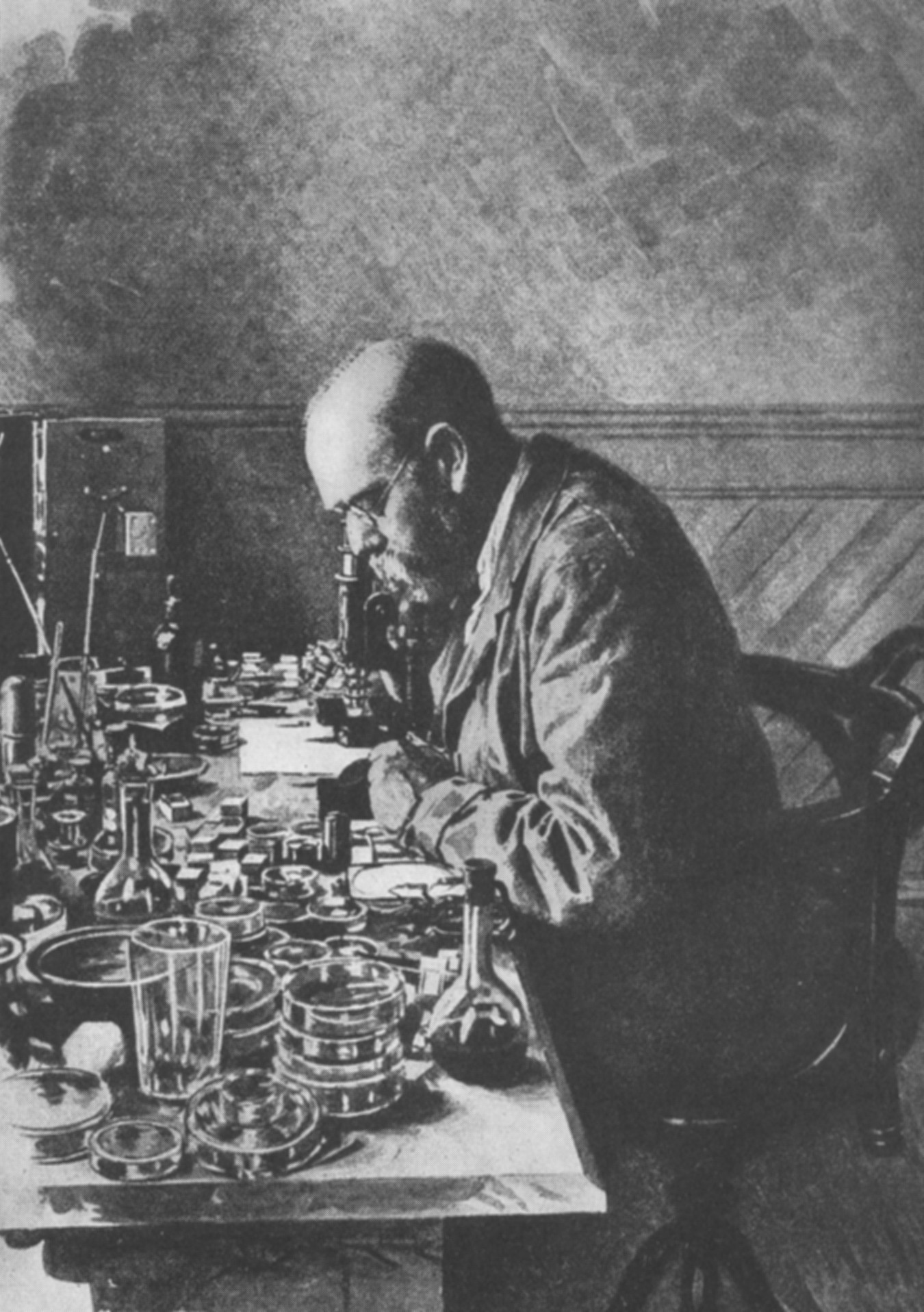
Image context: the cover uses a real archival laboratory photograph of Koch at a microscope rather than a drawing of bacilli. That choice matters because the 1882 paper is about method as much as discovery. Koch's claim depended on making a microscopic object visible, repeatable, and actionable inside a laboratory-public-health chain.[6]
The paper starts with burden, not glamour
Koch does not begin by inviting readers to admire a technical trick. He begins by making tuberculosis too large to ignore. In the 1882 text, he presents TB as one of the most destructive infectious diseases and says public hygiene has strong reason to attend to it.[1] That opening matters because it locates the research inside a civic problem. The question is not only "what is this disease?" It is "what must public health know before it can act?"
That scale remains recognizable. WHO's current fact sheet estimates that 10.7 million people fell ill with TB worldwide in 2024, and describes TB as preventable and curable while still treating drug-resistant TB as a health-security threat.[4] The modern numbers should not be read back into Koch's world as if treatment capacity were the same. They do explain why the 1882 paper still feels consequential. Koch was working on a disease that was already socially visible before it became bacteriologically visible.
The historical hinge is that older evidence had pointed toward transmissibility without settling mechanism. Koch cites prior animal inoculation and inhalation experiments as part of the case that tuberculosis belonged among infectious diseases.[1] His contribution was to make the agent itself carry the argument. Once a specific bacillus could be seen, isolated, and tied to disease, the debate changed from "is consumption a constitutional fate?" toward "how does this organism move, persist, and get interrupted?"
Visibility had to become reproducible
The most famous part of the paper is the staining. Koch describes a technique that made tubercle bacilli stand out from surrounding tissue; the bacilli remained visibly distinct while other material took on a different color.[1] The detail is easy to romanticize as a single moment at the microscope. Koch's real move was more rigorous: he made visibility into a procedure another investigator could, in principle, repeat.
That repeatability matters because tuberculosis was not an easy organism to place in the ordinary laboratory frame. The bacillus was thin, slow, and embedded in diseased tissue. A casual look could not carry a causal revolution. The claim needed a method that distinguished bacilli from cell nuclei, debris, and other bacteria; it also needed a pattern across cases, not one spectacular slide.[1][2]
Nobel's biographical account helps explain why Koch's tuberculosis work landed with such force. Before and around the TB discovery, Koch refined bacterial staining and culture methods, including pure-culture techniques on solid media and laboratory practices that made pathogenic bacteria easier to isolate and identify.[3] The 1882 paper therefore should not be read as a lone observation detached from craft. It was a concentrated use of a larger methodological program: stain the organism, separate it from visual noise, grow it when possible, and connect it back to disease.
Causation had to leave the slide
The strongest reading of the paper resists a common shortcut: seeing a microbe in diseased tissue is not the same thing as proving it caused the disease. Koch understood that boundary. The CDC's centennial account summarizes the evidentiary chain: Koch observed the bacillus with the disease, grew it outside the host, and reproduced disease in susceptible animals inoculated with pure culture.[2] That is the architecture that later became shorthand as Koch's postulates.
The postulates themselves were not a magic formula that solved every infectious disease. Some pathogens are hard or impossible to culture in ordinary ways. Some infections have carriers, latency, asymptomatic transmission, or host factors that complicate one-organism-one-disease logic. But for tuberculosis in 1882, the value of the framework was immense because it set a standard of causal burden. The bacillus was not merely a passenger in tuberculous lesions. The claim was that it belonged in the causal chain.
That distinction changed the status of the patient, the sample, and the room. Sputum was no longer only a symptom. It became an infectious material. A lesion was no longer only a pathologic endpoint. It became a place to search for an agent. A laboratory culture was no longer only a technical exercise. It became a bridge between bedside observation and public-health action.[1][2]
The public-health sentence is the hinge
The most modern part of the 1882 paper may be its practical turn. Koch points to the sputum of people with pulmonary tuberculosis as an essential source of infectious material and argues that rendering it harmless through disinfection should not be insurmountable.[1] That is the moment the bacillus leaves the slide and enters the world of behavior, sanitation, and institutions.
This does not mean Koch had a complete TB-control program. He did not. The paper predates antibiotics, modern contact investigation, BCG vaccination, molecular diagnostics, and the current drug-resistance landscape. But it gives public health a target surface. If a disease is caused by a specific organism that exits the body in sputum, then prevention can become less mystical: reduce infectious exposure, identify cases, manage contaminated material, and build diagnostic practices around the organism's properties.
The later history confirms that the discovery's value was partly diagnostic. CDC's centennial account traces subsequent diagnostic advances through acid-fast recognition, X-rays, tuberculin skin testing, and purified protein derivative.[2] Those later tools did not simply decorate Koch's discovery. They extended its logic: make infection and disease more visible at earlier or more precise points in the chain.
The failure boundary keeps the discovery honest
A close reading also needs to protect Koch from a victory myth. The 1882 paper supplied a cause and a method; it did not supply a cure. In 1890, Koch announced tuberculin as a hoped-for treatment, and the hope collapsed when it failed as therapy. Nobel's biography is blunt that the healing power claimed for old tuberculin was greatly exaggerated, though tuberculin later became diagnostically useful.[3]
That failure is not an embarrassing footnote. It is the boundary that makes the 1882 achievement clearer. Identifying a cause is not the same as neutralizing it. A disease can become scientifically intelligible long before it becomes easy to treat, cheap to diagnose, or politically simple to control. TB still proves the point. WHO's current fact sheet notes that TB is preventable and curable, yet millions still fall ill and drug-resistant TB remains a major problem.[4]
The commemoration history carries the same tension. March 24 became World TB Day a century after Koch's announcement, not because tuberculosis was finished, but because the discovery opened the path toward diagnosis and cure while the disease persisted.[5] Commemoration here is not a museum ritual. It is a reminder that a causal breakthrough has to be translated into systems that actually reach people.
What the paper teaches now
Koch's 1882 article is most useful when read as proof architecture. It asks the reader to follow a chain: social burden, prior transmissibility evidence, visual method, association with disease, culture and animal reproduction, then public-health implication. The sequence is the argument.
That is why the paper still matters outside tuberculosis history. Modern medicine often lives with partial signals: biomarkers, imaging findings, genomic variants, environmental exposures, and model outputs that can tempt people to confuse correlation with cause. Koch's paper is an older, stricter lesson. A visible signal becomes medically powerful only when it is placed inside a tested causal pathway and then connected to an intervention surface.
The bacillus mattered because it made tuberculosis specific. The method mattered because it made that specificity defensible. The public-health turn mattered because it made the discovery governable. Koch did not end TB in 1882. He changed what it meant to know what TB was.
Sources
- Robert Koch, "The Aetiology of Tuberculosis" (1882), English translation hosted by German History Intersections - primary-source excerpt and translation note.
- Centers for Disease Control and Prevention, "Historical Perspectives Centennial: Koch's Discovery of the Tubercle Bacillus" - announcement date, evidentiary chain, postulates, tuberculin, and later diagnostics.
- NobelPrize.org, "Robert Koch - Biographical" - laboratory methods, pure culture work, tuberculosis discovery, Nobel context, and tuberculin boundary.
- World Health Organization, "Tuberculosis" fact sheet - current global burden, preventability, curability, and drug-resistant TB context.
- Centers for Disease Control and Prevention, "History of World TB Day" - March 24, 1882 discovery context and 1982 commemoration.
- Wikimedia Commons, "File:Robert Koch in seine Laboratorium.jpg" - circa-1885 archival laboratory photograph used as the article image.