Fetal alcohol spectrum disorders are easy to misstate in two opposite directions. One version turns every pre-pregnancy or early-pregnancy drink into a certain catastrophe. The other version treats the lack of a neat dose-response cutoff as permission to keep drinking lightly. The evidence supports neither shortcut. It supports a stricter, less theatrical rule: alcohol exposure before birth can cause lifelong physical, behavioral, intellectual, and neurodevelopmental harm, and medicine has not identified a safe amount, safe time, or safe type of alcohol during pregnancy.[1][2]
That wording matters. "No known safe amount" is not the same sentence as "one sip always injures a fetus." It is a public-health boundary under uncertainty. Heavy drinking and binge drinking create the clearest and highest risks, but lower exposures are not easy to certify as harmless because timing, pattern, maternal metabolism, fetal genetics, nutrition, co-exposures, and ascertainment all complicate the evidence.[2][3] When the outcome can include permanent brain and developmental injury, the practical prevention rule is abstinence during pregnancy and when trying to become pregnant, paired with support for people who need help stopping.[1][2]
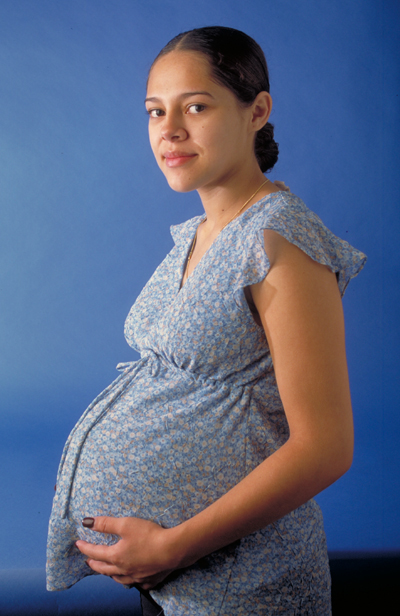
Image context: the cover uses a real USDA photograph of a pregnant woman at a WIC clinic in Virginia.[6] The image fits because fetal alcohol prevention is not an abstract warning label. It is a clinical and community-health conversation that has to happen in ordinary prenatal-care spaces, food-support programs, primary care, and pediatric follow-up.
Myth: fetal alcohol harm is only the classic facial syndrome
The public memory of fetal alcohol syndrome often begins with visible features. That history is understandable. In 1973, Kenneth Lyons Jones and David Weyhe Smith published a Lancet paper identifying additional early-infancy cases and describing prenatal-onset growth deficiency and serious dysmorphogenesis in a patient with fetal alcohol syndrome.[3] The diagnostic pattern became visible partly because some children had recognizable physical findings.
But that history can make the modern problem look too narrow. NIAAA defines fetal alcohol spectrum disorders as a wide range of physical, behavioral, and cognitive impairments caused by alcohol exposure before birth; those impairments can appear at different points in childhood and last throughout life.[2] It also lists the spectrum as including fetal alcohol syndrome, partial fetal alcohol syndrome, alcohol-related neurodevelopmental disorder, alcohol-related birth defects, and neurobehavioral disorder associated with prenatal alcohol exposure.[2]
The distinction is not taxonomy trivia. If the only mental image is a baby with classic facial features, many affected children disappear from view. A child can have learning, memory, attention, impulse-control, motor, coordination, social, or behavioral difficulties without fitting the most visible version of fetal alcohol syndrome.[2][5] That is why the article's first boundary is diagnostic: the absence of obvious facial features is not proof that prenatal alcohol exposure was harmless.
Evidence: the risk is real, but the threshold is not measurable enough to use
The clearest current guidance is blunt because the biology is unforgiving and the measurement problem is hard. CDC states that alcohol use during pregnancy can be harmful, that there is no known safe amount, that there is no safe time, and that all types of alcohol can be harmful.[1] The same CDC page explains why a simple "after this week" rule fails: alcohol can affect the baby throughout pregnancy, including before pregnancy is recognized, and brain development continues throughout pregnancy.[1]
NIAAA adds the risk-gradient nuance that should keep the message honest. Binge drinking and heavy drinking during pregnancy put the developing baby at the greatest risk for severe problems, but even lesser amounts can cause harm, and no known safe amount has been established.[2] This is the core evidence boundary. Risk is not uniform across all patterns of drinking. At the same time, clinicians cannot offer a reliable safe harbor that applies across pregnancies.
That is why "no known safe amount" is the right public-health sentence. It does not require pretending that every exposure has the same probability of harm. It refuses to invent a reassuring threshold where the evidence has not earned one. For a preventable exposure with potentially lifelong effects, the burden of proof has to sit on safety, not on visible injury after the fact.[1][2][4]
Myth: if many people drink before they know they are pregnant, the advice is unrealistic
This myth begins with a real problem. Pregnancy is often not recognized immediately, and NIAAA notes that approximately half of U.S. pregnancies are unplanned when explaining why the Surgeon General recommends that people who are pregnant, might be pregnant, or are thinking about getting pregnant avoid alcohol.[2] CDC also answers the common scenario directly: if someone has stopped drinking after learning they are pregnant, stopping is still beneficial because it is never too late to stop alcohol use during pregnancy.[1]
That is the practical middle ground. The advice is not useful if it becomes a shame machine for a person who drank before knowing they were pregnant. Shame does not reverse exposure and can delay prenatal care. The useful move is to stop once pregnancy is known or possible, discuss concerns with a health care provider, and keep regular prenatal care.[1]
At the same time, the difficulty of early recognition does not erase the prevention logic. It explains why the best counseling happens before pregnancy is confirmed: in primary care, contraception visits, fertility planning, mental-health care, substance-use treatment, and community programs. The message has to be simple enough to remember and humane enough to act on: if pregnancy is possible or intended, alcohol is not the safe default; if alcohol use is hard to stop, care should start with help, not punishment.[1][5]
Evidence: prevalence estimates show a hidden burden, not a rare curiosity
FASD is also easy to undercount because it is not one visible diagnosis captured cleanly at birth. CDC says that FASDs include several diagnoses, that exact counts are uncertain, and that different estimation methods produce different results.[4] Medical-record studies can find lower rates because they depend on recognition and documentation. Active community assessment finds more.
The 2018 JAMA study makes that difference concrete. It assessed first-grade children in four U.S. communities between 2010 and 2016. In a population of 13,146 first graders, 6,639 were selected for participation and 222 cases of fetal alcohol spectrum disorders were identified.[4] The most conservative prevalence estimates ranged from 11.3 to 50.0 per 1,000 children; weighted estimates ranged from 31.1 to 98.5 per 1,000.[4] The authors cautioned that the findings might not generalize to every community, but the study still changes the scale of attention.[4]
CDC's public summary converts that same evidence into a more readable estimate: the full range of FASDs might affect as many as 1% to 5% of school-aged children in the United States and some Western European countries.[4] NIAAA states the same 1% to 5% first-grade estimate from the NIAAA-supported JAMA work.[2] Those numbers do not mean every case looks the same. They mean the spectrum is large enough that schools, pediatricians, families, and support systems will keep meeting it even when prenatal exposure is not obvious in the chart.
This is also why prevention and diagnosis cannot be treated as rival priorities. Prevention reduces future exposure. Diagnosis and support reduce secondary harm for people already living with FASD. A public-health system that only warns pregnant people but fails children after birth has understood only half the problem.[5]
Myth: once exposure has happened, nothing can be done
FASD prevention rightly emphasizes avoiding alcohol exposure before birth, but that can create a second pessimism: if exposure occurred, the story is over. CDC's treatment page rejects that fatalism. There is no cure for FASDs, but early intervention treatment services can improve a child's development, and protective factors such as early diagnosis, special education support, stable nurturing environments, and social services can reduce secondary conditions and help people reach their full potential.[5]
That matters because the diagnosis is often socially loaded. Families may fear blame. Clinicians may avoid the conversation. Schools may see behavior without understanding disability. The result is a preventable second injury: a child with neurodevelopmental impairment gets treated mainly as willful, lazy, defiant, or poorly parented, rather than as someone who needs specific supports.[2][5]
The better frame is developmental. FASD can affect learning, memory, behavior, social interaction, growth, and brain-related function.[2][5] Those difficulties need individual assessment and strengths-based planning, not a one-size-fits-all label. CDC emphasizes that treatment works best when it addresses a person's specific impairments and builds on strengths.[5] That is the after-birth counterpart to abstinence advice before birth: both are practical, not moralistic.
What the boundary leaves standing
The strongest myth-vs-evidence conclusion is disciplined rather than dramatic. Heavy and binge drinking during pregnancy are especially risky.[2] Alcohol can disrupt fetal development at different stages, including before pregnancy is recognized, and the brain remains vulnerable across pregnancy.[1][2] FASD is a spectrum that can involve visible physical features, but it can also present as cognitive, behavioral, social, motor, or learning impairment without the classic public image.[2][5] Active community assessment suggests the burden is much larger than record-based diagnosis alone would imply.[4]
The prevention rule follows from that stack. Because no safe threshold has been identified, the safest course is not to drink during pregnancy or when trying to become pregnant.[1][2] Because real people may drink before they know they are pregnant or may struggle to stop, the clinical response has to include regular prenatal care, honest disclosure, treatment support, and nonjudgmental follow-up.[1][5] Because people already living with FASD can benefit from early intervention and stable supports, the system cannot stop at warning labels.[5]
That is the cleanest way to keep the evidence from becoming either panic or permission. Fetal alcohol risk is not a prophecy attached to one remembered drink. It is a preventable exposure problem where the safe threshold is not known, the highest-risk patterns are clear, the burden is often hidden, and the useful response is care that starts before birth and continues after diagnosis.[1][2][4][5]
Sources
- Centers for Disease Control and Prevention, "About Alcohol Use During Pregnancy" (updated April 2, 2026) - current guidance on no known safe amount, time, or type of alcohol during pregnancy, plus advice after early unrecognized exposure.
- National Institute on Alcohol Abuse and Alcoholism, "Understanding Fetal Alcohol Spectrum Disorders" - FASD definition, spectrum categories, exposure mechanism, 1%-5% first-grade estimate, and current pregnancy alcohol-use statistics.
- Kenneth L. Jones and David W. Smith, "Recognition of the fetal alcohol syndrome in early infancy," The Lancet, 1973 - original clinical recognition paper, DOI landing page.
- Philip A. May et al., "Prevalence of Fetal Alcohol Spectrum Disorders in 4 US Communities," JAMA, 2018 - active case-ascertainment study of first-grade children and prevalence estimates.
- Centers for Disease Control and Prevention, "Treatment of FASDs" (updated May 8, 2025) - early intervention, protective factors, individualized supports, and no-cure boundary.
- Wikimedia Commons, "PregnantWoman.jpg" - USDA photograph by Ken Hammond of a pregnant woman at a WIC clinic in Virginia, used as the article image.