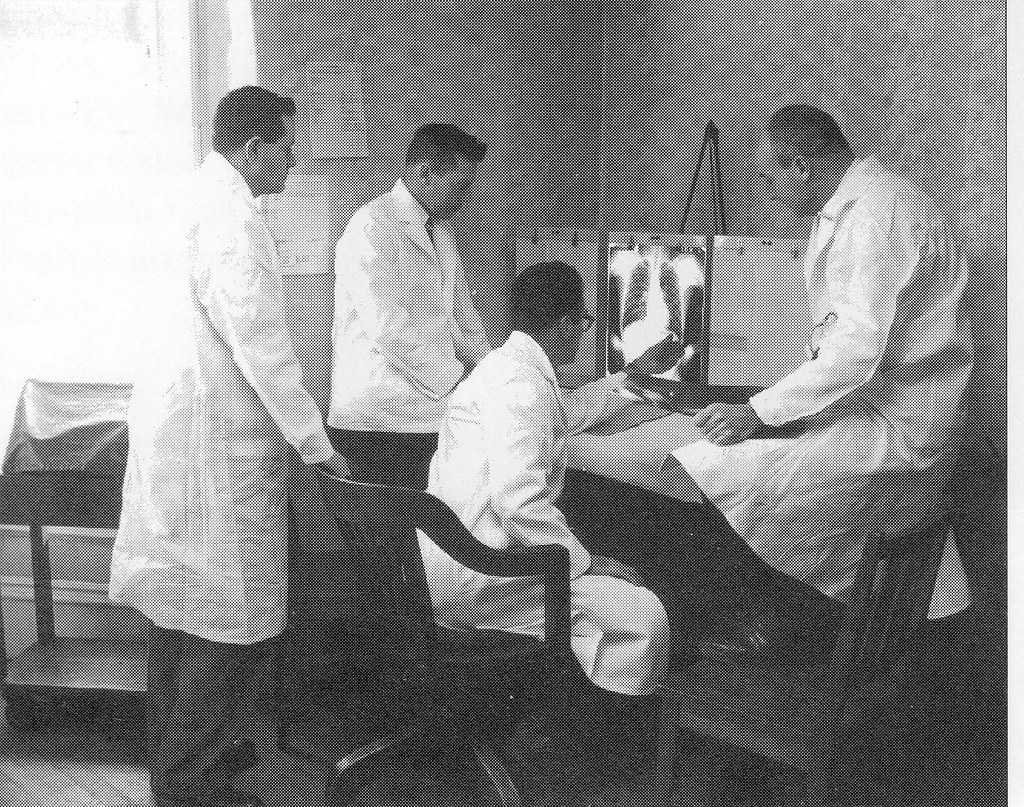
The most important sentence in mid-century cardiology was not a treatment order. It was a change in what physicians were asked to look at. By the early 1960s, Framingham investigators were no longer writing about coronary disease as a sudden, mysterious misfortune that announced itself only after infarction. In the title of a 1961 Annals of Internal Medicine paper, they reorganized the field around "factors of risk" and, in doing so, helped turn future illness into something clinicians were expected to measure before catastrophe arrived.[1]
That sounds obvious now because the phrase has become ordinary. Blood pressure, cholesterol, diabetes, smoking status, family history: modern medicine is saturated with the risk-factor habit. But the paper matters because it shows the habit at the moment of consolidation. A close reading of the Framingham sequence from 1948 to 1961 shows three linked moves: first, the conversion of a town cohort into a machine for observing chronic disease over time; second, the reframing of coronary disease as the cumulative output of several measurable traits rather than a single culprit; and third, the migration of that probabilistic language into ordinary clinical judgment.[1][2][3]
1. 1948 to 1959: from heart attacks to preconditions
The Framingham Heart Study began in 1948, in an American medical culture that still leaned heavily toward rescue after visible disease rather than intervention during the long silent interval before it.[3] The later historical literature is blunt about how different the period looked from the present. In the 1940s and 1950s, heart disease was common, therapeutics were thin, and even elevated blood pressure was often treated with a kind of fatalistic permissiveness. The epidemiologic premise behind Framingham - repeated examinations of a community sample over years, with later events linked back to baseline traits - was not yet the dominant medical style.[3]
That background makes the 1959 paper "Some Factors Associated with the Development of Coronary Heart Disease" worth reading as a bridge text.[2] Its title still sounds cautious. "Associated with" leaves room for modesty; the investigators are not claiming a single deterministic mechanism. But the paper already stacks the observational architecture that would later harden into the risk-factor model: serum cholesterol, blood pressure, body weight, cigarette use, and electrocardiographic findings are treated as variables whose combinations sort people into different futures.[2]
This is where the Framingham method did something quietly radical. It shifted the clinical scene from the bedside of a patient with chest pain to the exam room of an apparently well person whose numbers were beginning to sort them. A chronic disease cohort made visible what acute care could not: not just who was ill, but who was moving toward illness in patterned ways.[2][3]
2. 1961: reading the title as an argument
The 1961 paper is often remembered for popularizing the term "risk factor," and the historical literature is strong on that point.[1][3] But the phrase did more than supply a catchy label. It changed the grammar of explanation.
Start with the title: "Factors of risk in the development of coronary heart disease - six year follow-up experience. The Framingham Study."[1] The unit of attention is no longer disease alone. It is development. Coronary heart disease appears as an outcome that emerges along a path, and the path can be read in advance through plural, countable features. "Factors" matters because it rejects a monocausal picture. The physician is asked to think in bundles: blood pressure plus cholesterol plus tobacco plus weight plus age, not one villain acting alone.
That pluralism also softened an old clinical temptation, which was to wait for certainty. Framingham offered something less dramatic but more useful: graded likelihood. The close-reading point is that the paper does not promise prophecy. It offers a structured way to think under uncertainty. A patient with mildly elevated pressure, a smoker with rising cholesterol, or a man whose electrocardiogram looked slightly abnormal did not become a doomed case. He became someone whose future event probability was now legible enough to justify intervention before symptoms.[1][3]
In that sense, the title itself contains the prevention turn. If disease "develops," then medicine has a temporal opening. If risk comes in "factors," then management can be distributed across multiple levers. The paper's conceptual force lies there: it gave clinicians permission to treat a profile, not just a crisis.
3. Why the paper changed practice more than a pathology note would have
William Kannel later described Framingham's contribution as central to preventive cardiology, and that retrospective framing is accurate precisely because the study made common clinical traits newly combinable.[4] High blood pressure stopped being a background characteristic to be tolerated until organ damage became undeniable. Cholesterol stopped being only a laboratory curiosity. Smoking stopped being merely a habit with distant statistical significance. These became ingredients in a forecast.
That is the difference between a pathology-centered and a risk-centered clinic. In a pathology-centered clinic, coronary disease becomes real when angina, infarction, heart failure, or sudden death arrive. In a risk-centered clinic, disease becomes actionable earlier, when ordinary measurements begin to cluster into an adverse profile. The practical payoff was not only conceptual. Once clinicians and public-health researchers accepted that future coronary events could be estimated from interacting traits, they could build thresholds, treatment ladders, and eventually formal prediction tools.[4][5]
The 1998 Framingham paper on coronary prediction using risk-factor categories is the mature descendant of the 1961 move.[5] By then, the language had become operational. Recommended blood pressure and cholesterol categories could be fed into a multivariable algorithm to estimate 10-year coronary risk.[5] That later calculator culture is often criticized for flattening persons into score sheets, and some of that criticism is fair. But it is still worth noticing that the calculator is not the beginning of the story. The beginning is the earlier act of clinical seeing: learning to interpret several mildly abnormal findings together as a preventable future rather than an unconnected present.
4. What the paper could not solve
A close reading is also useful for recovering the boundaries. Framingham did not discover every relevant association from nothing. Smoking's harms were being clarified in other cohorts during the 1950s, and blood pressure debates were already underway.[2][3] The study's achievement was synthesis, persistence, and translatability. It put several strands into one durable framework and attached them to a familiar clinical workflow: measure, follow, compare, intervene.
Nor was the model universally portable. The original cohort came from one Massachusetts town and was overwhelmingly white, which later raised transportability problems when Framingham-derived tools were generalized across sex, race, and population settings far beyond the study's own base.[3][5] Risk-factor medicine is powerful, but it has always required recalibration. It can tell clinicians where to look; it cannot remove the need to ask whether the underlying population, baseline event rate, and social context have changed.
There is a second boundary as well. Risk-factor language is probabilistic, but clinicians and patients often hear it morally. Once numbers become forecasts, they are easily mistaken for verdicts. Framingham helped create preventive medicine's most useful vocabulary, yet that vocabulary can harden into overconfidence if scores are treated as destiny rather than guidance. The better reading of the 1961 paper is more disciplined: it teaches vigilance upstream, not certainty downstream.
5. Why the 1961 paper still feels current
What keeps the paper alive is not nostalgia. It is that modern medicine still operates inside the frame it established. Contemporary discussions about statins, blood-pressure targets, GLP-1 drugs, CAC scores, and wearable alerts all depend on the same underlying habit of mind: small present measurements are read as structured clues about future disease burden. Framingham did not finish that intellectual architecture, but it made it clinically usable.[1][4][5]
That is why the 1961 paper deserves to be read as more than an early epidemiology artifact. It is a document about time. In 1948, the study opened a way to observe chronic illness before catastrophe. In 1959, it showed that apparently ordinary traits sorted people into different coronary futures.[2] In 1961, it gave that sorting a durable name.[1] By 1998, the name had become a risk algorithm that ordinary physicians could apply in clinic.[5]
The long afterlife of the paper lies in that sequence. It taught medicine to see disease before disease looked obvious. That is a conceptual achievement large enough to hide inside a familiar phrase.
Sources
- William B. Kannel, Thomas R. Dawber, Abraham Kagan, Nicholas Revotskie, and Joseph Stokes III, "Factors of risk in the development of coronary heart disease - six year follow-up experience. The Framingham Study." Annals of Internal Medicine 55(1), 1961. Primary source that popularized the risk-factor framing.
- Thomas R. Dawber, William B. Kannel, Nicholas Revotskie, Joseph Stokes III, Abraham Kagan, and Tavia Gordon, "Some Factors Associated with the Development of Coronary Heart Disease - Six Years' Follow-Up Experience in the Framingham Study." American Journal of Public Health and the Nation's Health 49(10), 1959. Earlier Framingham bridge paper showing the pre-1961 observational architecture.
- Nabil T. Maraire and Ramachandran S. Vasan, "The Framingham Heart Study: the epidemiology of cardiovascular disease and the historical context." European Heart Journal 35(43), 2014. Historical synthesis on Framingham's origins, reception, and the prevention turn.
- William B. Kannel, "Bishop lecture. Contribution of the Framingham Study to preventive cardiology." Journal of the American College of Cardiology 15(1), 1990. Retrospective account linking Framingham findings to preventive cardiology practice.
- Peter W. Wilson, Ralph B. D'Agostino, Daniel Levy, Albert M. Belanger, Halit Silbershatz, and William B. Kannel, "Prediction of coronary heart disease using risk factor categories." Circulation 97(18), 1998. Framingham-derived 10-year risk algorithm as the mature clinical descendant of the earlier framework.
- History at NIH, "Framingham Heart Study physicians." Archival photograph showing study physicians in clinical review.