The Flexner Report is often remembered as a school-closing document, a brutal audit that separated serious medicine from diploma mills. That memory is true and still too thin. Read closely, the 1910 report does something more consequential. It moves medical legitimacy away from the individual doctor and into the institution around him. A physician is no longer defended mainly by personal apprenticeship, local reputation, or the fact of holding an MD. He is defended by an educational system: college preparation, laboratory science, hospital control, and university oversight.[1][2][3]
That institutional turn is the report's real victory and its lasting wound. In 1908 the Carnegie Foundation authorized the study; in 1910 Flexner published a survey of 155 medical schools in the United States and Canada.[1] He argued that medicine had become too important to be left to commercial schools and too scientific to be taught without laboratories. He also argued that the country had far too many poorly trained physicians, writing that American doctors were four or five times as numerous, relative to population, as those in Germany.[1] Those claims helped modernize medical training. They also gave reform a language of acceptable sacrifice, one that later narrowed Black medical education to a tiny institutional corridor.[3][4][5]
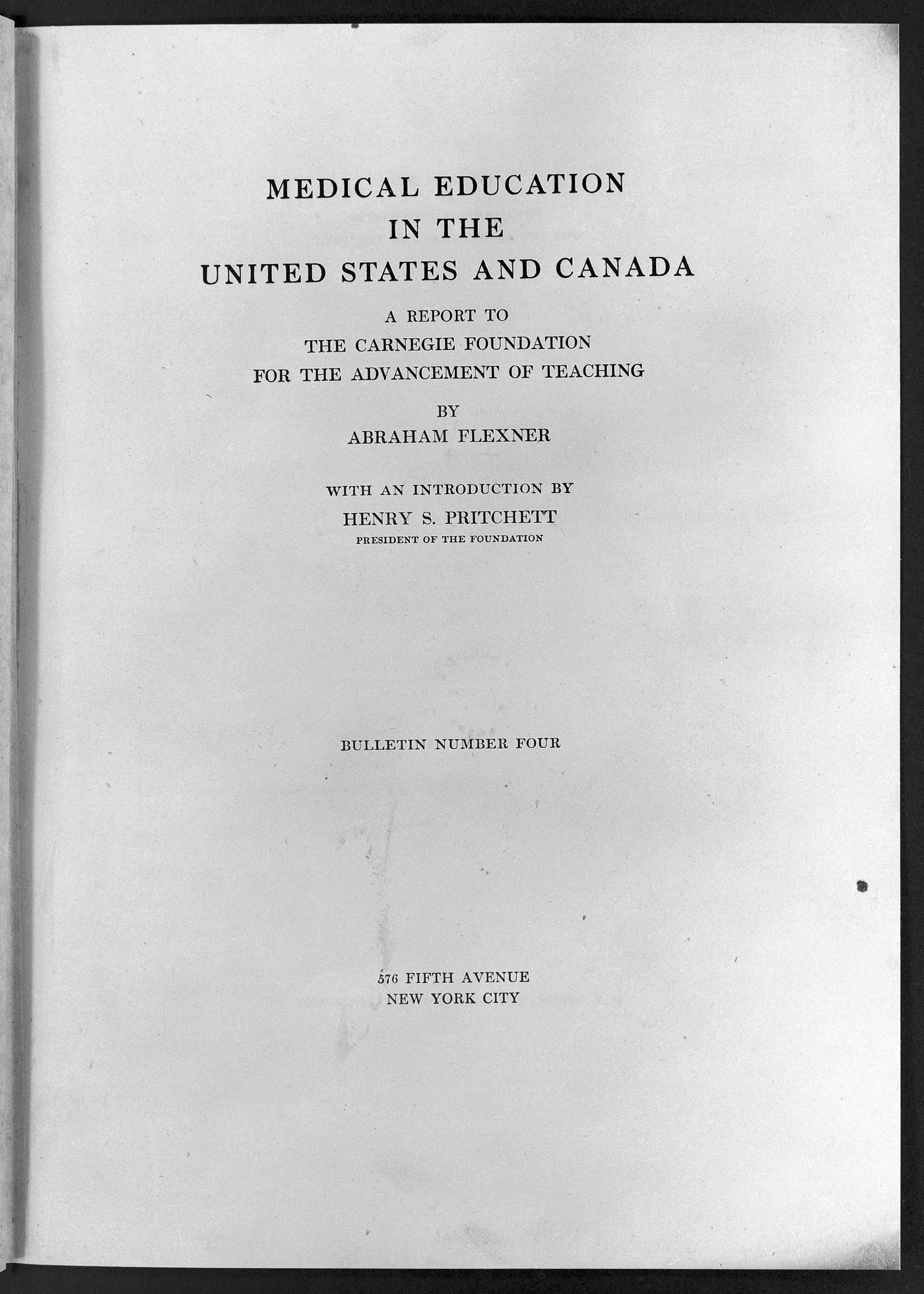
Image context: the lead image is the report's 1910 title page. It is used here because the article is reading the document as a program for institutional power, not as a generic reform emblem.[6]
1. The report changes the unit of judgment
One of the most revealing parts of the report appears before the school-by-school destruction begins. The Carnegie introduction insists that colleges and universities are "public service corporations" and that the public is entitled to know how their professional schools actually work.[1] That sounds administrative. In context it is a constitutional claim about medicine. If medical training serves the public, then the public can demand institutional evidence: budgets, laboratories, admissions standards, anatomy rooms, hospital access, and faculty responsibility.
This is the first major move in the report. Flexner does not ask whether a charismatic local teacher can train a doctor by force of will. He asks whether the school has the machinery to do so repeatedly and honestly. The target, therefore, is not merely ignorance. It is organization without substance: nominal university affiliations, proprietary schools living off tuition, and faculties that distribute titles more easily than they deliver instruction.[1][3]
That shift matters because it explains the report's tone. The famous contempt is not random cruelty. It comes from a specific new standard: once medicine is treated as a quasi-public profession, a weak school is no longer a small private failure. It becomes a public hazard. That is why the report rejects the sentimental defense that a poor school helps the "poor boy." Flexner's reply is merciless and exact: the argument is really one "in behalf of the poor medical school."[1]
2. Laboratory science and hospital control become the baseline
The report's second decisive move is to define what a real medical school must physically control. Flexner treats laboratory medicine not as an ornament of prestige but as the minimum grammar of modern diagnosis. Bacteriology, pathology, chemistry, and physiology are the conditions that make medicine scientific rather than merely anecdotal.[1][3] The report repeatedly returns to the same point: without those sciences, clinical judgment stays descriptive and local, not cumulative.
The same logic extends into the clinic. One of the report's sharpest lines states that a hospital under complete educational control is as necessary to a medical school as a chemistry or pathology laboratory.[1] That sentence is more radical than it first appears. It does not ask hospitals to be convenient teaching sites. It asks them to become part of the school's intellectual architecture. Clinical medicine, in this frame, must be supervised, repeatable, and tied back to scientific training rather than patched together through scattered voluntary privileges.
From there the report arrives at its institutional conclusion. The country needs fewer schools, fewer graduates each year, and tighter articulation with college preparation.[1] This is the part of Flexner most people recognize because it translated so quickly into closures, mergers, and prestige concentration. Yet the reasoning matters more than the body count. Medicine becomes modern, in Flexner's hands, when standards migrate from the bedside personality of the doctor to the systems that produce him.
3. The same standardization narrowed the pipeline
The difficulty is that the report's institutional rigor was not socially neutral. Its criteria were strongest where capital, university affiliation, and teaching-hospital control were already strongest. That helped eliminate commercial schools that deserved to disappear, but it also compressed the routes by which underrepresented groups could enter medicine.[2][3][5]
The sharpest case is Black medical education. Later historical work notes that in 1910 there were seven medical schools serving African Americans.[4] Flexner judged five of them incapable of contributing meaningfully and left Howard and Meharry as the surviving path.[4] Secondary literature has argued for years that this did not simply remove weak institutions; it constricted the long-run supply of Black physicians and narrowed care access for underserved communities.[4][5] The standard itself was not trivial. Many of those schools were badly underfunded. But the close-reading point is this: the report treats concentration as a cure even when concentration redistributes opportunity upward and away.
This is why the report is harder to classify than either its defenders or its critics sometimes allow. It is not merely a heroic science document, because its science standard traveled through institutions already shaped by race, money, and exclusion. It is not merely a villain text either, because its attack on proprietary undertraining and fake affiliations was often correct. The document's power lies in the way it binds those truths together. It makes higher standards inseparable from institutional narrowing, then presents the narrowing as the price of honesty.[1][3][4]
4. What the report still governs
Medical education still lives inside Flexner's settlement. Accreditation, prerequisites, lab-heavy preclinical years, teaching-hospital prestige, and the assumption that medicine belongs inside research universities all descend from the same institutional logic.[2][3] Even current attempts to reform the system toward community engagement, equity, and broader admissions are still arguing with a Flexnerian baseline rather than escaping it.[5]
That is why the 1910 report remains worth reading as a primary source rather than as a legend. Its core achievement was not simply to shame weak schools. It standardized a social contract. Medicine could ask for public trust, professional autonomy, and high status only if it agreed to become legible as an institution. The unresolved problem is that the report also standardized who would be allowed easiest access to that institution and who would have to pass through the narrowed gates left behind.
Read that way, the report's longest afterlife is double. It gave American medicine a serious scientific floor. It also left a structural question that has never fully closed: how to keep standards high without letting concentration masquerade as fairness.
Sources
- Abraham Flexner, Medical Education in the United States and Canada: A Report to the Carnegie Foundation for the Advancement of Teaching (1910). Primary source for the report's language on public service, commercial schools, laboratory science, hospital control, and the reduction of school numbers.
- Association of American Medical Colleges, "AAMC History." Institutional history page summarizing how the Flexner era accelerated school closures and tightened modern medical-education standards.
- Thomas P. Duffy, "The Flexner Report - 100 Years Later." Yale Journal of Biology and Medicine (2011). Historical interpretation of the report's science-first model and its continuing hold on U.S. medical education.
- Tiesha Lawrence, Chelsea Murdock, and Joy A. Williamson-Lott, "HBCUs and the Production of Doctors." Open-access article on Black medical schools, Howard, Meharry, and the report's role in narrowing the training pipeline.
- Jennifer A. Ahn, Karen A. Keawe'aimoku Kaholokula, and coauthors, "Historical Inequities in Medical Education - Commitment to Opportunity, Diversity, and Equity at the University of Hawai'i School of Medicine." Open-access historical review on how exclusionary structures in medical education, including the Flexner era, shaped later workforce inequity.
- Wikimedia Commons, "A. Flexner, 'Medical Education', 1910; title page Wellcome L0015353." Source page for the archival title-page image used as the article lead.