The Elixir Sulfanilamide disaster is often summarized in one clean sentence: more than 100 people died, Congress reacted, and the modern FDA era began.[1][2][4] That summary is accurate enough to remember and too compressed to understand. The more useful reconstruction is procedural. In 1937, the federal government could identify a deadly drug, warn the public, and send inspectors across the country to retrieve it. What it could not do, under the old law, was require proof of safety before the product went on sale. By the time officials moved, the bottle had already traveled farther than the statute.[1][3][4]
That distinction matters because sulfanilamide itself was not an unknown poison. It was already a trusted anti-infective in tablet and powder form.[1] The catastrophe entered when a familiar drug was reformulated into a sweet liquid without toxicity testing, then distributed at industrial speed. The public-health shock was therefore not simply "a bad medicine appeared." It was that a seemingly modern dosage form exposed how little premarket authority the state actually had.
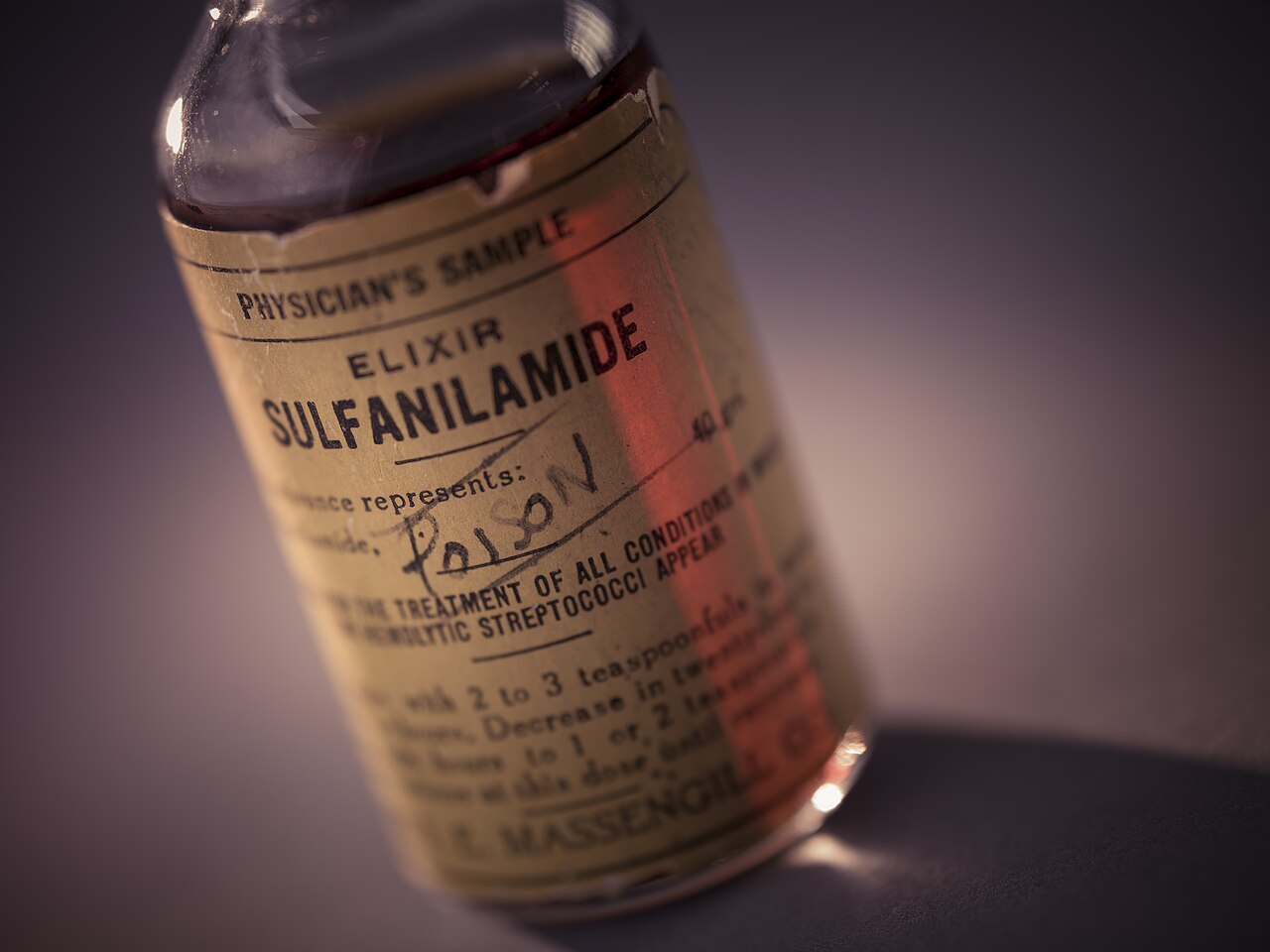
Image context: the cover image shows a surviving Elixir Sulfanilamide bottle. It belongs here because the episode turned on appearance as much as chemistry: a raspberry-flavored bottle that looked ready for ordinary prescribing, while the law still had no machinery to demand safety evidence before shipment.[6]
Timeline anchors: how a bottle became a national chase
- June 1937: a salesman for the S.E. Massengill Company reported demand in the South for a liquid form of sulfanilamide.[1]
- Early September 1937: the first shipments went out; FDA's history says the company sent 633 shipments around the country.[1]
- October 11, 1937: the American Medical Association received reports from Tulsa physicians, isolated diethylene glycol as the toxic ingredient, and issued a public warning.[1][5]
- October 14, 1937: a New York physician alerted FDA headquarters; an FDA inspector quickly confirmed deaths linked to the product in Oklahoma.[1]
- Late 1937: nearly the whole FDA field force, 239 inspectors and chemists, joined the retrieval effort; of 240 gallons manufactured and distributed, 234 gallons and 1 pint were recovered.[1]
- June 25, 1938: Franklin D. Roosevelt signed the Federal Food, Drug, and Cosmetic Act, creating premarket safety requirements for new drugs and the legal basis for the new drug application.[2][3][4]
1) The first failure was a dosage-form shortcut, not the original drug
The story starts with a demand signal, not with a laboratory accident. Sulfanilamide was already known to physicians as an effective treatment for streptococcal infections.[1] The commercial problem was form. Patients, especially children, are easier to dose with a liquid than with tablets or powders. In June 1937, Massengill's chief chemist and pharmacist, Harold Cole Watkins, found that sulfanilamide would dissolve in diethylene glycol. The firm's control laboratory checked flavor, appearance, and fragrance, found the result satisfactory, and the company moved straight to production.[1]
That sequence is why the disaster still reads as a systems case rather than a freak contamination story. Nothing in the pre-1938 federal regime required that a newly formulated drug be tested for safety before marketing.[1][3] The company had made something palatable, stable, and sellable; the law did not yet require anyone to establish that it was survivable. In other words, the relevant regulatory question was still whether a product was what it claimed to be, not whether its reformulation had created a lethal new risk.
2) The signal surfaced through physicians and laboratory confirmation, then outran paperwork
The crucial turn came in October, after the product was already in circulation. FDA's historical account says the AMA received reports on October 11 from physicians in Tulsa that an unfamiliar sulfanilamide compound was associated with deaths.[1] The AMA asked for samples, isolated diethylene glycol as the toxic ingredient, and warned the public through newspapers and radio.[1] The point is easy to miss if the episode is retold only as a later legislative parable: the first effective alarm was not Congress or a court. It was a professional network moving from bedside observations to laboratory identification fast enough to change behavior.[1][5]
Three days later, on October 14, a New York physician notified FDA headquarters after learning of the deaths. An FDA inspector from the Kansas City station confirmed that eight children and one adult had died after taking the product.[1] That is the moment when a medical warning became a federal retrieval problem.
This sequence still feels modern. Authorities did not wait for a finished epidemiologic paper. They worked from clustered fatalities, a shared product label, and a quickly identified toxic solvent. In emergency regulation, that is often how intervention thresholds really work: pattern first, formal closure later.
3) The retrieval effort looked like outbreak tracing because the bottle had already escaped
Once FDA entered the case, the agency found that Massengill had already sent telegrams to salesmen, druggists, and physicians asking for the product back. FDA judged those messages too soft because they failed to say plainly that the drug could kill. Under agency pressure, the company sent a stronger version warning that the product "may be dangerous to life."[1]
Then the search widened dramatically. FDA assigned practically its entire field force, 239 inspectors and chemists, to the task.[1] State and local health officials joined in. Shipping records were checked. Distribution lists from four wholesalers were traced. Retailers' order slips were reviewed one by one, with 20,000 slips examined in a single establishment.[1] Read in sequence, this is one of the clearest pre-digital examples of pharmaceutical traceback in American health governance.
The scale tells you something important about timing. Recall power is impressive only if exercised before consumption. By the time the retrieval system was fully mobilized, the product had already dispersed through a national retail network. FDA eventually recovered 234 gallons and 1 pint out of 240 gallons manufactured and distributed.[1] That sounds like an administrative success, and in one sense it was. It was also a measure of how much of the remedy happened after irreversible exposure had begun.
4) The strangest fact in the case is the one that mattered most legally
The most revealing detail in the entire reconstruction is that FDA's principal federal charge was not homicide, poisoning, or marketing an unsafe drug. It was misbranding.[1]
The agency made 25 seizures under the 1906 law because the word "elixir" implied an alcoholic solution, while Massengill's preparation contained no alcohol and was in fact a diethylene glycol solution.[1] FDA's own historical account states the point with almost painful clarity: if the product had been called a "solution" instead of an "elixir," the agency would have had no legal authority to force its removal on that basis.[1]
That is the hinge on which the story turns. Before 1938, federal drug control still attached more securely to labeling categories and adulteration doctrines than to affirmative proof of safety.[3][4] The state could chase a lethal product across state lines, but its cleanest legal hook was a word on the label. The disaster therefore exposed not just a poisonous solvent, but a statutory mismatch between twentieth-century pharmaceutical practice and nineteenth-century-style enforcement logic.
5) The 1938 Act mattered because it moved power upstream
The public outcry from the Elixir Sulfanilamide deaths helped push a stalled reform bill through Congress.[1][2][4] Roosevelt signed the Federal Food, Drug, and Cosmetic Act on June 25, 1938.[4] FDA's historical pages describe the core shift in practical terms. The new law required that new drugs be shown safe before marketing, that adequate directions for safe use appear on labeling, and that FDA gain stronger inspection and injunction tools.[2][4]
The NDA history page makes the same change even more precisely: the disaster set the stage for the birth of the new drug application, the mechanism through which manufacturers had to submit evidence of safety before a drug could reach the market.[3] That change did not merely punish one company after the fact. It changed the direction of regulation. Authority moved upstream from seizure and cleanup toward premarket gatekeeping.
This is why the episode remained durable in FDA memory. The retrieval effort was dramatic, but it was not the lasting fix. The lasting fix was to make "show us it is safe first" a legal condition of sale rather than a moral hope about manufacturer behavior.[2][3][4]
6) Two interpretations, and why one is stronger
Interpretation A: this was mainly a chemist's deadly mistake and a company's reckless rush
This reading has obvious support. Watkins chose diethylene glycol as the solvent. The company shipped widely without toxicity testing. It later sent return telegrams that understated the danger.[1] If the question is who acted irresponsibly, the answer is not difficult.
Interpretation B: the disaster revealed that the old federal framework was structurally too weak for modern drug commerce
This interpretation is stronger because it explains both the retrieval drama and the legislative aftermath. The same sources that document corporate irresponsibility also document the state's limited toolkit: misbranding seizures, not premarket safety review; emergency tracing, not prior authorization; distributed retrieval, not prevention.[1][3][4] The 1938 law was not written as a memorial to one bad bottle. It was written because the bottle had revealed the system's upstream blind spot.
What would change this assessment? Evidence that the 1906 regime already gave FDA a clear way to block untested reformulations before sale would narrow the lesson back toward Interpretation A. The historical record presented in FDA's own account points the other way.[1][3][4]
Why this reconstruction still matters
Elixir Sulfanilamide remains one of the cleanest examples of a regulatory truth that still governs medicine: a familiar active ingredient can become a new safety problem when formulation, solvent, route, or dosage form changes. The 1937 disaster mattered because the country learned this lesson through death and retrieval instead of through premarket proof. What followed in 1938 was a legal admission that search and seizure are late-stage tools. For drugs, the more durable protection begins before the first shipment leaves the warehouse.
Sources
- U.S. Food and Drug Administration, "Sulfanilamide Disaster" - June 1937 formulation, October warning sequence, 239-inspector retrieval effort, gallon-recovery figures, and the misbranding seizure theory.
- U.S. Food and Drug Administration, "A Brief History of the Center for Drug Evaluation and Research" - the over-100 deaths summary and the 1938 shift to premarket drug safety requirements.
- U.S. Food and Drug Administration, "Summary of NDA Approvals & Receipts, 1938 to the present" - how the sulfanilamide deaths led to the 1938 law and the birth of the new drug application.
- U.S. Food and Drug Administration, "Part II: 1938, Food, Drug, Cosmetic Act" - June 25, 1938 signing date and the law's added powers: premarket approval, labeling, inspections, and injunctions.
- William H. Bradley, "Concerning Elixir of Sulfanilamide" (California and Western Medicine, November 1937) - contemporary medical-journal record of the emergency around the product.
- Wikimedia Commons, "File: Elixir Sulfanilamide, 1937.jpg" - photographic source page for the bottle image used as the article lead.