
The revealing instruction in the NHS bowel-screening demonstration is a small one: cover the grooves on the sampling stick. A person holding a medical kit might reasonably assume that a generous specimen would be helpful. Here, restraint is part of doing the test correctly. England's written instructions, updated on 23 June 2025, explicitly say to collect only a little stool and avoid adding extra.[3]
The NHS published the three-minute video below on 19 February 2023. Its value is in making an unfamiliar bathroom task ordinary enough to attempt. Watch the explanation beginning at 0:26, then the collection sequence from 0:58. The interesting question is how a sample gathered at home becomes useful laboratory evidence—and where that evidence stops.[1]
There is a history behind the simpler task. Public Health England reported that FIT had been sent to all bowel-screening participants in England since June 2019, replacing a guaiac kit requiring three separate stool samples with a test requiring one. Its February 2020 account of an earlier instructional film described work on clearer narration and accessible subtitles. The later NHS video belongs to that practical communication problem: a test's instructions must make sense where people actually use it.[2]
At 0:26: the laboratory is looking for a signal
FIT stands for faecal immunochemical test. The chemistry matters: antibodies detect haemoglobin, the blood protein, in the stool sample. The National Cancer Institute distinguishes this from the older guaiac test, which uses a chemical reaction to detect haem and can respond to substances in food. Dietary restrictions are typically unnecessary for FIT.[4]
That specificity should not be confused with a diagnosis. Detecting blood identifies something that may need investigation; it does not identify its cause. Polyps and cancers can bleed, but blood can also come from conditions such as haemorrhoids. FIT does not provide an image of the bowel, take a tissue biopsy, or remove a polyp. Those differences explain why a positive stool-screening result leads to a different kind of test.[4]
This is the useful distinction to carry through the film. Collecting the sample correctly helps the laboratory answer its narrow question. It cannot enlarge that question into a complete account of someone's health. The reassuring simplicity of the collection method should not make the interpretation seem equally simple.
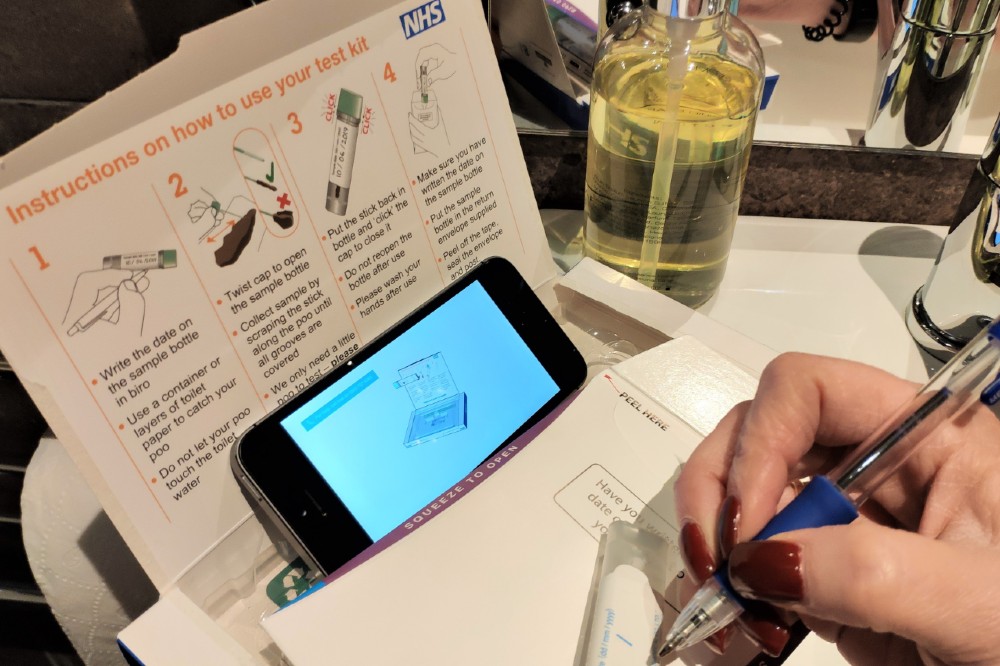
From 0:58: a small sample, collected deliberately
Read the collection sequence alongside the current written instructions. The stool should be caught before it reaches toilet water. The end of the stick is drawn along it until the grooves are covered; the stick then goes back into its bottle. England's screening instructions say to close the cap until it clicks, leave it closed, wash your hands, and return the dated bottle in the supplied envelope promptly.[1][3]
The grooves provide a visible stopping point. Without one, “collect a sample” leaves the user to decide what enough means. Cancer Research UK explains the consequence of overfilling: extra stool can leave the laboratory unable to process the specimen, making another collection necessary. More material can therefore create less usable information.[6]
The date and return envelope deserve attention too. The demonstration does not end when the stick enters the bottle; it carries the viewer through preparing the sample for its journey. The written instructions likewise finish with a check of the date and prompt posting.[3] That ending is an editorial strength. It treats collection as a task with a destination, rather than a private action whose remaining steps can be assumed.
Follow the instructions supplied with your own kit. FIT is also used when clinicians investigate bowel symptoms, and Cancer Research UK describes samples being returned to a GP, a hospital, or by post. A familiar-looking tube does not guarantee an identical return route.[6]
At 2:27: the result needs its own explanation
The video's results section begins at 2:27.[1] The NHS written guidance supplies an important qualification: screening results usually arrive within two weeks, but can take longer. A request for further tests means blood was detected and needs investigation. In England's screening programme, a specialist nurse discusses the result and next steps; a colonoscopy is usually needed. The letter is the beginning of that conversation, not a cancer diagnosis.[5]
The other result also has limits. A screening letter saying no further tests are needed does not eliminate the possibility of bowel cancer. The NHS advises seeing a GP about concerning symptoms even after a reassuring screening result.[5] Cancer Research UK makes the related point for people tested because of symptoms: return to the GP if symptoms persist, change, or worsen despite a normal FIT result.[6]
These are patient instructions and institutional explanations of the testing pathway. They support the practical reading of the film; the film itself does not establish a cancer-detection rate or prove that watching it improves outcomes. Its accomplishment is more modest and observable: it gives a person a sequence they can follow. The accompanying writing has a different job—to keep the meaning of the result proportionate to the evidence in that small tube.
Sources
- NHS, “How to use the bowel cancer screening FIT kit,” 19 February 2023 — official video and chapter timings.
- Miranda Lawton, Public Health England, “Rolling out the new bowel cancer test kit via video,” 5 February 2020 — rollout history, earlier film development, and photograph.
- NHS England, “NHS bowel cancer screening: FIT kit instructions (English),” updated 23 June 2025 — sampling and postal-return instructions for England.
- National Cancer Institute, “Screening Tests to Detect Colorectal Cancer and Polyps” — FIT chemistry, other causes of blood, and follow-up colonoscopy.
- NHS, “Bowel cancer screening” — result timing, specialist review, and the limits of a reassuring screening result.
- Cancer Research UK, “Testing for blood in your poo using FIT,” reviewed 21 November 2024 — excess sample, symptomatic testing, return routes, and persistent symptoms.