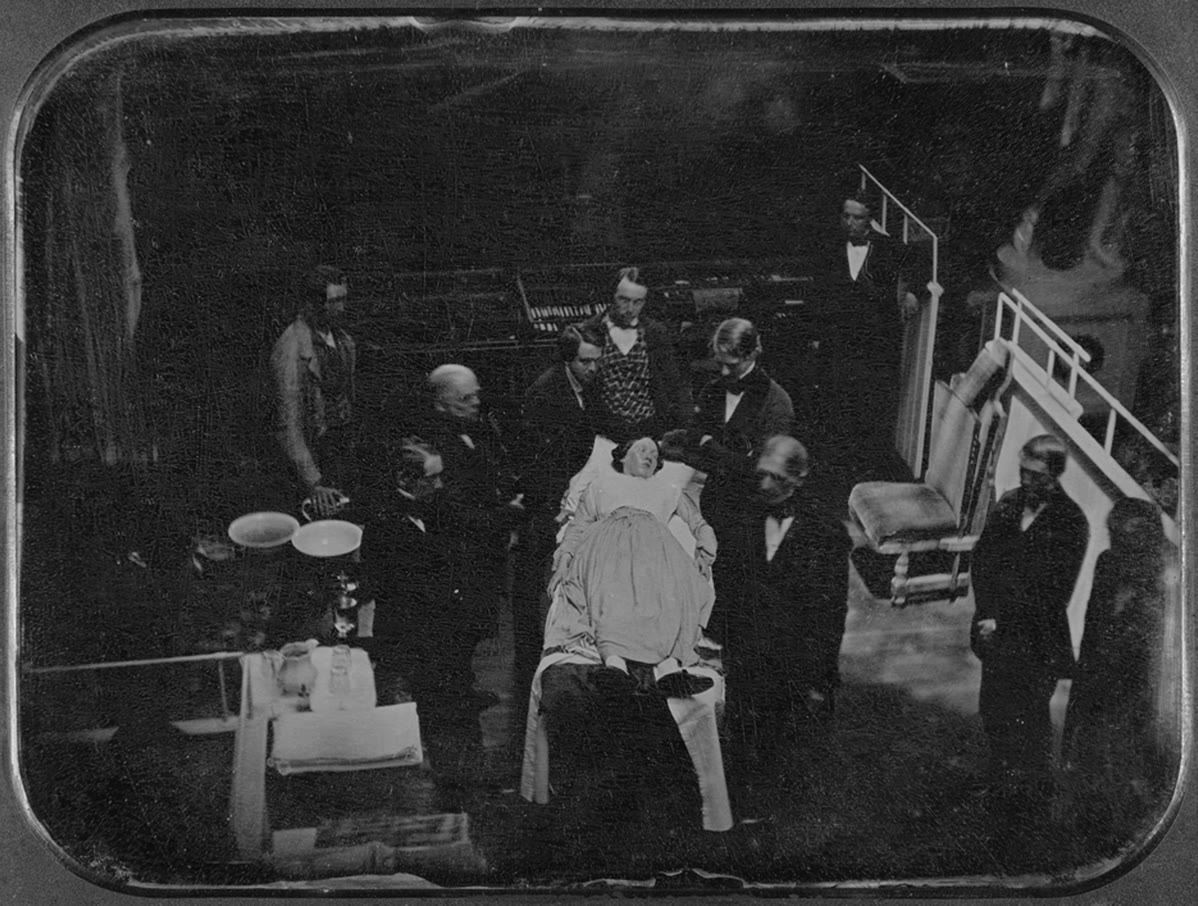
The Ether Dome enters public memory as a clean miracle. A dentist lifts an inhaler, a surgeon cuts, a patient stays quiet, and modern medicine suddenly begins. The more useful reconstruction is rougher and more interesting. On October 16, 1846, William T. G. Morton did demonstrate ether in Massachusetts General Hospital's surgical amphitheater, and that event does deserve its fame.[2][4] Yet the case that made Ether Day historic was not immaculate. Henry Jacob Bigelow's first printed report says Edward Gilbert Abbott muttered during the neck operation and later said the pain had been "considerable, though mitigated."[1]
That imperfection is the point of entry, not a problem to be hidden. Ether Day mattered because a teaching hospital did not stop at one dramatic claim. It kept testing the claim in public view. The next day another patient underwent tumor removal with what Bigelow called complete success, and within weeks the hospital had moved on to major procedures including an above-knee amputation.[1] Public proof emerged as a sequence: one partial success, one clearer success, then repetition strong enough to change what surgeons believed they could attempt.
Read that way, the Ether Dome did more than reduce suffering. It changed surgery's time budget. Before anesthesia, the question was never pain alone in the abstract. Pain set the tempo of the room. It limited how long a patient could endure, how much restraint assistants needed, how much precision a surgeon could afford, and how much shock the body might absorb before the operation became a race.[1][4] Ether did not make surgery safe in one stroke. It gave the operator more time to think and cut before agony took command.
The cover image keeps that room logic visible. It uses an archival daguerreotype of an ether operation in the Ether Dome, because the breakthrough belonged to a physical scene: a patient under vapor, a surgeon working under altered conditions, and an audience watching the old operative clock begin to loosen.[5]
Timeline anchors before the legend hardens
- 1845: Horace Wells's public nitrous-oxide demonstration near Massachusetts General Hospital was judged a "humbug," leaving Boston with a fresh memory of failure just before Morton's chance arrived.[2]
- October 13, 1846: according to the later reconstruction from Abbott's records, John Collins Warren deferred Abbott's planned operation so Morton could try his method for preventing pain in surgical operations.[3]
- October 16, 1846: Warren operated on Abbott after Morton administered ether in the amphitheater now known as the Ether Dome.[1][2][4]
- October 17, 1846: George Hayward removed a fatty tumor from a woman's arm with what Bigelow described as complete success under ether.[1]
- November 7, 1846: Bigelow reported an above-knee amputation and another jaw operation under ether at Mass General, showing the method had moved beyond one narrow test.[1]
- November 18, 1846: Bigelow published the early Mass General series, helping turn local demonstration into portable medical knowledge.[1][3]
- December 1846: WLM's timeline records news traveling on the paddle steamer Acadia to Britain, followed by dental and surgical ether use there within days.[2]
Pain had been the room's hardest deadline
Bigelow opened his paper with a plain sentence: it had long been an important problem in medical science to devise some method of mitigating the pain of surgical operations.[1] That opening matters because it restores the operating conditions Ether Day was up against. Surgeons were already skilled. Hospitals already existed. The limiting factor sat in the conscious body on the table.
When every incision had to be made against a fully feeling patient, speed became a virtue with a hard edge. Assistants restrained. Patients cried out, struggled, fainted, or anticipated the next stroke before it arrived. The surgeon's talent was partly technical and partly temporal: how fast could the essential steps be completed before pain, movement, blood loss, and exhaustion turned the room against the operator?[1][4] Ether's significance begins there. It did not only promise mercy. It promised duration.
That is why Wells's 1845 failure mattered so much in Boston.[2] One public embarrassment had already shown how quickly an analgesic claim could collapse when a patient still reacted. Morton therefore entered a skeptical room, not a gullible one. Ether had to survive witnesses.
Abbott's case was famous because it was imperfect in public
Bigelow's account of October 16 is more revealing than the later triumphal version. Abbott inhaled Morton's preparation. Warren then made an incision near the lower jaw "of some inches in extent." During the operation Abbott muttered in a semi-conscious state and later compared the pain to skin scratched with a hoe.[1] Bigelow did not suppress this. He printed it and suggested there had probably been some defect in the inhalation process.[1]
That honesty helps explain why the event remained credible. The article does not read like propaganda for an infallible marvel. It reads like a serious hospital trying to decide whether a new operative condition has appeared. Ether Day's first lesson was not "pain has been abolished forever." Its first lesson was narrower and still revolutionary: pain could be altered enough that the old surgical assumptions might no longer hold.[1][3]
The later Abbott-records reconstruction sharpens the scene further. Abbott had already been admitted, Warren delayed the operation so Morton could have the opportunity, and only later was a retrospective note added to the record once ether's value became clearer.[3] In other words, the famous day did not arrive as a polished ceremonial debut. It was a hospital experiment that acquired cleaner documentation as the room began to understand what it had seen.
The next cases converted a claim into public proof
If Ether Day depended only on Abbott, its legacy would be shakier. Bigelow's paper shows why it endured. On October 17, Hayward removed a sizable fatty tumor from a woman's upper arm. The operation lasted four or five minutes. Afterward she said she had felt no pain and had known nothing of the operation, being concerned only about a child left at home.[1] Bigelow says observers had no doubt that the unconsciousness was real.[1]
That case changed the meaning of the first one. Abbott had shown attenuation; the second patient showed something closer to operative insensibility. A method had begun to separate itself from an anecdote.
Then came scale. In Bigelow's later November cases, a young girl underwent amputation above the knee after becoming insensible in about five minutes, and another patient underwent partial lower-jaw removal.[1] The girl later remembered the mouthpiece and a remark made near the end of vessel ligation, yet knew nothing of the incision itself and could not say whether the limb had been removed.[1] This was not modern balanced anesthesia. Patients could still move, vocalize, or hold fragmentary memory.[1] Yet the essential threshold had been crossed. Serious surgery was being carried out under a new physiologic arrangement.
That is the real October-November arc. Ether did not win because the first demonstration was theatrically pure. It won because repeated hospital cases made it increasingly difficult to deny that a surgeon now had more usable operative time than before.[1][3]
Print and steam turned a Boston room into a world event
A hospital breakthrough becomes history only when it travels. Bigelow's November 18, 1846 publication did that work first.[1][3] The report did not merely announce a wonder; it described cases, named operators, admitted imperfection, and gave other physicians something they could imitate.[1]
WLM's chronology then shows how quickly the news escaped Boston. The paddle steamer Acadia carried reports to Francis Boott and onward to James Robinson in London; Robinson extracted a tooth under ether on December 19, and on December 21 British surgeons performed major operations under ether, with Robert Liston famously calling it a "Yankee dodge" that beat mesmerism hollow.[2] Speed of adoption mattered because it answered the hardest historical question. Was Ether Day a local curiosity, or had surgery actually changed? By the end of 1846, the answer was already visible in more than one country.[2]
That broader spread also explains why Massachusetts General still frames the Ether Dome as the site of the first public surgery using anesthetic.[4] The phrase "public surgery" is doing real historical work. The decisive thing was not that someone somewhere inhaled ether in private. The decisive thing was that an amphitheater, a faculty surgeon, a skeptical audience, a printed journal, and then other hospitals treated the event as reproducible knowledge.[1][2][4]
Why the Ether Dome still matters in 2026
The durable lesson of Ether Day is narrower than "medicine became humane" and deeper than "one patient felt no pain." The breakthrough sat at the level of operative conditions. Once pain ceased to be the room's absolute master, surgery could lengthen, teaching could happen under less chaos, and more exacting procedures became imaginable.[1][2][4]
That did not solve the rest of nineteenth-century surgery. Infection still killed. Hemorrhage still threatened. Airway control, dosing control, and anesthetic safety were still crude by modern standards.[2] Yet the operative clock had changed. A surgeon could now attempt steps that were previously too slow, too delicate, or too unbearable to sustain.
So the Ether Dome deserves its myth only after the myth is trimmed back. Abbott's first case was incomplete. The next cases were stronger. Publication and steamship circulation made the evidence portable. What emerged from October to December 1846 was not a single magic moment, but a new agreement inside medicine: pain no longer had to dictate the speed of the knife.[1][2][3][4]
Sources
- Henry J. Bigelow, "Insensibility during surgical operations produced by inhalation" (Boston Medical and Surgical Journal, 1846) - primary report describing Abbott's partial analgesia, the next day's complete success, and the later November operations that made ether convincing.
- Wood Library-Museum of Anesthesiology, "History of Anesthesia" - institutional chronology covering Wells's 1845 failed public demonstration, Morton's October 16, 1846 Ether Day, Holmes's naming of anesthesia, and the rapid spread to Britain by December 1846.
- Sukumar P. Desai, "Ether Day Revisited: The Surgical Records of Edward Gilbert Abbott" (Annals of Surgery Open, 2022) - reconstruction from Abbott's records showing the October 13 deferment, retrospective documentation, and the November publication-and-diffusion sequence.
- Massachusetts General Hospital, "The Ether Dome at Mass General" - museum exhibit page identifying the amphitheater as the site where Morton demonstrated the first public surgery using anesthetic ether on October 16, 1846.
- Wikimedia Commons, "File: Ether Dome Daguerreotype No. 2.png" - archival daguerreotype source page for the Ether Dome image used as the article cover.