Charles Drew is remembered so often as the "father of the blood bank" that the phrase can flatten the real shape of his work. It suggests a lone inventor and a single invention. The more exact story is operational. By 1940 and 1941, Drew's importance lay in turning a cluster of existing scientific possibilities into a disciplined mass workflow: blood drawn at multiple hospitals, plasma separated and pooled under aseptic conditions, bacteriological checks centralized, records standardized, containers packed for transport, and later donors brought in through mobile units.[1][2][3]
That distinction matters because medicine had known pieces of the problem before Drew. Researchers already understood blood groups, the utility of plasma in shock, and the basic fact that preserved blood products could extend care beyond the direct donor-to-recipient moment.[2][3] The bottleneck was scale. A wartime system could not rely on one surgeon's hands or one hospital's habits. It needed procedures that would hold across institutions, staff shifts, and shipping routes. Drew's breakthrough was to make that administrative and laboratory discipline visible enough to copy.[1][2]
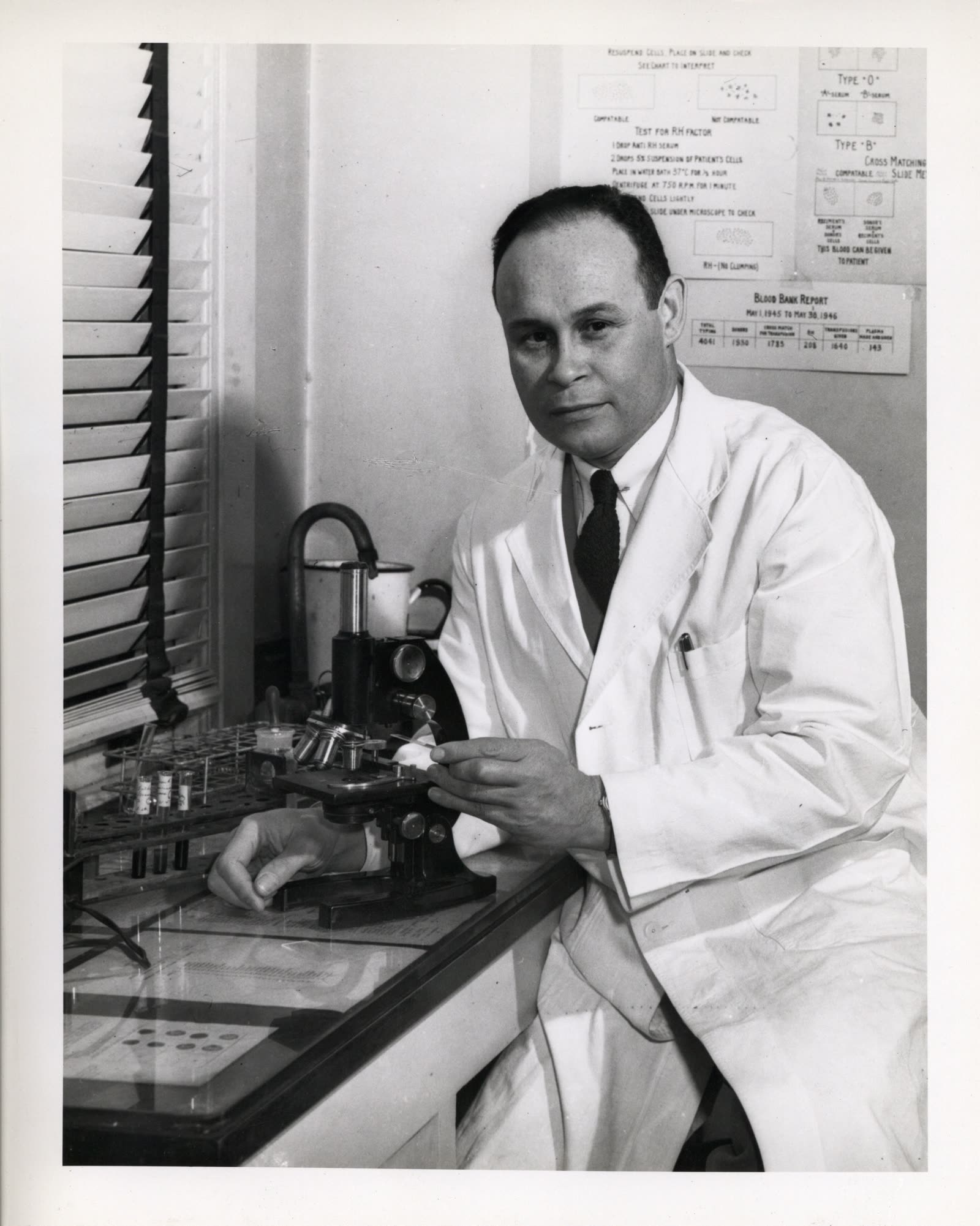
The cover image keeps the story attached to that setting. It uses a circa 1940-1941 National Library of Medicine photograph of Drew in the lab beside a microscope, because this article is not about celebrity medicine. It is about the point where a preservation problem, a quality-control problem, and a logistics problem were forced into the same room.[4]
Timeline anchors before the legend sets
- August 1939: Drew and John Scudder opened an experimental blood bank at Presbyterian Hospital in New York, the practical base for Drew's dissertation work on preservation and transfusion.[1]
- June 1940: Drew received his doctorate in medical science from Columbia University, becoming the first African American to earn that degree there; his dissertation grew directly from the Presbyterian blood-bank project.[1][3]
- August 16, 1940: the Blood for Britain program formally opened after a satisfactory trial shipment of plasma to England.[2]
- September 1940: Drew returned to New York as full-time medical supervisor when it became clear that the participating hospitals needed tighter coordination and common standards.[1][2]
- January 1941: Blood for Britain concluded after 14,556 donations and more than 5,000 liters of plasma saline solution shipped to England.[2]
- February-April 1941: Drew helped shape the Red Cross pilot for a national blood-banking system and introduced mobile collection units later known as bloodmobiles.[2][3]
Those dates show why 1940-1941 is the right frame for Drew's microhistory. The key movement is fast. In less than a year, an experimental hospital setup became a transatlantic wartime program and then a template for national collection.
1. Drew's dissertation mattered because it sat between bench work and hospital routine
The biographical temptation is to begin with honors. The stronger starting point is the Presbyterian blood bank in 1939.[1] Drew was already a trained physician and surgeon-in-formation, but his importance rose because he was working exactly where several lines of inquiry met: shock treatment, blood chemistry, storage, transfusion, and hospital procedure.[1][3] His dissertation, Banked Blood: A Study in Blood Preservation, did not matter as a ceremonial credential alone. It condensed a practical problem: how to store blood products long enough, safely enough, and predictably enough that treatment could outlast the presence of the donor.[1][3]
This is the first boundary worth keeping clear. Drew did not single-handedly discover plasma or invent every scientific premise involved in transfusion medicine.[2] What he helped produce was a usable system architecture. Blood had to leave the realm of talented local handling and enter the realm of reproducible practice. That is why the dissertation and the hospital bank belong together. The research was already pointed toward workflow.
The wartime context made that workflow problem urgent. Plasma had advantages especially relevant to emergency and combat medicine: unlike whole blood, it could be used across blood types, endured transport better, and could replace fluid in shock even though it lacked red cells.[2][3] Those properties made plasma strategically attractive. They did not by themselves create a large-scale program. Somebody still had to design a process that many hospitals could follow without contaminating the product or losing track of the batches.
2. Blood for Britain was the scale test, and Drew's job was discipline
That scale test arrived when Britain, under German attack, needed blood products urgently.[1][2] The Blood for Britain project began with Presbyterian and other New York hospitals collecting blood for export, but the initial arrangement quickly showed its weakness: different institutions were drawing blood in different ways, preparing it with different habits, and generating a system too loose for reliable mass shipment.[2][3] Drew was called back in September 1940 to tighten the operation.[1][2]
The National Library of Medicine's account is unusually useful here because it preserves the mechanics of the program. Plasma was separated from blood cells by centrifuging or sedimentation. The plasma from an average of eight collection bottles was pooled under aseptic conditions in a dust-proof, air-conditioned, ultraviolet-lighted room under a laboratory hood. Samples were cultured for bacteria, merthiolate was added, batches were tested again after a week, then transferred into shipping containers and diluted with sterile saline solution before a final sample was taken and the container sealed.[2] This is what Drew's contribution looked like at working level: not romance, but process control.
Under Drew's direction, procedures, equipment, and record-keeping were standardized, with final bacteriological checks concentrated at Presbyterian Hospital.[2] The point was not only to make good plasma once. It was to make comparable plasma repeatedly from multiple sites. That repeatability is what converted hospital expertise into a transportable public-health asset.
By the time the program ended in January 1941, the numbers were large enough to prove the method had escaped the pilot stage: 14,556 donations and more than 5,000 liters shipped to England.[2] The National WWII Museum's account adds another useful detail. Drew developed a packaging logic that turned plasma into one-liter units boxed for transport, which makes clear how thoroughly the work belonged to logistics as much as laboratory medicine.[3] His achievement was not that blood existed. It was that blood products could now move through a chain.
3. The real hinge was a shift from heroic medicine to audited medicine
Drew's reputation hardened because institutions recognized that Blood for Britain was more than relief. It was rehearsal.[2] If the United States entered the war, the country would need a national donation and distribution system, not scattered acts of generosity. Drew used the Blood for Britain experience as the model for a Red Cross pilot program to mass-produce dried plasma, and during that phase he introduced the mobile collection units that later became famous as bloodmobiles.[2][3]
The bloodmobile is a revealing detail because it captures the deeper historical turn. Drew was not simply improving what happened after blood arrived at a laboratory. He was reorganizing how the system reached donors in the first place. That extended the bank outward. The collection site no longer had to be a fixed hospital room waiting for nearby volunteers. It could become a planned route, a timed stop, a managed intake point.[2][3]
This is why his biography matters inside health history. Some medical advances win by discovering a new drug or a new organism. Drew's greatest wartime contribution looked different. He made a fragile chain inspectable. Collection, separation, pooling, testing, packing, shipment, and later mobile intake all had to fit together tightly enough that institutions could trust the product at the far end. In that sense, Drew's work belongs to the history of standardization as much as to the history of surgery.
4. The segregation fight shows what kind of public system Drew had actually built
The cruel irony is that the expanding blood program was shaped by racist policy at the same time it relied on Drew's expertise.[1][2] As the wartime system widened, African Americans were first excluded from donation and then accepted only under segregation rules. Drew criticized these policies repeatedly as unscientific and insulting.[1][2][3] That protest belongs in the story because it clarifies the meaning of his work. He had helped prove that blood banking could function as a national infrastructure, and the institution then tried to stamp racial hierarchy onto a system whose product had no scientific racial distinction in the way policy implied.
The evidentiary boundary matters here too. The National Library of Medicine notes that there is no clear evidence the segregation policy by itself explains Drew's departure from the pilot program; family life and his long-term commitment to Howard University also mattered.[2] The safer claim is the narrower one: the public system Drew helped build exposed, rather than solved, the political stupidity around it. He had created a standardized medical network. The nation still chose to govern that network badly.
Why Drew's biography still reads sharply in 2026
Drew's place in medical memory lasts because he solved a problem that modern health systems still recognize. A technique is not enough. A promising product is not enough. A therapy changes history when somebody makes it collectible, checkable, storable, and movable without losing trust at the destination.
That is the right scale on which to read Drew. In 1939, he was working inside an experimental hospital blood bank.[1] In 1940, he turned that work into a dissertation and then into the core discipline of Blood for Britain.[1][2] By 1941, he had helped show that plasma banking could be run across many hospitals and donor streams, and had pushed collection outward through mobile units.[2][3] The historical force lies in that compression. Within two years, blood preservation moved from a specialized hospital problem toward a modern infrastructure logic.
Calling Drew the "father of the blood bank" is therefore not wholly wrong. It is just too vague. His real breakthrough was not symbolic paternity. It was scale.
Sources
- National Library of Medicine, "Biographical Overview | Charles R. Drew" - official overview covering Drew's McGill and Howard training, the 1939 Presbyterian blood bank, his June 1940 Columbia doctorate, his September 1940 return to direct Blood for Britain, and his later criticism of blood segregation.
- National Library of Medicine, "Becoming 'the Father of the Blood Bank,' 1938-1941" - primary institutional narrative of Blood for Britain, including aseptic pooling, bacteriological checks, the January 1941 total of 14,556 donations and over 5,000 liters shipped, and the later bloodmobile pilot.
- Rob Wallace, "Medical Innovations: Charles Drew and Blood Banking." The National WWII Museum, published May 4, 2020 - wartime summary used here for the one-liter transport units, the national pilot context, and the outward-facing logistics of bloodmobiles.
- National Library of Medicine Profiles in Science, "Charles Drew in lab in front of a microscope" - source page for the circa 1940-1941 documentary photograph used as the article image, credited to The Scurlock Studios and held in Howard University's Moorland-Spingarn Research Center.
Editor’s Pick Review
This piece earns the pick because it turns a familiar commemorative label into a sharper systems history. Instead of repeating “father of the blood bank,” it shows exactly how Drew’s achievement moved through procedure: aseptic pooling, bacteriological checks, standardized records, shipping containers, and mobile collection. The article also keeps its ethical boundary clean. It gives the racism of the wartime blood program its full weight while preserving the narrower evidentiary line around Drew’s departure, which makes the judgment more credible rather than softer.
The visual choice also fits the updated image policy: the cover is an immersive, topic-grounded archival laboratory photograph, not an analytical diagram. It anchors the reader in the room where preservation, quality control, and logistics became one problem, and the Chinese version carries the same argument in natural, readable prose with the required translator-persona note.