
As of 2026-03-30 UTC, the most useful way to watch EpiPen's official training video is not as brand advertising but as a public anti-hesitation drill.[1] The clip spends more time than a confident adult might expect on cap removal, hand position, thigh placement, and what to do after the injection. That repetition is the point. In anaphylaxis, delay often begins before any drug reaches the muscle. It begins in the seconds when a bystander wonders whether this is really the moment, whether the device is upside down, whether clothing has to come off, or whether calling 911 should happen first.
Read against the NIAID food-allergy guidelines, the video's compression looks clinically sound. The guideline summary states plainly that epinephrine is the first-line treatment in all cases of anaphylaxis, that other drugs act more slowly, and that calling for help should not delay epinephrine.[3] The video is therefore doing a very specific kind of work. It is not trying to teach the whole medical management of allergic shock. It is trying to eliminate the first layer of public confusion so that intramuscular epinephrine can happen fast enough to matter.
That is why the clip remains useful even though it is manufacturer-specific. Its best lessons are broader than the product name. The script keeps narrowing the field: check whether the device is ready, pull the safety release correctly, inject into the middle of the outer thigh, hold long enough for delivery, keep fingers away from the needle end, and get emergency help right away.[1][2] AAAAI's public emergency-medications guide adds the same operational principle in quieter language: instructions and practice with the device are necessary before the moment when someone actually needs it.[4]
The harder truth comes after the injection. The video description itself says the device does not take the place of emergency medical care.[1] NIAID's guidance reinforces the sequence: give epinephrine promptly, call 9-1-1 or the local equivalent without letting that step delay injection, and discharge patients with instructions and two doses because a single intervention may not close the whole episode.[3] In other words, the video's real argument is not "one click solves anaphylaxis." Its argument is that good emergency response begins by removing the excuses for not giving the first-line treatment.
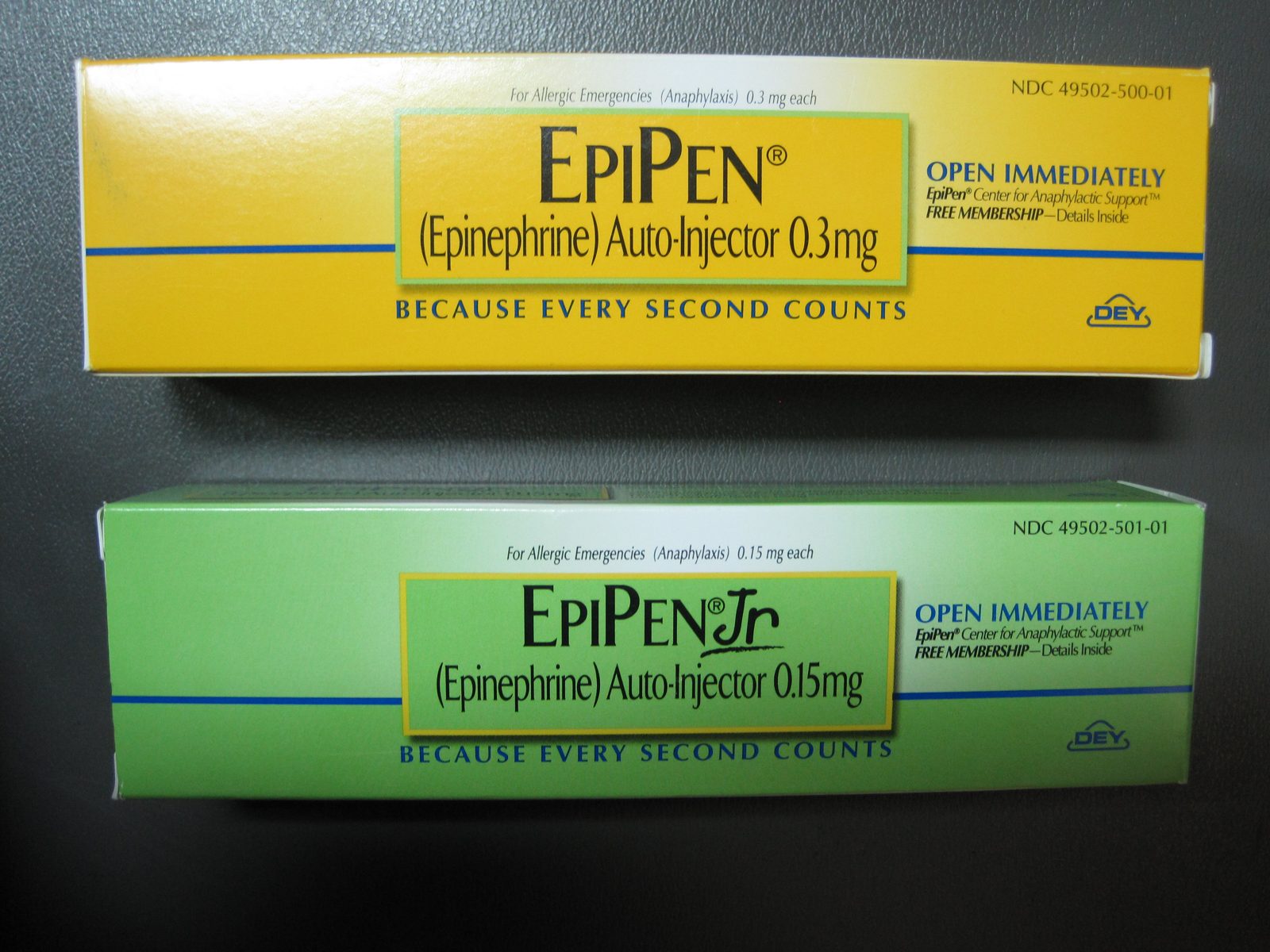
Image context: the cover uses a documentary-style photograph of boxed EpiPen and EpiPen Jr products. That image fits this article because the video's most practical message is about readiness: correct strength, accessible packaging, and immediate recognition all matter before anyone even reaches the injection step.[6]
Around the first two minutes, the video turns preparedness into part of treatment
One of the smartest choices in the clip arrives before the injection demo. The opening minutes do not rush toward the dramatic moment of use. Instead, they linger on the blue safety top, the protective case, and the viewing window, warning viewers not to use a device with a raised safety release or discolored medicine.[1] That may look overly cautious until it is read beside FDA's 2018 alert about EpiPen user errors and device problems. FDA warned that sideways force on the blue safety release could contribute to accidental activation, and it explicitly told patients and clinicians to review the instructions periodically rather than assume the device is self-explanatory.[5]
That pairing reveals the video's real design logic. The manufacturer understands that error prevention starts before symptoms escalate. A responder who first notices a damaged device in the middle of an allergic emergency has already lost time that anaphylaxis does not give back. By front-loading the readiness check, the video quietly redefines treatment as a chain: storage, inspection, grip, injection, and follow-through belong to the same emergency script.[1][5]
Around 2:25 to 4:10, the choreography is there to kill ambiguity
The central demonstration is memorable because it narrows movement to a few commands. Pull the blue safety top straight up and away. Keep the orange needle end pointing down. Never place a thumb or hand over that end. Press into the outer thigh, through clothing if needed, and hold for 3 full seconds.[1] The EpiPen healthcare-professional page reinforces the same point in written form: the device must be held firmly on the middle of the outer thigh for at least three full seconds, or the correct dose may not be delivered.[2]
This is not instructional redundancy for its own sake. It is a method for reducing the two kinds of mistakes that matter most in a panic: wrong-site injection and incomplete delivery. The video keeps the geography of the body very simple because the alternatives are dangerous. The healthcare-professional page warns against injecting into veins, buttocks, fingers, toes, hands, or feet, and says accidental injection outside the outer thigh warrants immediate emergency-room evaluation.[2] Once that warning is paired with the clip's repeated hand-position cues, the video starts to look less like a brand tutorial and more like a safety barrier against exactly the errors that frightened or inexperienced users are most likely to make.
Around 4:15, the child segment exposes the real enemy: movement under pressure
The most revealing section may be the one aimed at caregivers of young children. The video pauses to show the child being held firmly before and during the injection so the leg does not jerk away during those three seconds.[1] That detail is easy to underrate if you imagine a cooperative patient and a calm room. Real emergencies rarely offer either.
This is where the clip becomes stronger than a generic slogan about carrying epinephrine. It acknowledges that the problem is not merely remembering the medicine exists. The problem is delivering it accurately into a body that may be frightened, moving, crying, or already collapsing. The written product guidance says plainly that if you inject a young child, you should hold the leg firmly in place before and during the injection to prevent injuries.[2] That instruction turns the scene from a pharmaceutical transaction into a piece of physical emergency care. The adult is not just operating a device. The adult is stabilizing a body long enough for the device to work.
Around 5:27, the most important line comes after the injection
The video's best sentence arrives after the demonstration: get emergency medical help right away, and use a second auto-injector if symptoms continue or return.[1] This is the part many short public explainers get wrong. They treat epinephrine like a complete fix rather than a first-line interruption in a potentially evolving event.
NIAID's summary is much sharper. Epinephrine remains first-line because every other drug has a delayed onset of action, and repeated epinephrine can still remain first-line when symptoms progress.[3] The same guideline says patients discharged after food-induced anaphylaxis should receive an epinephrine auto-injector prescription with 2 doses and instructions.[3] The logic is structural rather than dramatic. Anaphylaxis can outlast one bystander's feeling of relief. Symptoms can recur, observation still matters, and the emergency system still has work to do after the first correct injection.
That is why the official video description is more responsible than it first appears when it says the device does not replace emergency care.[1] A good training video does not promise mastery; it makes the first useful action easier. The deeper medical management belongs to clinicians, monitoring, and the rest of the emergency pathway. The clip's success lies in how consistently it protects that boundary.
Why this video still matters
The enduring value of this training video is its refusal to romanticize courage. It does not ask the viewer to become heroic. It asks for a sequence: recognize the emergency, remove the safety top correctly, keep fingers off the wrong end, inject the outer thigh, hold for three seconds, and keep moving into emergency care.[1][2][3] In health communication, that is a serious strength. Panic thrives when people feel they must improvise. This clip reduces improvisation.
That is also why it belongs in the Annotated Viewing mode rather than as a bare embed. Without written context, a viewer could mistake it for a self-contained product demo. Read alongside NIAID, AAAAI, and FDA materials, it becomes clearer what the video is really doing. It is compressing the first minute of anaphylaxis into a public script that is narrow enough to remember, specific enough to reduce common mistakes, and humble enough to admit that the click is only the beginning.[3][4][5]
Sources
- EpiPen, "How to Use an EPIPEN (epinephrine injection, USP) Auto-Injector," YouTube video, published October 3, 2023.
- EpiPen, "About EPIPEN and EPIPEN JR Auto-Injectors" - healthcare-professional instructions on outer-thigh injection, three-second hold time, and child-leg stabilization.
- National Institute of Allergy and Infectious Diseases, Guidelines for the Diagnosis and Management of Food Allergy in the United States: Summary for Patients, Families, and Caregivers - epinephrine as first-line treatment, 9-1-1 sequencing, and two-dose discharge guidance.
- American Academy of Allergy, Asthma & Immunology, "Allergic Emergency Medications" - public guide to epinephrine emergency products and the need to practice device use before an emergency.
- U.S. Food and Drug Administration, "FDA alerts patients and health care professionals of EpiPen auto-injector errors related to device malfunctions and user administration" (March 26, 2018).
- Wikimedia Commons, "File:Epi-Pens (1).JPG" - photographic source for the article image.