The birth control pill is often remembered as if it entered history already wearing its later myth. In that memory, one invention appears, sexual freedom accelerates, and modern womanhood takes a chemical shortcut into autonomy. The record is rougher and more specific. The first pill reached women through a coalition of activists, private money, reproductive scientists, physicians, trial subjects, and regulators, and it first moved through medicine as a managed prescription routine rather than as a clean political symbol.[1][2][3][4][5]
That is why Enovid is still worth reading as a health microhistory in 2026. The key question is not whether the pill changed social life. It did. The better question is how it first became administratively legible enough to be sold at all. The answer runs through Katharine McCormick's funding, Gregory Pincus's hormonal research, John Rock's clinical access to patients, Puerto Rico's trial infrastructure, and an FDA path that first treated the drug as a therapy for menstrual disorders and infertility before approving it as contraception in 1960.[2][3][4][5][6]
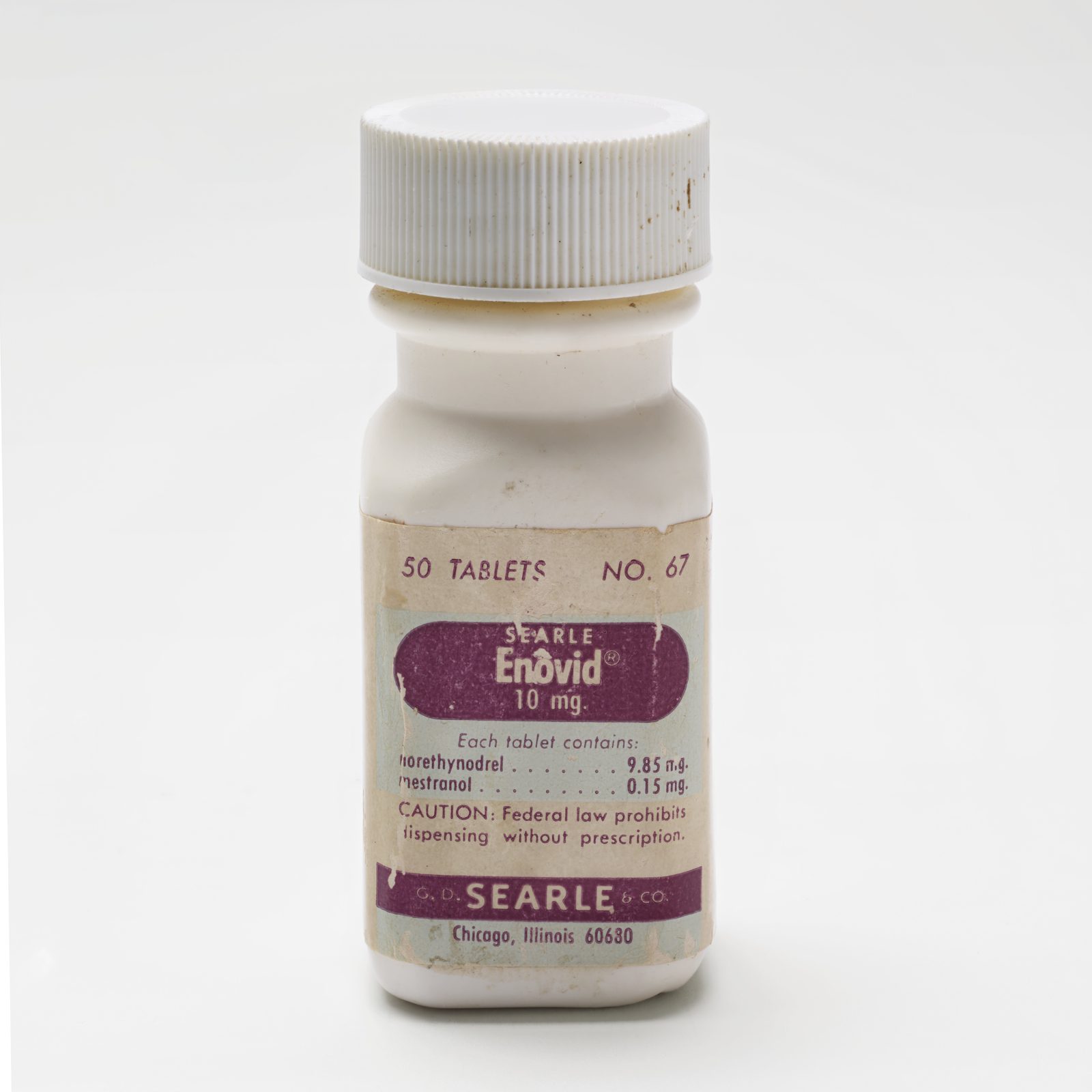
Image context: the cover uses a real archival photograph of an Enovid bottle. That choice is deliberate. This article is about a concrete medical object moving through the world as a labeled prescription, not about a floating slogan of freedom.[7]
Timeline anchors before interpretation
- 1947: Katharine McCormick gained full control of her late husband's estate, giving her the financial independence that later made large-scale pill funding possible.[4]
- 1951: Margaret Sanger found in Gregory Pincus a scientist willing to pursue the long-imagined "magic pill" and then connected him to backers who wanted results rather than abstract theory.[3]
- 8 June 1953: McCormick visited Pincus's Worcester laboratory and wrote the first large check that began sustained financing for pill development.[4]
- Summer 1955 to April 1956: Puerto Rico was chosen for large-scale trials because clinic networks already existed there and anti-birth-control laws did not block the work.[5]
- 1957: Enovid entered the U.S. market not as contraception but as a treatment for "disturbances of menstruation," even while many women and doctors understood its contraceptive effect.[2][6]
- 9 May 1960: FDA approved Enovid for contraceptive use, making it the first birth control pill legally marketed for that purpose in the United States.[1][2][3]
Those dates matter because they show that the pill was not one instant of discovery. It was a chain of translation. Money had to become laboratory work, laboratory work had to become trial evidence, trial evidence had to become an acceptable regulatory story, and then the drug still had to become a habit people could actually follow.
1. Before the pill was a product, it was a funding problem with a political edge
The pill's origin is easy to sentimentalize if one starts at the pharmacy counter. The harder and more revealing place to start is financing. In the early 1950s, contraceptive research still sat close to legal restriction, moral suspicion, and institutional caution.[3][4] Margaret Sanger wanted a female-controlled method that would be easier to hide, easier to use, and less dependent on male cooperation. What she did not yet have was a reliable laboratory route or a benefactor willing to carry the project beyond rhetoric.[3][4]
Katharine McCormick supplied the decisive missing element. PBS's McCormick profile is unusually blunt: in a period when government, major medical institutions, and much of industry wanted little to do with contraceptive research, McCormick provided almost every dollar needed to develop the pill.[4] Her role matters because it changes the invention from a pure scientific breakthrough into a privately underwritten health project with an explicit political goal. McCormick did not fund the work as detached philanthropy. She wanted a woman-controlled contraceptive in her lifetime, and she pressed the project toward deliverable results.[4]
Gregory Pincus and John Rock then gave that money two different kinds of traction. Pincus supplied endocrine ambition and laboratory direction. Rock supplied a clinical route through infertility practice and respectability within obstetrics and gynecology.[3][5] This pairing is one of the core facts of the story. The pill was not born in a self-contained contraceptive laboratory. It emerged from the overlap between reproductive endocrinology and fertility medicine, which is one reason it could be routed into mainstream care before American public culture was ready to speak plainly about contraception.[2][3]
2. Puerto Rico gave the project scale, and later criticism gave the trials their hardest historical edge
Small laboratory promise was not enough. A pill intended for repeated use by healthy women needed larger human trials, and 1950s America made that difficult.[3][5] PBS's account of the Puerto Rico trials explains why the island looked attractive to the researchers: there were already birth-control clinics in operation, officials supported family-planning efforts, and local law did not contain the same anti-contraception barriers that existed in many U.S. states.[5]
That practical advantage came with a moral cost that the history can no longer ignore. According to PBS, after a year of testing, Dr. Edris Rice-Wray reported that the pill was highly effective when taken properly but also produced frequent side effects, including nausea, dizziness, headaches, stomach pain, and vomiting.[5] Later critics treated the Puerto Rico trials as a case study in the ethics of mid-century clinical research, especially around informed consent and the use of vulnerable populations. The FDA history exhibit now describes the Enovid trials as work that involved methodology and vulnerable populations later invoked in demands for major reforms in clinical-trial conduct.[1]
That point needs a careful boundary. The evidence does support saying that Puerto Rico made large-scale testing possible and that the ethics of the trials later became part of the case for reform.[1][5] The evidence does not justify pretending that the entire pill story can be reduced to one moral verdict. Historical force often works in this harsher way: a project can be medically consequential and ethically compromised at the same time. The first pill belongs in that category.
3. The FDA route matters because Enovid first entered the market under another name for its purpose
The most revealing fact in the FDA record is also the least mythic one. Suzanne White Junod's FDA history makes clear that the first oral contraceptive was submitted in 1957 as a treatment for menstrual disorders and infertility, not as a contraceptive, even though the drug had been developed with contraception in mind.[2] Only in 1960 was the same drug submitted for approval specifically as an oral contraceptive.[2]
That sequence changes how the breakthrough should be read. The pill did not burst into the market under a fully open language of sexual choice. It moved through a therapeutic label first. Dittrick's history of oral contraception says the same thing from the market side: Enovid was first sold in the United States in 1957 to help with "disturbances of menstruation," and by 1959 more than half a million American women were already using it for contraception before FDA formally approved birth-control use in 1960.[6]
In other words, women, clinicians, manufacturers, and regulators were already living inside a partially acknowledged reality. The drug's contraceptive effect was not a secret in the practical sense. But the route to legitimacy still passed through familiar medical vocabulary. That is the deeper point of the 1957 label. Enovid first became acceptable as something medicine already knew how to name.
4. The first pill was also a daily discipline technology
The old liberation story is weakest when it forgets the object itself. The first pill did not arrive as an abstract right. It arrived in a bottle. Dittrick's exhibit on the oral contraceptive pill notes that early Enovid came packaged like other medicines and that women were expected to take one pill a day for 20 days, then stop for 7 days before beginning again.[6] That regimen made adherence part of the invention. A woman had to remember where she was in the cycle, whether she had missed a day, and when the bottle should restart.
That daily routine helps explain why the FDA exhibit stresses that Enovid was a prescription medication taken over long periods of time and that it transformed women's relationships with doctors and the structure of reproductive health care.[1] The pill was empowering, but not in the cartoon sense of an instant exit from gatekeeping. It shifted gatekeeping into a new form: clinic visits, prescriptions, long-term use, calendar discipline, and eventually compliance packaging designed to reduce user error.[1][6]
This is a more exact way to describe the technology's social force. The pill separated sex from pregnancy more effectively than prior methods for many users. But it did so by asking healthy people to accept a repeated pharmaceutical routine and a continuing medical relationship. Freedom came through management.
5. Safety did not sit outside the breakthrough. It defined the shape of it.
The FDA sources are especially useful here because they resist simple triumphalism. Junod's history says the pill was approved before the thalidomide revelations and before the 1962 Drug Amendments, meaning it passed through a regulatory environment that soon would have become more cautious for any drug meant for widespread use in women of childbearing age.[2] The same document says regulators judged safety and efficacy together because pregnancy and childbirth themselves carried medical risk; if the pill had not prevented pregnancy well, it would have been harder to defend as safe enough.[2]
The later safety story then changed the device's public meaning again. The FDA exhibit notes that shortly after Enovid was marketed, it became linked to increased risk of venous thrombosis, after which FDA required a Patient Package Insert explaining risks, making it only the second product to carry such a requirement.[1] That matters because it shows how quickly the first pill ceased to be only a scientific or social event. It became a modern risk-communication problem.
The breakthrough, then, was never just that a hormone combination could block ovulation. The harder breakthrough was building a world in which healthy women would take that combination repeatedly, under prescription, with side effects to watch, instructions to follow, and a state willing to treat the risk-benefit equation as acceptable.[1][2][6]
The strongest two interpretations
Interpretation A: the first pill's main significance was liberation
This interpretation captures an important truth. Once Enovid existed, women had a more private, reliable, female-controlled means of preventing pregnancy than most earlier options offered.[1][3][4] That changed lives and later reshaped work, marriage, and education.
Interpretation B: the first pill's decisive historical form was a medically routed routine built from money, trials, labels, and follow-up discipline
This interpretation fits the evidence more tightly. The crucial turns are McCormick's financing, the Pincus-Rock research partnership, Puerto Rico's trial infrastructure, the 1957 therapeutic label, the 1960 contraceptive approval, and the problem of adherence and safety communication afterward.[1][2][4][5][6]
Interpretation A explains why the pill became a symbol. Interpretation B explains how it first became a product.
Why this microhistory still matters
Enovid still matters because modern health technologies often travel this same path. A device or drug is remembered later as a symbol of autonomy, disruption, or progress, while its first real life depends on something slower: financing, trial geography, regulatory naming, packaging, instructions, and the behavior of ordinary users. The first pill changed history. It also had to survive as a bottle on a dresser, a prescription in a chart, and a regimen someone could keep straight on an ordinary Tuesday.
That is the durable lesson. The first pill did not enter American life as a pure idea of liberation. It entered as a managed medical routine that millions of people then turned into something larger than its label.
Sources
- U.S. Food and Drug Administration, "Drug Therapeutics & Regulation in the U.S." - FDA history exhibit on Enovid as a long-term prescription medication, its social and therapeutic framing, thrombosis risk, and the later patient package insert requirement.
- Suzanne White Junod, "FDA's Approval of the First Oral Contraceptive, Enovid" - FDA historical essay on the 1957 menstrual-disorders submission, the 1960 contraceptive approval, and the pre-thalidomide regulatory context.
- PBS American Experience, "Margaret Sanger (1879-1966)" - Sanger's search for a "magic pill," her 1951 connection to Gregory Pincus, and the move to secure funding.
- PBS American Experience, "Katharine Dexter McCormick (1875-1967)" - McCormick's financing role, the 1947 estate turning point, and the 1953 check that put sustained pill development on a workable footing.
- PBS American Experience, "The Puerto Rico Pill Trials" - why Puerto Rico was chosen, what the trial reports said about effectiveness and side effects, and why the episode later drew ethical criticism.
- Dittrick Medical History Center, "Oral Contraceptive Pill" - early Enovid marketing, the 20-days-on / 7-days-off bottle routine, and the later move toward compliance packaging.
- Wikimedia Commons, "File:Bottle of Enovid 10 mg Oral Contraceptive - DPLA - 0cc9d42b69b6fd3d586205f5831cade0.jpg" - source page for the archival Enovid bottle photograph used as the article image.