Alma-Ata is remembered in two thin ways. In one version, it survives as a noble slogan about "health for all." In the other, it gets flattened into the origin story for a cheap village-clinic package meant for poorer countries. Read the 1978 declaration closely and neither memory really holds. The text is more political than the slogan version and more system-minded than the bargain-medicine version.[1][2]
What the declaration actually builds is a sequence. It starts with health as a right, calls health inequality politically and economically unacceptable, pushes responsibility beyond the health sector, then defines primary health care as both the central function of the health system and the first level of contact in a continuing process.[1] The famous list of basic services sits inside that larger design. Alma-Ata is not saying that countries should settle for less medicine. It is saying that a health system organized upside down around distant specialists, weak prevention, and passive patients will never produce health on a mass scale.[1][3][4]
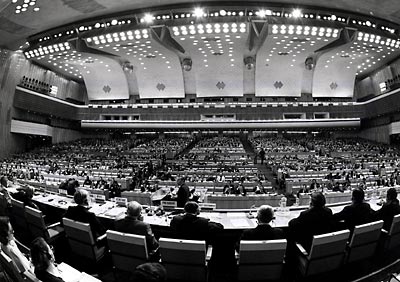
Image context: the cover uses a real archival conference photograph from the 1978 meeting in Alma-Ata. That choice matters because the declaration was a public political event with delegates, bargaining, and institutional ambition, not just a floating paragraph about clinics.[6]
Timeline anchors before the close reading
- 6-12 September 1978: WHO and UNICEF jointly convened the International Conference on Primary Health Care in Alma-Ata, in what is now Almaty, Kazakhstan.[1][4]
- 12 September 1978: the conference adopted the Declaration of Alma-Ata and made primary health care the key route toward "Health for All" by the year 2000.[1][2]
- 2003: PAHO's retrospective account argued that later "selective primary health care" packages distorted the declaration's broader original concept.[3]
- 13 September 2018: WHO Europe marked the declaration's fortieth anniversary in Almaty, explicitly treating the city as the birthplace of modern primary health care.[4]
- 25 October 2018: the Declaration of Astana formally reaffirmed Alma-Ata and restated primary health care as a foundation for universal health coverage.[5]
Those dates matter because they show two histories at once: the 1978 text itself, and the long afterlife in which later institutions kept returning to it in order to recover what had been narrowed or forgotten.
1. The declaration opens above medicine
The first surprise in the text is where it begins. Alma-Ata does not open with clinics, nurses, or lists of treatments. It opens with a definition of health as "complete physical, mental and social wellbeing," frames that condition as a fundamental human right, and then says the goal cannot be reached by the health sector alone.[1][2] This is an unusually high starting point for a document often remembered as practical and local.
That opening matters because it changes the logic of everything that follows. If health is a right and not merely a technical service, then health policy cannot be reduced to hospital throughput or physician supply. The declaration immediately adds that gross inequality in health status, both between countries and within them, is politically, socially, and economically unacceptable.[1] In other words, inequity is not treated as sad background. It is treated as a condition governments should regard as intolerable.
The third and fourth principles carry the argument even farther. Economic and social development are described as basic to health attainment, and people are said to have both the right and the duty to participate in planning and implementing their health care.[1] By the time the document reaches the phrase "primary health care," it has already shifted the frame from medicine as repair to health as a social, developmental, and political question.
2. "Primary" does not mean minor, cheap, or separate
The sixth section is the hinge, and it is the part most often misremembered. Primary health care is defined as essential health care that is practical, scientifically sound, and socially acceptable, made universally accessible through community participation and at a cost countries can maintain.[1] That sentence is often summarized as affordability. But the definition is doing more than that. It is setting a standard for method, legitimacy, reach, and durability all at once.
Then comes the clause that rescues the document from later minimalist readings. Primary health care, the declaration says, forms an integral part of the country's health system, "of which it is the central function and main focus," while also serving as the first level of contact and the first element of a continuing health care process.[1] That is not the language of a fallback tier for places that cannot yet afford real medicine. It is the language of system architecture.
This is the key close-reading point. "Primary" in Alma-Ata does not mean low-status. It means foundational. The first level of contact is supposed to connect outward and upward, not sit alone. The document assumes a continuum: local access, comprehensive organization, and referral beyond the front line.[1] Once that is visible, the cheap-clinic memory starts to look like a truncation rather than a faithful summary.
3. The famous service list sits inside a broader social design
The seventh section is often the part people cite because it offers a concrete list: health education, nutrition, safe water and sanitation, maternal and child health including family planning, immunization, endemic disease control, treatment of common diseases and injuries, and essential drugs.[1] That list is real, and it matters. But read in context, it is not a small-bore package. It is the operating edge of a much larger theory.
Several items in the list are already outside the clinic door. Safe water and basic sanitation cannot be delivered by medicine alone. Food supply and proper nutrition are not specialist procedures. Education about prevailing health problems is not a downstream extra once "real care" has been completed. Alma-Ata places these alongside treatment and essential drugs because it is trying to reorganize what counts as health action.[1][2]
The next clauses make that explicit. Primary health care must involve related sectors of national and community development, including agriculture, animal husbandry, food, industry, education, housing, public works, and communications.[1] This is one of the document's sharpest lines because it refuses the habit of loading health outcomes onto ministries of health while leaving the upstream determinants to someone else's budget. The declaration is broad on purpose.
That breadth is also why later selective versions felt easier to implement. A shorter package of measurable interventions is administratively cleaner than a program that asks governments to coordinate sanitation, nutrition, financing, local participation, and referral logic. PAHO's retrospective account says this impatience with structural change helped produce later distortions into "low-cost interventions" that kept the language of primary health care while narrowing its ambition.[3]
4. Alma-Ata expects participation and referral, not abandonment to self-help
Another common caricature treats primary health care as self-help medicine for places left outside the formal system. The declaration again says something different. It calls for maximum community and individual self-reliance and participation, but it pairs that demand with suitably trained health teams, referral systems, and national policy backed by political will and resource mobilization.[1]
That pairing is the point. Participation is not a euphemism for governments walking away. The document says governments remain responsible for the health of their people and must provide adequate health and social measures.[1] Local participation appears as a way to make systems legitimate, usable, and responsive, not as an excuse to replace systems with voluntarism.
The referral clause matters just as much. Primary health care should be sustained by integrated, functional, and mutually supportive referral systems that progressively improve comprehensive care for all, giving priority to those most in need.[1] This is why the declaration does not read as anti-hospital or anti-specialist. It reads as anti-fragmentation. Hospitals without strong first contact and prevention produce exclusion. Frontline care without referral produces abandonment. Alma-Ata asks for neither.
5. Why this close reading still matters after Astana
The declaration's afterlife helps explain why its wording deserves slow attention. WHO's 2018 anniversary materials returned to Alma-Ata as the birthplace of primary health care, while the Astana declaration reaffirmed the 1978 text and recast its priorities in contemporary language: political choices across sectors, sustainable primary health care, empowered communities, and aligned support behind national plans.[4][5] Institutions do not keep reissuing a document like this because it was perfectly implemented the first time. They return because its original framing remains unfinished.
That unfinished quality is visible inside the text itself. Alma-Ata is more ambitious than many health declarations now feel comfortable being. It talks about inequality, social justice, international resource use, participation, and disarmament alongside drugs, vaccines, and treatment.[1][2] The document keeps insisting that health systems fail when they are treated as detached clinical islands.
That is the strongest reason to read it closely in 2026. Alma-Ata did not ask countries to accept less medicine. It asked them to stop confusing medicine's most expensive edge with a health system. The declaration's real subject is sequencing: rights first, inequality named, sectors coordinated, communities included, referral built, and only then can first-contact care do the mass work the slogan promised.
Sources
- World Health Organization and UNICEF, Declaration of Alma-Ata: International Conference on Primary Health Care, Alma-Ata, USSR, 6-12 September 1978 - the primary document defining health as a right, primary health care as the central function of the health system, and the service list, referral, participation, and intersectoral clauses discussed here.
- World Health Organization, "WHO called to return to the Declaration of Alma-Ata" - WHO excerpt page emphasizing the declaration's language on rights, inequality, participation, affordability, and social sectors beyond health.
- Pan American Health Organization, "The Alma-Ata Declaration: A Pivotal Moment in Global Health" - retrospective account on drafting, conference politics, and the later distortion of Alma-Ata into selective low-cost packages.
- WHO Regional Office for Europe, "Almaty celebrates the official 40th birthday of primary health care" - anniversary note identifying Almaty as the birthplace of primary health care and linking the 1978 conference to later PHC work.
- World Health Organization, "New global commitment to primary health care for all at Astana conference" - official 2018 WHO account explaining that the Declaration of Astana reaffirmed Alma-Ata and set four renewed commitment areas for PHC.
- Wikimedia Commons, "File: International conference on Primary Health Care - Conferencia Internacional sobre Atención Primaria de Salud - Almaty -1978.jpg" - archival conference photograph source page for the article image.