Trachoma is easy to misread as a simple infection story: find Chlamydia trachomatis, give an antibiotic, and the problem should recede. The disease does not behave that neatly. Its blindness pathway is cumulative. Children carry and recarry infection in households where eye and nose discharge move by hands, bedding, clothing, and flies; years of repeated inflammation scar the inner eyelid; the lid turns inward; lashes scrape the cornea; pain, opacity, and irreversible visual loss follow.[1]
That chain explains why the WHO-endorsed SAFE strategy is more than a slogan. Surgery, Antibiotics, Facial cleanliness, and Environmental improvement each hit a different link in the same mechanism.[1][2] If any one part is mistaken for the whole intervention, the control logic weakens. Surgery can protect a cornea already under attack, but it cannot clean up community transmission. Antibiotics can reduce infection pressure, but they do not rebuild water access or make children's faces stay clean. Facial cleanliness can reduce discharge-driven spread, but only if households have the time, water, and sanitation environment to make cleanliness repeatable. Environmental improvement is the slowest arm, but it is the one that keeps a program from becoming an annual emergency.
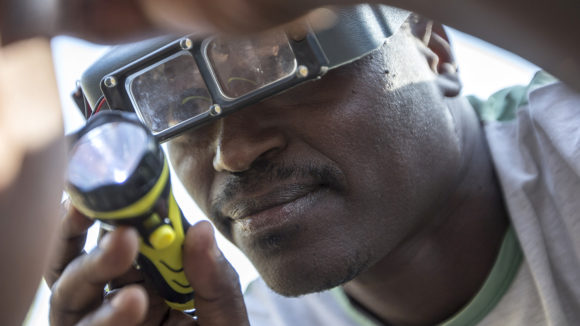
Image context: the lead image shows an eye examination in practice, replacing the earlier object-only buttonhook image.[6] The swap matters editorially: trachoma is not just an artifact story about inspection. It is a living public-health chain in which eyelid damage, infection pressure, facial cleanliness, water, sanitation, and surveillance all have to remain visible.
Timeline anchors
- 1993: WHO adopted the SAFE strategy for trachoma control.[1]
- 1996: WHO launched the Alliance for the Global Elimination of Trachoma by 2020, creating a multi-country platform for surveys, implementation, monitoring, and resource mobilization.[1][2]
- 1998: the World Health Assembly adopted resolution WHA51.11, setting global elimination of trachoma as a public-health target.[1]
- 2002: an estimated 1.5 billion people were at risk and required interventions; by November 2025, that figure had fallen to 97.1 million, a 94% reduction.[2]
- 2024: countries reported 87,349 trichiasis surgeries, 44.4 million people treated with antibiotics, and 39% global antibiotic coverage.[1]
- 14 May 2026: WHO validated Tunisia as having eliminated trachoma as a public-health problem, making it the 31st country worldwide to reach that milestone.[3]
The first link is the eyelid, not the bacterium
The most visible tragedy of trachoma is blindness, but the immediate surgical problem is mechanical. WHO describes repeated infection as a process that can scar the inside of the eyelid until it turns inward, causing eyelashes to rub against the eye. That condition, trachomatous trichiasis, creates constant pain and can damage the cornea until visual loss becomes irreversible.[1]
This is why the "S" in SAFE comes first in the acronym even though infection starts the disease. Surgery is not there to cure the bacterium. It is there to stop the late-stage anatomy from continuing to injure the eye. For a person with lashes already scraping the cornea, a clean-water campaign or next year's antibiotic round may be necessary for the community, but it does not answer the immediate problem of every blink becoming abrasion.
WHO's elimination threshold captures that distinction. A country or district is not simply judged by whether infection has become rare. It must also show that trachomatous trichiasis "unknown to the health system" is below 0.2% among adults aged 15 years or older, roughly one case per 1,000 total population, and that there is a system able to identify and manage incident cases.[1][3] The threshold is a public-health design statement: elimination must include the people whose eyelids already crossed into the blinding stage.
Antibiotics reduce pressure, but stopping them requires surveillance
The "A" arm attacks active infection. WHO's current fact sheet identifies mass drug administration of azithromycin as the main antibiotic tool, with medicine donated to elimination programs through the International Trachoma Initiative.[1] Systematic-review evidence treats azithromycin mass drug administration as a central control tool, while still making the effect depend on district context, prevalence thresholds, and repeated program measurement.[5] At program scale, that is a large operation rather than a clinic prescription: tens of millions of people are treated in endemic communities, and coverage becomes part of whether infection pressure can be pushed down.[1][5]
But antibiotics alone create a second question: when can a program safely stop? The answer cannot be guessed from one good campaign. WHO's elimination standard requires trachomatous inflammation-follicular in children aged 1 to 9 years to remain below 5% in every formerly endemic district for at least two years without ongoing antibiotic mass treatment.[1][3] That is a stricter concept than "cases look lower this year." It asks whether transmission has stayed low after the drug pressure is removed.
The January 2026 WHO milestone helps explain why that surveillance logic matters. The global population requiring interventions fell below 100 million for the first time, but WHO still framed the achievement as progress toward a 2030 elimination target, not as the end of the disease.[2] Decline changes the work. It shifts programs from broad suppression toward targeted surveys, surgery backlogs, recrudescence detection, and the harder business of sustaining water, sanitation, and community routines after donors and headlines move on.
The face is a transmission surface
The "F" arm can sound like a hygiene slogan until the transmission mechanism is made concrete. Trachoma spreads through eye and nose discharge by direct and indirect contact, including hands, clothing, bedding, hard surfaces, and flies.[1][2] In that setting, a child's face is not just a symptom site. It is part of the transmission environment.
The best evidence is not perfect, but it points in the same direction. A 2014 PLOS Medicine systematic review and meta-analysis found that having a clean face was associated with reduced odds of active trachoma signs, with an odds ratio of 0.42 for trachomatous inflammation-follicular or intense, and lack of ocular discharge was also associated with reduced infection odds.[4] The authors emphasized limitations: many studies were observational, definitions varied, and water access was often measured crudely. Still, the direction matters. Facial cleanliness is not cosmetic. It reduces the visible discharge pathway that keeps infection moving among children and close contacts.[4]
That also explains why women can carry disproportionate burden. WHO notes that women are blinded up to 4 times as often as men, probably because of close contact with infected children and more frequent infection episodes.[1] This is not a biological footnote. It is a care-work and exposure pattern. The people washing faces, holding children, changing bedding, and absorbing household infection risk are part of the disease ecology.
Water and sanitation make the gains durable
The "E" arm is the easiest to underfund because it is not a single medical act. It means improving access to water and sanitation, reducing conditions that favor transmission, and making hygiene practical rather than aspirational.[1] A program can distribute tablets on schedule and still fail to make cleanliness durable if the household has too little water, no usable sanitation facility, and repeated fly exposure around human waste.
The same PLOS Medicine review found sanitation access associated with lower odds of trachoma signs and C. trachomatis infection, while facial-cleanliness indicators had some of the strongest associations.[4] The authors did not claim that any one latrine or washing rule is sufficient. Their point is more useful: the F and E parts of SAFE need standardized measurement and serious investment because durable elimination depends on ordinary repeated behavior and infrastructure, not only on episodic drug delivery.[4]
Tunisia's 2026 validation makes that mechanism visible at country scale. WHO credited decades of national effort: nationwide screening and treatment campaigns, primary-care and school-health integration, community hygiene work, wide access to primary health care, and progress in water and sanitation coverage.[3] The article does not prove that every country can reproduce Tunisia's pathway on the same schedule. It does show what kind of package WHO is willing to validate as elimination: not one campaign, but a health system with surveillance, treatment capacity, and social conditions that make transmission less likely to restart.[3]
What SAFE teaches beyond trachoma
Trachoma control is a useful public-health model because it refuses a one-tool answer. The disease begins with infection, but the public-health problem is a chain of recurrence, scarring, poverty, household contact, gendered care exposure, water access, sanitation, surgery, drug logistics, and surveillance. SAFE works when it preserves that whole chain instead of letting any one link impersonate the solution.
That is why the examination image belongs at the center of the argument. It keeps the article close to the living encounter where eyelid damage is seen, treatment decisions begin, and surveillance becomes practical rather than abstract.[6] Modern elimination then asks a harder question. What would have to be true about a community for that eyelid injury to become uncommon, treatable, traceable, and unlikely to return?
The answer is not just better medicine, though medicine is essential. It is surgery for late damage, antibiotics for infection pressure, clean faces for transmission reduction, water and sanitation for durability, and surveillance for proof. Trachoma falls when the chain is treated as a chain.[1][2][3][4]
Sources
- World Health Organization, "Trachoma" fact sheet (4 March 2026) - current disease mechanism, burden, SAFE strategy, 2024 surgery and antibiotic-treatment figures, and WHO elimination thresholds.
- World Health Organization, "Global population requiring interventions against trachoma falls below 100 million for the first time" (6 January 2026) - progress figures from 2002 to November 2025, SAFE scale-up context, survey infrastructure, and 2030 target.
- World Health Organization, "Tunisia validated by WHO as having eliminated trachoma as a public health problem" (14 May 2026) - Tunisia validation, SAFE implementation, surveillance, and elimination criteria.
- Stocks ME, Ogden S, Haddad D, Addiss DG, McGuire C, Freeman MC, "Effect of Water, Sanitation, and Hygiene on the Prevention of Trachoma: A Systematic Review and Meta-Analysis" (PLOS Medicine, 2014) - evidence on facial cleanliness, sanitation, and WASH exposure associations.
- Xiong T, Yue Y, Li WX, et al., "Effectiveness of azithromycin mass drug administration on trachoma: a systematic review" (Chinese Medical Journal, 2021; PubMed record) - antibiotic mass-drug-administration evidence and TF threshold framing.
- Sightsavers, "SAFE: trachoma control" - program page explaining SAFE implementation and source page for the eye-examination photograph used as the article cover.