CPAP is often described as if one mechanical success should automatically produce one clinical success. The airway stays open, oxygen dips fall, so the heart should be safer too. The evidence base is more layered than that. Continuous positive airway pressure clearly changes the immediate mechanics of obstructive sleep apnea, but the downstream gains separate into different outcome lanes: daytime sleepiness, sleep-related quality of life, blood-pressure control, and hard cardiovascular events do not all move with the same speed or reliability.[1][2][3][4][5]
That distinction matters because CPAP works through a very direct proximal mechanism. NHLBI's treatment page describes a CPAP machine as providing constant air pressure through the mouth or nose to keep the airway open during sleep.[1] Once that splinting effect is in place, apneas and hypopneas can drop sharply. What happens after that depends on which part of the disease burden is being measured and how many hours per night the machine is actually used.[1][3][5]
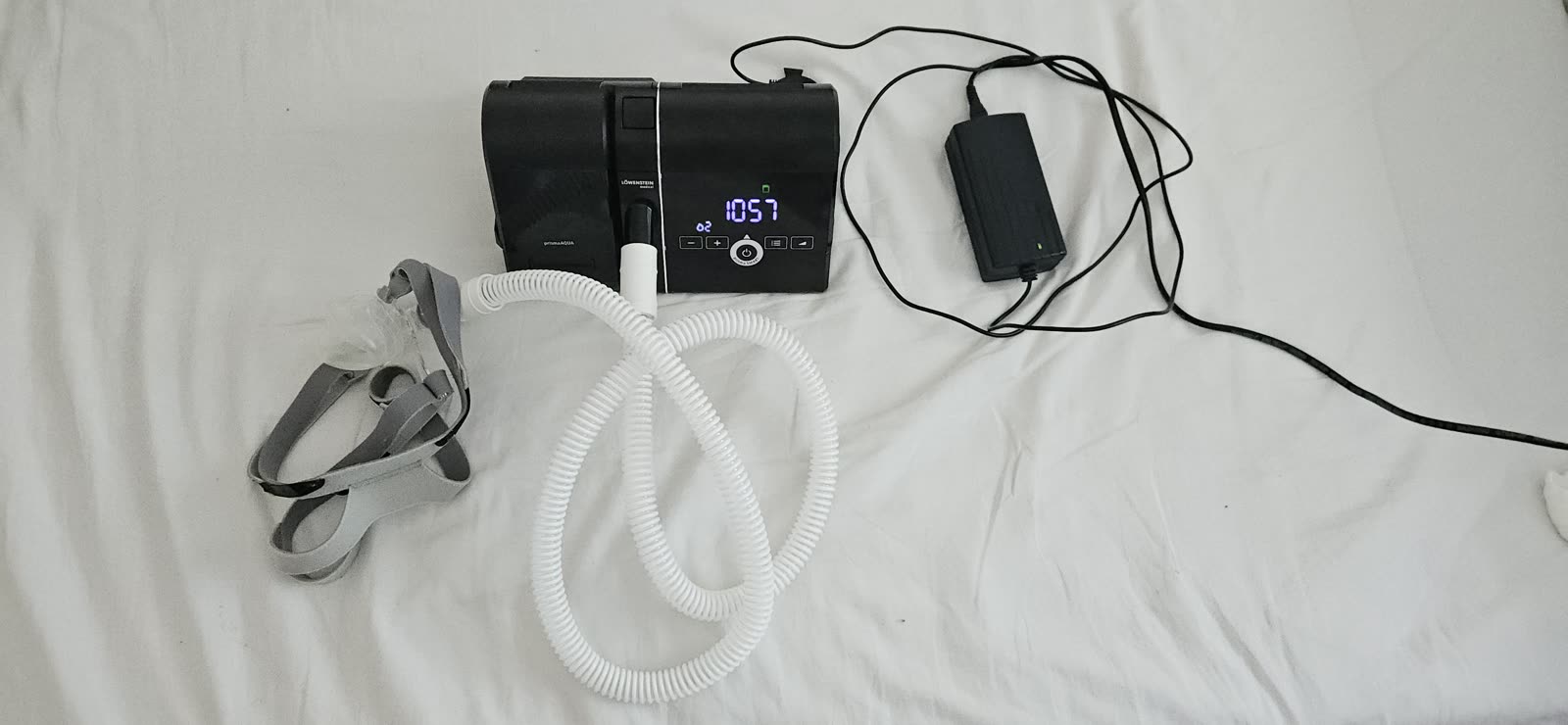
Image context: the cover photo shows a real home CPAP setup with the machine, tubing, and mask visible at once. It fits this article because the central question is what this device can change mechanically every night, and what still depends on hours of use and follow-through.[6]
Timeline anchors before interpretation
- 2013: the HIPARCO randomized trial tested CPAP in 194 patients with resistant hypertension and obstructive sleep apnea across 24 teaching hospitals in Spain.[4]
- 2016: the SAVE trial reported cardiovascular outcomes after a mean follow-up of 3.7 years in patients with moderate-to-severe OSA and established cardiovascular disease.[3]
- 2019: the American Academy of Sleep Medicine issued its PAP guideline, strongly recommending PAP for adults with OSA and excessive sleepiness and conditionally supporting use for impaired sleep-related quality of life and comorbid hypertension.[2]
- 2023: an individual-participant-data meta-analysis pooled 4,186 participants from randomized trials to re-examine whether adherence changes the cardiovascular story.[5]
The first effect is mechanical, and the guideline reflects that
The cleanest part of the CPAP story is the one closest to the mask. OSA is a collapse-and-reopening problem. PAP treatment counteracts that collapse by keeping upper-airway tissue from repeatedly obstructing airflow during sleep.[1] That is why the AASM guideline stays concrete about where the evidence is strongest. It recommends PAP for adults with OSA and excessive sleepiness, and it adds good-practice statements that treatment should follow objective testing and should include troubleshooting plus monitoring of efficacy and usage data after initiation.[2]
Those details are easy to skim past, but they tell us how the therapy should be read. CPAP is not a pill that either "works" or "fails" in one undifferentiated way. It is a device-mediated treatment whose benefit depends on diagnosis quality, mask fit, tolerance, and enough nightly exposure to suppress repeated airway collapse.[1][2]
Why symptom benefit shows up before blanket cardioprotection
This is where the outcome ladder matters. If a patient's main burden is sleep fragmentation, loud snoring, and daytime sleepiness, CPAP has a short causal path to improvement. The machine reduces the respiratory interruptions that keep waking the brain and stressing the body overnight.[1][2][3]
SAVE is useful precisely because it shows both the strength and the limit of that logic. In that trial, mean adherence in the CPAP arm was only 3.3 hours per night, yet the apnea-hypopnea index still fell from 29.0 events per hour at baseline to 3.7 during follow-up.[3] CPAP also significantly reduced snoring and daytime sleepiness and improved mood and health-related quality of life.[3] So the device was doing its proximal job. The reason the trial still landed as a disappointment is that the distal cardiovascular endpoint did not follow automatically.
Blood pressure can move even when major event curves do not
The most persuasive evidence for an intermediate clinical benefit comes from the hypertension pathway. HIPARCO enrolled patients with both OSA and resistant hypertension, a population in which sympathetic activation, nocturnal surges, and non-dipping patterns are central parts of the disease burden.[4] After 12 weeks, the CPAP group achieved a greater reduction in 24-hour mean blood pressure of 3.1 mm Hg and in 24-hour diastolic blood pressure of 3.2 mm Hg than the control group, and the share of patients with a normal nocturnal dipper pattern rose from that baseline landscape as well.[4]
That trial helps explain why AASM's hypertension recommendation is conditional rather than absent.[2] The pathway is plausible and the randomized signal exists, but it is narrower than a promise that CPAP will prevent every downstream cardiovascular event in every OSA population. Blood pressure is closer to the overnight physiology being treated. Myocardial infarction, stroke, and cardiovascular death sit farther down a chain that includes age, vascular damage already accumulated, other medications, and how consistently the mask is worn across years.[3][4][5]
Why SAVE looked neutral
The headline result of SAVE was straightforward: after 3.7 years of follow-up, the primary composite cardiovascular endpoint occurred in 17.0% of the CPAP group and 15.4% of the usual-care group, for a hazard ratio of 1.10 with a 95% confidence interval of 0.91 to 1.32.[3] No significant reduction appeared for the individual or composite cardiovascular endpoints.[3]
But the population and usage pattern matter. SAVE participants had established cardiovascular disease and, as the abstract notes, minimal sleepiness.[3] That makes the cohort clinically important, but it also means CPAP was being tested in people who already had a heavy background burden of vascular risk and who were not the most symptom-driven users. The machine corrected breathing events very effectively, yet average use stayed at 3.3 hours nightly.[3]
My inference from the source stack is that nightly hours are not an implementation footnote. They are part of the treatment mechanism. If the airway is splinted for only part of the night, then a therapy aimed at repeated overnight stress is being delivered fractionally rather than continuously. SAVE proved that physiological improvement plus partial use is not enough to guarantee broad secondary cardiovascular prevention.[3]
The adherence signal is real, but it needs careful reading
The 2023 JAMA individual-participant-data meta-analysis is helpful because it separates the randomized and adherence questions.[5] In the intention-to-treat comparison, CPAP did not reduce recurrent major adverse cardiac and cerebrovascular events: the hazard ratio was 1.01 with a 95% confidence interval of 0.87 to 1.17.[5] That preserves the main trial-level verdict.
At the same time, the on-treatment analysis found that good adherence, defined as 4 or more hours per day, was associated with a lower risk of recurrent major adverse cardiac and cerebrovascular events, with a hazard ratio of 0.69 and a 95% confidence interval of 0.52 to 0.92.[5] This should not be oversold as a new randomized proof that long-night users are guaranteed protection. It is still an adherence-based analysis nested inside trial populations. But it is strong enough to reinforce a practical reading: CPAP's cardiovascular ceiling is constrained not only by biology, but by whether patients can actually stay on the machine long enough each night.[5]
What this changes in 2026
The most accurate sentence for clinicians and readers is a narrower one. CPAP is a strong therapy for the mechanical problem of obstructive sleep apnea, with clearer evidence for improving sleepiness, sleep-related quality of life, and some blood-pressure outcomes than for delivering blanket cardiovascular-event prevention across all comers.[1][2][3][4][5]
That is also why the AASM guideline emphasizes education, behavioral support, troubleshooting, and usage monitoring at initiation.[2] Those steps are not service extras. They determine whether a mechanically sound therapy is actually present for enough of the night to matter.
So the cleanest causal summary is this: CPAP reliably opens the airway, often makes people feel better, can help on blood pressure in the right population, and reaches harder cardiovascular outcomes only under tighter boundary conditions than early enthusiasm implied.[1][2][3][4][5]
Sources
- NHLBI, "Sleep Apnea - Treatment" (official NIH overview of PAP types and the airway-opening mechanism).
- Patil SP, et al., "Treatment of Adult Obstructive Sleep Apnea with Positive Airway Pressure: An American Academy of Sleep Medicine Clinical Practice Guideline" (Journal of Clinical Sleep Medicine, 2019; PubMed abstract with recommendations and follow-up requirements).
- McEvoy RD, et al., "CPAP for Prevention of Cardiovascular Events in Obstructive Sleep Apnea" (New England Journal of Medicine, 2016; PubMed abstract with SAVE trial results).
- Martinez-Garcia MA, et al., "Effect of CPAP on blood pressure in patients with obstructive sleep apnea and resistant hypertension: the HIPARCO randomized clinical trial" (JAMA, 2013; PubMed abstract with 12-week ambulatory blood-pressure results).
- Sanchez-de-la-Torre M, et al., "Adherence to CPAP Treatment and the Risk of Recurrent Cardiovascular Events: A Meta-Analysis" (JAMA, 2023; PubMed abstract with intention-to-treat and >=4-hour adherence analyses).
- Wikimedia Commons, "File:CPAP machine.jpg" (photographic source for the article image).