The Dalkon Shield is often remembered as a scandal with a single moral: one dangerously designed intrauterine device injured thousands of women, lawsuits followed, and the market moved on. The stronger reconstruction is harsher and more useful. The device mattered because it joined three failures in sequence: aggressive scale, a pregnancy-and-infection hazard that became visible only after widespread use, and a legal regime that still treated medical devices mainly as products to police after harm rather than products to screen before launch.[1][5][7]
That is why the Dalkon Shield sits in health history as more than a contraceptive failure. By the time regulators and clinicians were counting septic abortions, the device had already reached a huge population. The FDA-linked image record says it was used by nearly three million women at its peak.[7] The 1976 Medical Device Amendments later gave the FDA premarket approval authority over higher-risk devices, but that authority arrived after the Dalkon Shield had already shown what the earlier system could not prevent.[5]
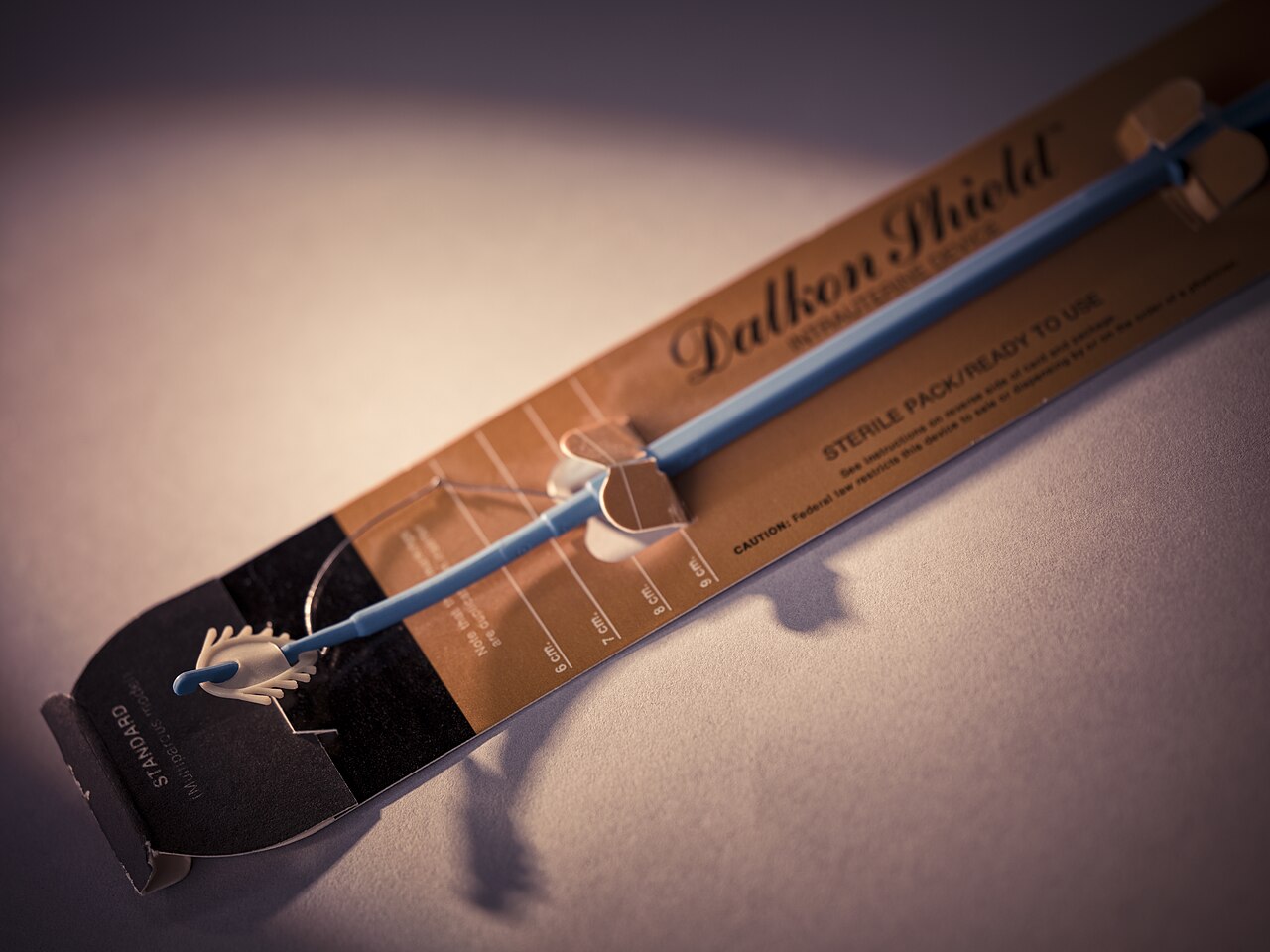
Image context: the lead image uses the actual Dalkon Shield, inserter, and holder from the FDA's archival image record. That matters here because the decisive hazard was not an abstract "women's health controversy." It was built into an object that could be inserted in minutes and then sit inside the body for months or years, carrying a tail whose structure became part of the clinical story.[7]
Timeline anchors before the interpretation fight
- 1971: the Dalkon Shield enters the U.S. market, years before the FDA gains power to pre-approve medical devices as such.[5][7]
- May 1974: A.H. Robins notifies physicians that 36 septic abortions, including 4 deaths, have been reported in Dalkon Shield users; the FDA Consumer summary later notes that the count rises to 219 septic abortion cases and 13 deaths as reports accumulate.[1]
- June 1974: at FDA request, sales of the device are suspended.[1]
- February 1975: a JAMA structural study says the recent report involved 209 septic spontaneous abortions and 11 maternal deaths, then argues the Dalkon tail is structurally different from the tails of four comparison IUDs.[2]
- 1975: federal hearings on Dalkon Shield problems help underscore the need for a separate medical-device law.[5]
- 1976: Congress enacts the Medical Device Amendments, replacing what President Ford called "horse and buggy" authority with a device-classification and premarket-review structure.[5]
- 1983: a case-control study of 155 PID cases and 305 controls still finds the Dalkon Shield riskier than copper IUDs, suggesting the problem was not mere panic spillover from the 1974 news wave.[3]
Those dates show why the device cannot be reduced to one bad newspaper cycle. The event starts as a product launch, becomes an obstetric emergency, turns into a design argument about bacterial access, and only then hardens into a legislative rewrite.
1. The first failure was regulatory timing
The Dalkon Shield came to market in 1971, during a period when the FDA still lacked the later system of premarket approval for medical devices.[5] That timing matters because the device was not entering a world in which implanted products had to clear the same front-end evidentiary gate that later high-risk devices would face. According to the FDA's own regulatory history, there was still "no requirement for pre-market testing, review, or approval" for devices in the decades before the 1976 amendments.[5]
This does not mean the Dalkon Shield was launched into total legal emptiness. It means the governing model was reactive. The FDA could police adulteration and misbranding, but the stronger preventive architecture came later.[5] In practice, that left women, clinicians, and hospitals performing the early detection function that a stricter front-end review might have handled more systematically.
That sequence also helps explain why the Dalkon Shield grew so fast before the full public-health argument had formed. A contraceptive can spread quickly because its success case is mundane: simple insertion, private use, no daily pill burden. Harm signals, by contrast, arrive through the slower path of pregnancy failures, hospital admissions, surveillance, and retrospective comparison. The product can therefore outrun the evidence that ought to govern it.
2. The sepsis signal changed the category of the problem
The most important historical turn was not simply that the Dalkon Shield failed to prevent some pregnancies. Other contraceptives fail. What changed the category of concern was the pattern of second-trimester septic abortion and severe pelvic infection.[1][2][4] In the 1975 FDA Consumer account, physicians were told that once pregnancy was confirmed, the device should be removed as soon as possible, and that therapeutic abortion should be advised if removal proved difficult.[1] That is not routine contraceptive counseling. It is emergency risk management.
The clinical literature from the same period makes the severity plain. Vujcich and Korman describe the product as having been withdrawn after reports of 11 maternal deaths and 209 septic midtrimester abortions, then add four late-midtrimester septic abortions of their own, all ending in neonatal death and one nearly killing the mother through septic shock.[4] What matters in reconstruction terms is the shape of the signal: pregnancy with the device in place did not merely raise the prospect of contraceptive inconvenience. It opened a pathway to catastrophic infection.
Once that happened, the Dalkon Shield could no longer be judged by contraceptive convenience or failure-rate marketing alone. The clinical question became whether the device introduced a route by which vaginal bacteria could reach the uterine cavity during pregnancy or under other conditions of cervical change.[2][4] That shifted the debate from "Is this an effective IUD?" to "What kind of biological pathway did this device create?"
3. The braided tail mattered because it supplied a mechanism
The reason the Dalkon Shield became more than a lawsuit story is that investigators eventually had more than anecdotes. They had a plausible design mechanism. In the 1975 JAMA study, Tatum and colleagues concluded that the Dalkon tail was "structurally and functionally different" from the tails of four other IUDs and that its unique characteristics could provide a path by which pathogenic bacteria moved from the vagina into the uterine cavity and caused sepsis.[2]
Later clinical summaries condensed that point into blunt language. The American Academy of Family Physicians notes that the Dalkon Shield's multifilament string was believed to transmit bacteria into the uterus, describes the tail as a pathway that bypassed the endocervical barrier, and cites a fivefold increase in pelvic inflammatory disease associated with this design flaw.[6] That later restatement is useful because it shows what survived the controversy after the courtroom heat cooled down: not every IUD shared the same risk profile, and the tail design itself became inseparable from the product's harm.
This is also where the Dalkon Shield stopped being interpretable as generic anti-IUD panic. If the danger had been only cultural backlash, later comparative epidemiology should have collapsed toward parity once the most dramatic media cycle passed. Instead, the 1983 case-control study still found the estimated PID risk highest for Dalkon Shield users. Compared with copper-containing IUDs, the relative risk estimate for the Dalkon Shield was 6.5; 9 of 11 Dalkon Shield PID cases were classified as severe, versus 12 of 40 copper-device users and 9 of 32 Lippes Loop users.[3] That is not a perfect causal proof by modern standards, but it is far too strong to dismiss as atmosphere.
4. Two competing interpretations explain the event differently
Interpretation A: the Dalkon Shield was mainly a one-product design defect
This interpretation puts most of the explanatory weight on the device itself. The evidence for it is substantial. The multifilament tail was unusual, structural studies gave a mechanism for bacterial ascent, pregnancy with the device in place carried a serious septic-abortion pattern, and later comparative data still ranked the Dalkon Shield worse than copper IUDs.[2][3][4][6] On this view, the central lesson is engineering discipline: one defective design damaged patients and damaged confidence in a whole contraceptive category.
Interpretation B: the stronger lesson is that pre-1976 device oversight was too weak for implanted products
This interpretation does not deny the design defect. It argues that the Dalkon Shield became historically decisive because it revealed a regulatory mismatch. The FDA history is explicit that premarket approval authority over devices did not arrive until the 1976 Medical Device Amendments, and that Dalkon Shield hearings in 1975 helped underscore the need for that law.[5] On this reading, the scandal mattered less because one product was bad than because a risky implanted product could scale nationally before a proper front-end evidentiary filter existed.
Current assessment: Interpretation B is stronger for explaining why the episode changed national policy, while Interpretation A remains indispensable for explaining why women were injured in the first place. The law moved because a defective object exposed the weakness of the system around it.
What would change the assessment: evidence that a comparably hazardous implanted device would have been stopped quickly under the pre-1976 regime would narrow the regulatory argument. The sequence recorded by the FDA points the other way.[5]
5. Why this reconstruction still matters
The Dalkon Shield remains a live health-system case because it shows how device harm can unfold through three layers at once:
- Design layer: a physical feature changes microbial risk.[2][6]
- Clinical layer: pregnancy, infection, and pelvic inflammatory disease convert that design into hospital-level injury.[1][3][4]
- Governance layer: lawmakers realize that policing after harm is too late for implanted technology and build a premarket regime around that recognition.[5]
This layered reading also corrects a common simplification. The Dalkon Shield did not discredit every IUD on equal evidence. It discredited a period in which device categories could be argued about too loosely and reviewed too late. That distinction matters, because later IUDs with different materials and strings were forced to live under the shadow of a product whose most infamous feature was not contraception alone, but the way a small piece of braided material turned an internal device into a bacterial corridor.[2][3][6]
If there is one durable lesson in the event chain, it is that implanted products should never be judged only by whether they accomplish their intended task. They also have to be judged by the routes of harm their materials, geometry, and failure states make possible inside the body. The Dalkon Shield taught that lesson through injury first and law second.
Sources
- FDA Consumer, "The Dalkon Shield" (February 1975) - physician warning counts, June 1974 sales suspension, and the shift from multi- to single-filament string.
- H. J. Tatum, F. H. Schmidt, D. Phillips, M. McCarty, and W. M. O'Leary, "The Dalkon Shield controversy. Structural and bacteriological studies of IUD tails." JAMA (1975) - structural evidence for why the Dalkon tail could provide a bacterial route to sepsis.
- D. W. Kaufman, J. Watson, L. Rosenberg, S. P. Helmrich, D. R. Miller, O. S. Miettinen, P. D. Stolley, and S. Shapiro, "The effect of different types of intrauterine devices on the risk of pelvic inflammatory disease." JAMA (1983) - case-control comparison of 155 PID cases and 305 controls, including Dalkon-versus-copper risk estimates.
- J. Vujcich and B. Korman, "Second trimester septic abortion and the Dalkon shield." Medical Journal of Australia (1975) - clinical consequences of pregnancy with the device in place and the severity of septic-abortion cases.
- U.S. Food and Drug Administration, "Medical Device & Radiological Health Regulations Come of Age" - FDA history of the pre-1976 gap and the role of Dalkon Shield injuries in the Medical Device Amendments.
- Timothy P. Canavan, "Appropriate Use of the Intrauterine Device." American Family Physician (1998) - later clinical synthesis on the Dalkon Shield's multifilament string, PID risk, and the U.S. IUD backlash.
- Wikimedia Commons / U.S. Food and Drug Administration, "File:Dalkon Shield, ca. 1971.jpg" - documentary source page for the device, inserter, and holder image used here.