At a street corner in Colchester, Vermont, the sidewalk finishes its descent a little early. There is a patch of level ground where someone walking down the ramp has already felt the slope end but has yet to reach the road. Look at what occupies that patch in the photograph below. The slope does one job for the person crossing. The bumps do another. [1]
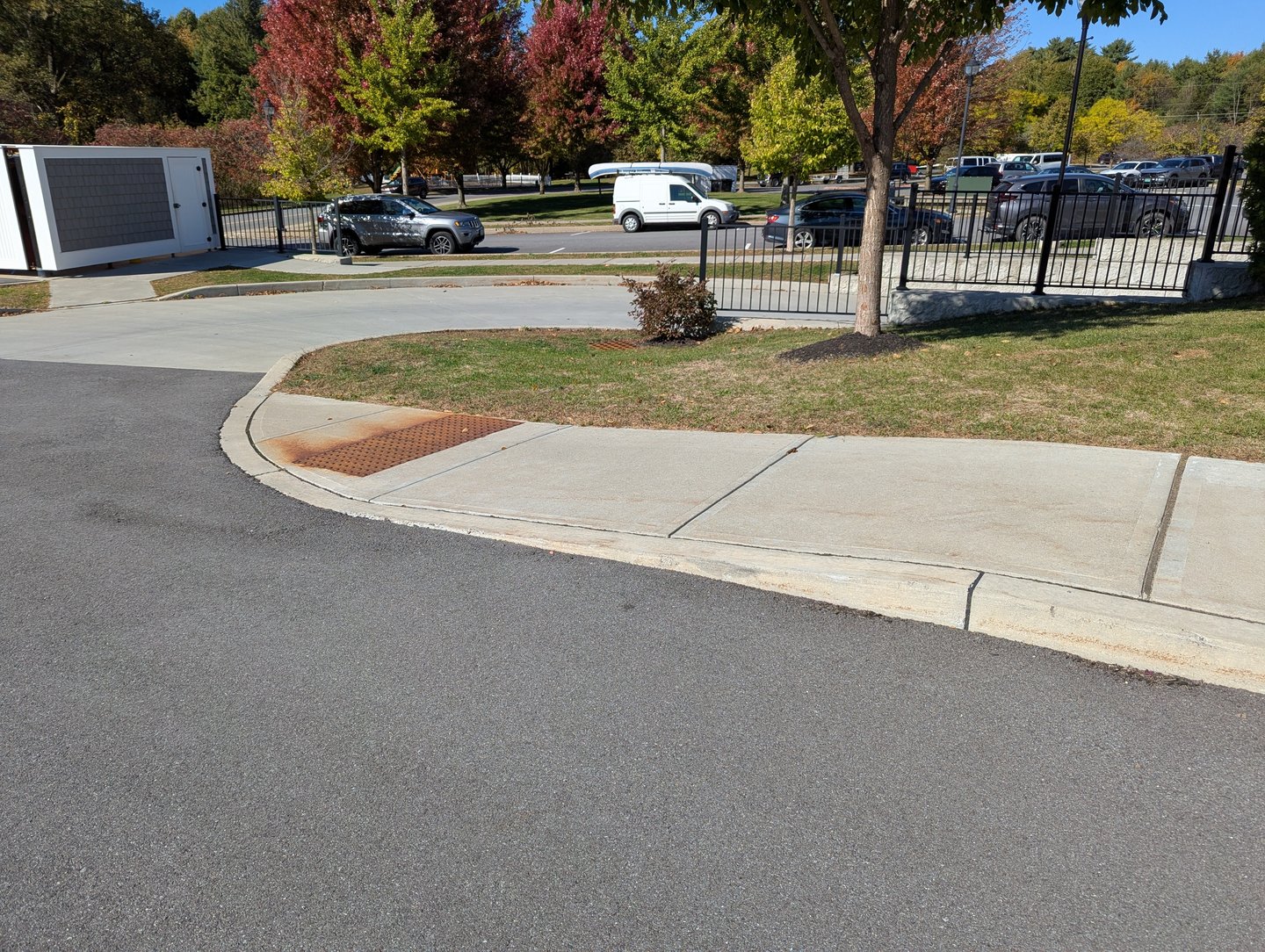
An upright curb gives a person sweeping a long cane something to find. The tip can drop over the lip while the pedestrian is still on the sidewalk. Lower the curb and a wheelchair can roll through, but a cane tip can roll through too. A gentle change in grade can be hard to feel. And even when the slope is perceptible, the Vermont photograph shows the trouble with using it to judge exactly where the street begins. [1][2]
A strip wide enough to meet in mid-stride
The little bumps have a surprisingly precise name, truncated domes. Each has a broad base and a flat top. Together they give a cane tip or the sole of a shoe a distinctive patch of texture. Their message holds for someone arriving at the left side of a ramp as well as for someone coming straight down the middle. That is why the width of the strip matters. Leave a smooth path around one end and a pedestrian can miss the warning altogether. Its other dimension matters for a different reason. A very narrow strip can fall between two footfalls. [2][3]
How much of the ramp should carry that texture? The original U.S. accessibility guidelines in 1991 called for covering the ramp surface. In its 2002 draft for public streets, the U.S. Access Board proposed a band at least 24 inches deep in the direction of travel, spanning the ramp's width. The board expected that shorter stretch, along with wider spacing between domes, to ease the passage of wheelchair wheels. Placement gave the change a further advantage. A pedestrian who feels bumps all the way down a long ramp learns where the ramp begins. A pedestrian who first feels them near the street learns where to pause. [2][3][4]
What yellow looks like from eight feet away
A pedestrian with some usable sight may pick out the strip before a cane reaches it. In 2006, James Jenness and Jeremiah Singer reported an outdoor experiment with 50 adults with low vision. They set warning panels against four simulated sidewalk surfaces. Participants approached from a distance and said when they could see a panel. At eight feet, those who could see it also rated how likely it would be to catch their attention on that pavement. These are different questions. You can find an object you have been asked to look for and still judge it easy to overlook on an ordinary walk. [4]
Consider a single panel color, federal yellow. Against asphalt, 92 percent of participants gave it a high attention rating. Against white concrete, 50 percent did. Both numbers come from the same row of the researchers' table. A town choosing a color from a supplier's catalog would know only half of what those participants saw. The pavement already poured at the corner supplies the other half. The study measured visibility and judgments of conspicuousness under test conditions. It did not count injuries at intersections. [4]
Back at the Colchester ramp, the bumps will feel the same under a shoe whether traffic is moving or stopped. They answer one question a pedestrian once could have answered by finding the drop of a curb. Where is the street? A walk signal, the sounds of traffic and the pedestrian's own judgment still have work to do after that. [2][5]
Sources
- Ezekielf, photograph of the sidewalk ramp and tactile paving in Colchester, Vermont. Wikimedia Commons.
- U.S. Access Board, 2002 Draft Guidelines for Accessible Public Rights-of-Way, discussion of section 1108 on detectable warnings.
- U.S. Access Board, Accessible Public Rights-of-Way advisory committee final report, recommendations on detectable warnings and their placement.
- James Jenness and Jeremiah Singer, Visual Detection of Detectable Warning Materials by Pedestrians with Visual Impairments, May 2006. Methods, table 14 and regulatory history.
- U.S. Access Board, Pedestrian Access to Modern Roundabouts, background on how blind pedestrians locate crossings and decide when to cross.