The handle in a 1914 photograph of a mine canary’s cage is thick enough to look uncomfortable. It had to hold more than the weight of the bird. The cylinder across the top carried oxygen. A rescuer walking into a damaged mine could carry, in one hand, both a way to test the air and a small supply of different air for the animal doing the testing. [1][2]
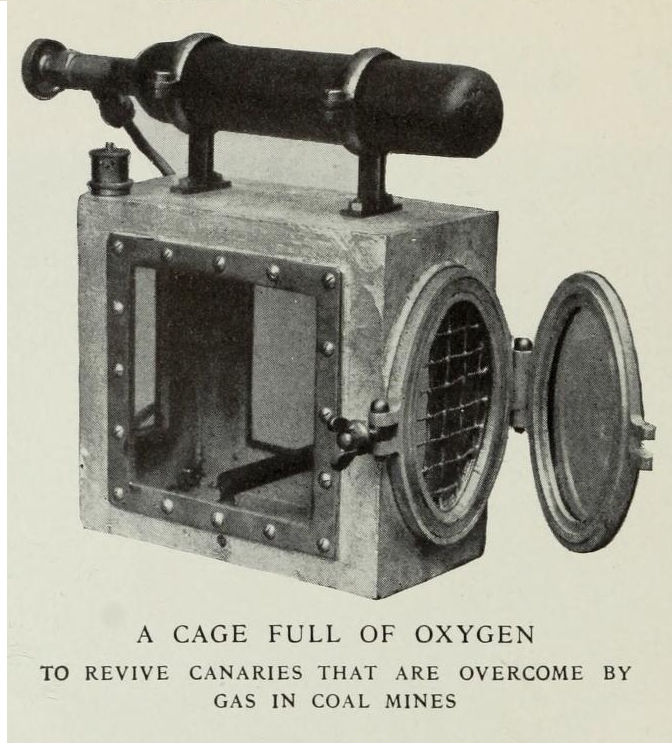
Consider the door. On a surviving British cage made by Siebe Gorman, a grille kept the bird inside even when the round door stood open. That was the working position. Air from the passage reached the perch, and a rescuer could see how the canary was bearing up. At signs of poisoning, the rescuer could shut the door and turn the oxygen valve. From that moment the bird and its carrier were breathing different air. A bird that got back on its feet inside the sealed box told the crew something about the bird. The passage could still be just as dangerous. [2]
What the crowd at Forbes Field could see
On October 31, 1911, spectators at Pittsburgh’s Forbes Field saw the reasoning behind the open door tested in public. George Burrell, an assistant chemist with the U.S. Bureau of Mines, stepped into a glass-paneled enclosure with three canaries. The air inside contained carbon monoxide. Within three minutes all three birds had collapsed. Someone passed them out of the enclosure and held them up by their legs so the crowd could see. Two died. Burrell stayed inside for eight minutes and reported feeling well. [3]
The bureau’s account, published in 1912, puts a less spectacular observation in the very next sentence. During an earlier, longer exposure, Burrell had felt only a slight headache at the time and became ill afterward. Nobody in the stands could have seen that delay. It explains why a rescuer might need persuading to turn back. A man hurrying toward trapped colleagues had the evidence of his own senses telling him he could keep going. The bird’s distress gave the party a reason to retreat or use breathing apparatus while that man could still act for himself. [3]
The bird that stayed on its perch
In 1916 Burrell and two colleagues published Black Damp in Mines. This time they asked what happened as the oxygen content of the air fell. On page 14 they recorded a result that qualified the Pittsburgh demonstration. Even at an oxygen concentration of 7.1 percent, some canaries remained upright. In their comparisons, oxygen deprivation began to affect people and the small animals on much the same timescale. A rescuer watching a perch in oxygen-poor air could be in trouble by the time the bird showed it. [4]
The two reports make an important distinction for anyone trying to picture a rescue. After a fire or explosion, dangerous carbon monoxide could be present while an oil lamp still had enough oxygen to burn. Under those conditions the bird could give a warning the flame could never supply. But suppose the danger in the next stretch of passage was a shortage of oxygen itself. The same bird, under the same watchful eye, offered little advance warning. Its value depended on which hazard reached the cage. [3][4]
The photograph preserves one more distinction that a phrase like “canary in a coal mine” tends to lose. At Forbes Field, holding the stricken birds aloft let a distant crowd see the result. Underground, the person who saw the first signs of distress already had a hand on the oxygen supply. The cage was built for the interval when the warning had come and there was still time to save the animal that gave it. [1][2][3]
Sources
- The World’s Work, vol. 28 (1914), photograph of a canary revival cage, via Wikimedia Commons.
- Science Museum Group, “Cage for reviving canary,” Lancashire Coal Mining Collection, object Y2002.19.254.1.
- Herbert M. Wilson and Albert H. Fay, First National Mine-Safety Demonstration, U.S. Bureau of Mines Bulletin 44 (1912), p. 47.
- G. A. Burrell, I. W. Robertson and G. G. Oberfell, Black Damp in Mines, U.S. Bureau of Mines Bulletin 105 (1916), p. 14.