One participant in the Amsterdam Hip Protector Study broke a hip while every pair of their protective underpants was in the wash. The researchers gave the incident one sentence near the end of their 2003 paper. It belongs beside the main result. If you ran a care home and bought these garments for your residents, a fracture on laundry day would count just as much as one on any other day. If you designed the protective shell and wanted to know how much force it could withstand, the same fracture would tell you very little. [1]
What went into the count
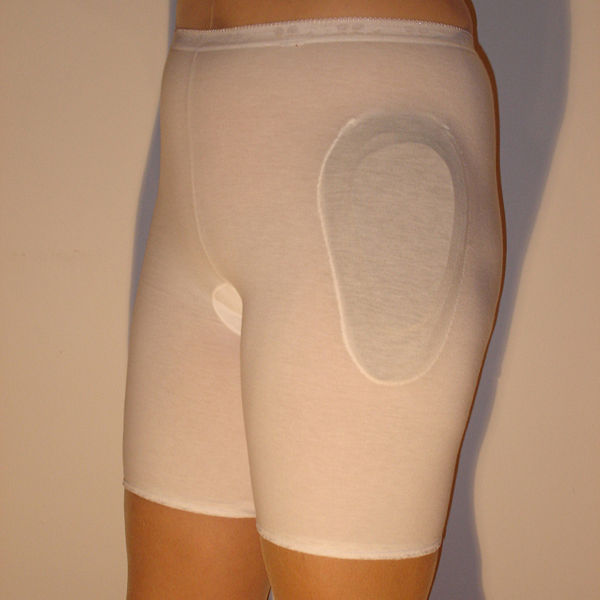
The Amsterdam team fitted residents with special underpants that held a rigid shell over the bony prominence at each outer hip. In a sideways fall, the shell was meant to carry some of the impact away from the bone and into the surrounding tissue. An earlier Danish study had given the idea a striking result. In 1993, researchers reported eight hip fractures across wards supplied with protectors and 31 across the larger group of wards assigned to usual care. All eight residents who fractured a hip in the supplied wards had been without their protector when it happened. That detail invited a question the trial could only partly answer. Who was wearing the garment during the falls that ended without a fracture? The Danish team kept a fall register in just four of its 28 wards. [1][3]
In Amsterdam, researchers randomized individuals within homes. Between 1999 and 2001 they enrolled 561 people at high risk of hip fracture. They marked the garments with each recipient’s name and room number. They asked residents or caregivers to record falls on calendars and made unannounced visits to check whether people were wearing the protectors. By the end of follow-up in 2002, the team had counted 18 hip fractures in the group offered protectors and 20 in the comparison group. Allowing for the time each group spent under observation, both experienced about five hip fractures per 100 person-years. The uncertainty around the estimate still allowed for substantial benefit or harm. [1]
What a spot check misses
At the first unannounced check, 61 percent were wearing the garment. By the last check, the figure was 37 percent. But even someone wearing a protector at every visit might have spent every night without one. Fewer than 16 percent wore theirs at night, and at least four fractures in the group given protectors happened late at night or early in the morning. Weekend laundry service varied between homes. Someone who needed frequent changes could run through the supply before a clean pair came back. A room number sewn into a waistband could get the garment back to its owner. It could do nothing about the wait. [1]
It is tempting to set aside the falls that happened during that wait. Doing so would sacrifice what random assignment bought. The two groups started out comparable by design. Once researchers select the people who managed to keep a garment on, that group may also differ in the help available to dress, change or get up during the night. Even perfect records of who wore what would leave those differences to untangle. And four Amsterdam participants fractured a hip while wearing the protector. A clean pair within reach would have solved only one of the problems the paper documents. [1]
A 2014 Cochrane review put the Amsterdam numbers beside other trials. Across 14 studies in nursing or residential care, the reviewers estimated that supplying protectors meant 11 fewer people with a hip fracture per 1,000 residents. The confidence interval ranged from 20 fewer to no difference. Studies of people living in the community showed little or no benefit. Those figures describe what happened when people received garments under the conditions of the trials. [4]
The laundry incident gives that average a human scale. For the resident waiting for a clean pair, access to protection depended on how many pairs the home stocked and when it ran the wash. The Amsterdam investigators preserved a piece of evidence that a fracture count alone could never recover. They recorded where the protector was when its owner needed it. [1]
Sources
- N. M. van Schoor and colleagues, “Prevention of Hip Fractures by External Hip Protectors,” JAMA (2003).
- GERAS Centre, “Hip Protectors in Long-Term Care,” illustrated guide and photograph.
- J. B. Lauritzen, M. M. Petersen and B. Lund, “Effect of external hip protectors on hip fractures,” The Lancet (1993).
- N. Santesso and colleagues, “Hip protectors for preventing hip fractures in older people,” Cochrane (2014).