The unsettling sentence in the 2004 CRASH report comes after the result: the investigators could not explain the increased mortality. Patients allocated methylprednisolone had died more often, but the biological route to that harm remained uncertain.[1]
Read together, those findings pose a practical question. How much must medicine understand about a treatment's failure before it can act on the evidence? CRASH makes the distinction unusually clear: uncertainty about how harm happens need not leave the decision about routine use equally uncertain.
The protocol made uncertainty an entry condition
The protocol published in June 2001 began with a modest ambition. A small survival improvement could matter enormously for a common injury, yet the existing trials were too small to resolve it. Its rationale included experimental work suggesting methylprednisolone could limit damaging chemical reactions in injured nervous tissue. That was a reason to investigate, not an established survival benefit.[2]
Eligibility made this uncertainty explicit. Patients were intended to be at least 16, within eight hours of head injury, and have impaired consciousness—a Glasgow Coma Scale score of 14 or below. The responsible doctor also had to be uncertain whether steroids should be used. A clear indication or contraindication kept a patient outside the comparison.[2]
The machinery was deliberately simple: a telephone call assigned a numbered pack, followed by a high-dose methylprednisolone infusion or matching placebo. No special investigations were required. Outcomes would be compared according to the original allocation, even if treatment was interrupted.[2]
This design put the question into ordinary emergency departments. Its ambition was to learn whether adding the drug helped patients through the injury, while keeping the extra research work small enough for busy staff to perform.
The death count changed the question
Recruitment stopped in May 2004, after 10,008 patients had been randomized. Among patients with known two-week outcomes, 1,052 of 4,985 allocated steroids died, compared with 893 of 4,979 allocated placebo: 21.1% versus 17.9%. The relative risk was 1.18, with a 95% confidence interval of 1.09–1.27.[1]
Subtracting those reported percentages gives an absolute difference of 3.2 percentage points—about three additional deaths per hundred patients under the trial conditions. The relative increase was 18%, not 18 percentage points.
The report acknowledged a limitation: investigators had not asked clinicians to assign a principal cause of death, because multiple consequences of trauma could contribute. Recorded infections and gastrointestinal bleeding did not provide a clear explanation for the excess mortality.[1]
That gap matters for biological explanation. It does not require discarding the randomized comparison. Identifying which individual death a drug caused is a different task from estimating whether allocating the drug changes a group's chance of survival.
Six months brought a second, separate reading
The June 2005 follow-up obtained outcomes for 96.7% of participants. Mortality remained higher with steroids: 25.7% versus 22.3%, a relative risk of 1.15 with a 95% confidence interval of 1.07–1.24.[3]
The combined endpoint of death or severe disability requires more careful wording. It occurred in 38.1% versus 36.3%; its relative-risk confidence interval, 0.99–1.10, included no difference. The paper therefore supports increased mortality, while the combined outcome was less conclusive. Calling both results statistically significant would misread the source.[3]
Nor does the combined outcome's uncertainty cancel the mortality finding. Combining different outcomes changes what is being counted. The two estimates answer related questions, with different precision. A reader should keep each outcome attached to its own estimate instead of letting one headline stand for the entire paper.
This was follow-up of the same randomized population, not an independent replication. It nevertheless addressed a consequential possibility: the adverse survival pattern had not disappeared when observation extended beyond the first fortnight.
A review need not produce one pooled number
The Cochrane review, whose searches were updated through January 2008, identified 20 trials with 12,303 participants. CRASH supplied roughly four-fifths of them. Because trial results differed substantially, the reviewers declined to calculate a single pooled mortality estimate and placed greatest weight on the largest trial.[4]
That decision is part of the evidence, too. A systematic review does not become more trustworthy simply by compressing every study into one number. Here, the disagreement needed to remain visible. Equally, counting papers as votes would give a small experiment the same influence as a much larger comparison. The reviewers' approach preserved the differences while explaining which evidence carried the most weight.
The boundary of the conclusion
The Brain Trauma Foundation's fourth-edition severe-TBI guidelines advise against steroids for improving outcomes or reducing intracranial pressure. They specifically identify high-dose methylprednisolone as contraindicated in severe traumatic brain injury because of increased mortality.[5]
That is a defined clinical conclusion. CRASH tested a particular regimen, population, and treatment window; it did not test every corticosteroid use in medicine. Reading the boundary carefully prevents the finding from becoming an indiscriminate claim about an entire drug class.
The lasting methodological lesson is demanding enough on its own. A plausible treatment deserves a comparison capable of finding harm. When that comparison changes the balance of evidence, practice need not wait for a complete biological explanation. The unanswered mechanism becomes a research question, rather than a reason to keep the treatment routine.
Sources
- MRC CRASH Trial Collaborators, 14-day results, The Lancet 364:1321–1328 (October 9, 2004) — original randomized comparison, stopping date, mortality denominators, and discussion of the unexplained harm; full-text PDF hosted by King Saud University.
- CRASH Trial Management Group and collaborators, “The CRASH trial protocol,” BMC Emergency Medicine 1:1 (June 11, 2001) — rationale, eligibility, numbered treatment packs, outcome collection, and analysis plan.
- Phil Edwards et al., final MRC CRASH results at six months, The Lancet 365:1957–1959 (June 2005) — follow-up completeness, mortality, and the combined death-or-severe-disability outcome; PubMed record and abstract.
- Phil Alderson and Ian Roberts, “Corticosteroids to treat brain injury,” Cochrane, review CD000196 — evidence summary reporting searches through January 2008, trial heterogeneity, and the decision not to pool mortality.
- Brain Trauma Foundation, Guidelines for the Management of Severe TBI, Fourth Edition, section 7, “Steroids” — clinical recommendation and incorporation of the CRASH six-month results.
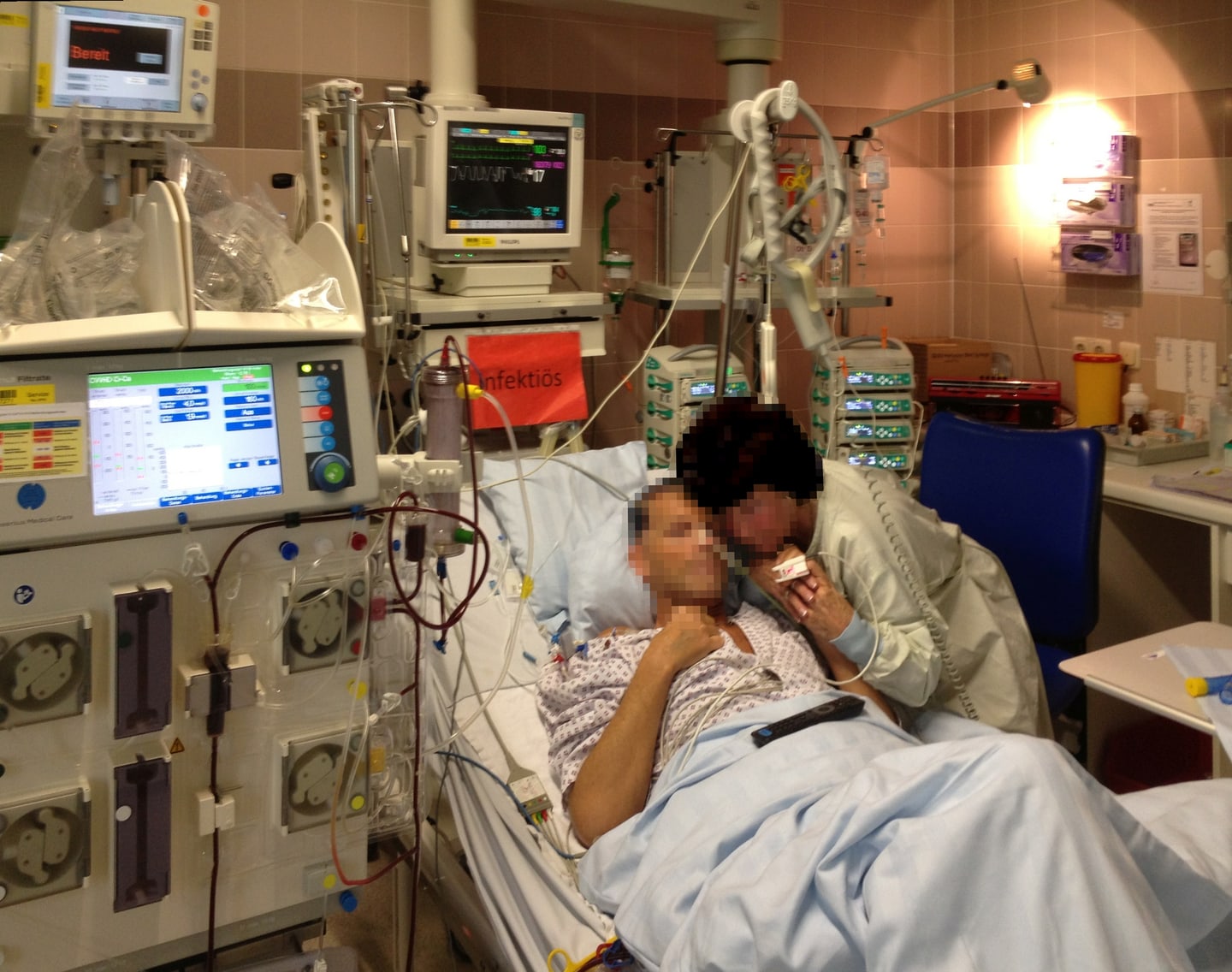
- Pittigrilli, intensive-care photograph, Germany (May 9, 2015), Wikimedia Commons — original image, description, and CC BY-SA 4.0 license.