A donor liver can spend the interval before transplantation doing something more revealing than waiting: it can metabolize. On a warm perfusion circuit, clinicians supply oxygen and nutrients, then watch how the organ responds. That creates an opportunity to learn about its function before a recipient depends on it. The difficult question is how much reassurance those measurements deserve.[1]
The answer begins with two jobs that can look identical from beside the machine. Preserving an organ means limiting injury. Assessing it means finding evidence that it can sustain a patient. A technique can improve preservation while still leaving gaps in assessment.
Why warming requires a circulation
Cold storage buys time by reducing the liver's metabolic demands. The organ is flushed with preservation solution and cooled, slowing the reactions that would otherwise consume its energy reserves. Cooling cannot supply oxygen, however. The interval without an adequate oxygen supply is called ischemia; restoring circulation can itself contribute to injury.[3][4]
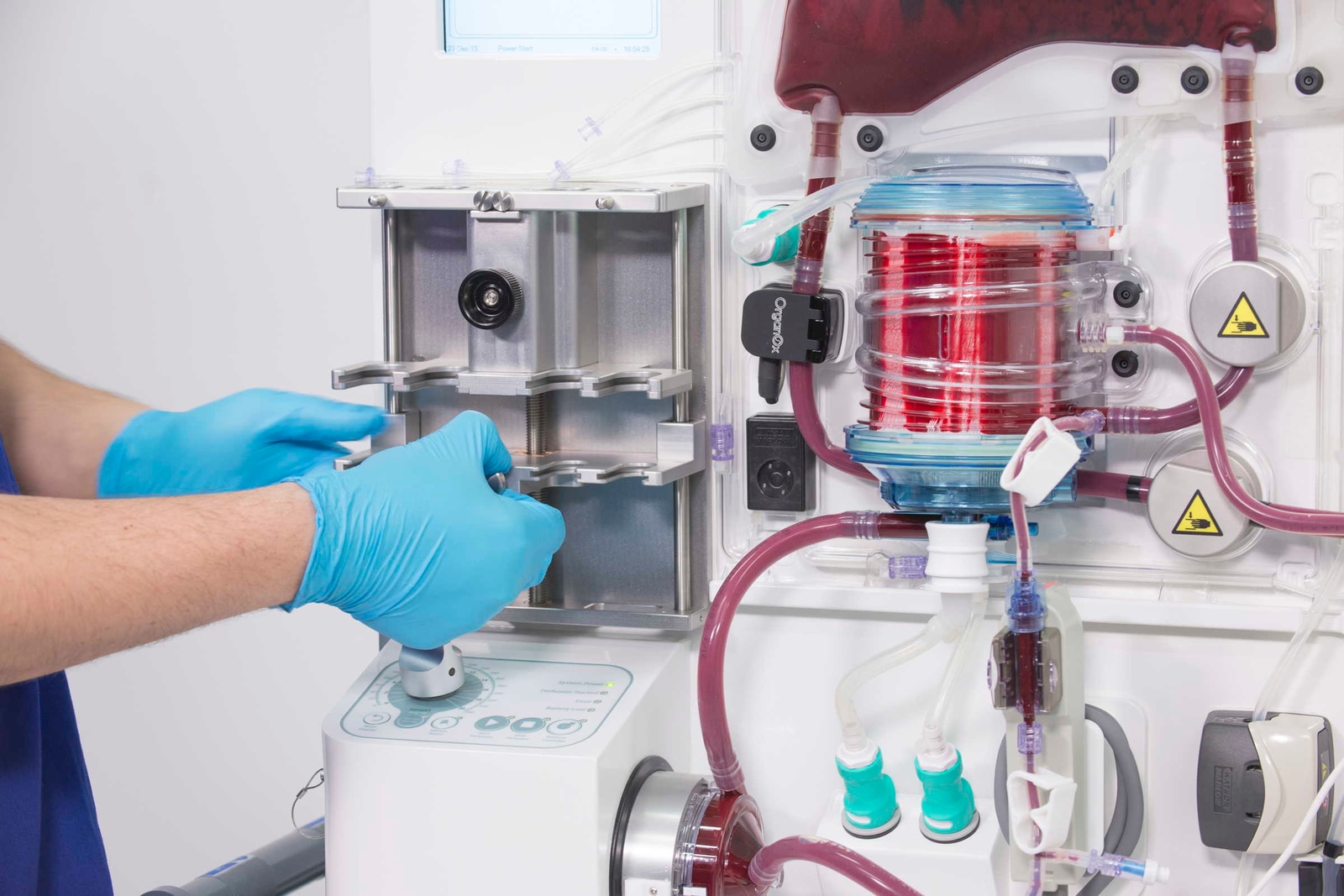
Warm perfusion changes both sides of that problem. It supports metabolism by delivering oxygen and nutrients through the liver's two incoming blood vessels, the hepatic artery and portal vein. Pumps, an oxygenator, temperature control, and a specially prepared circulating fluid take over selected functions normally supplied by the donor's body. At warm temperatures, the oxygen supply has to meet the organ's renewed demand.[3]
This is why temperature alone is a poor description of preservation. The 2019 Groningen trial protocol also described oxygenated perfusion at low temperature, followed by controlled rewarming and then warm assessment. Its sequence pursued different benefits at different stages: support cellular energy recovery while demand remained low, then examine function as metabolism increased. A cold organ on an oxygenated circuit and one resting in an ice box are undergoing different treatments.[3]
A blood test becomes a conversation with the organ
During warm perfusion, repeated samples reveal what the liver does to the fluid circulating through it. Lactate can fall as the organ metabolizes it. Glucose handling, acid–base balance, blood flow, and the appearance of the perfused tissue provide other observations. Their value comes from considering them together.[4][5]
The VITTAL study, published in June 2020, made that approach explicit. It assessed 31 previously discarded livers. Eligibility required lactate to fall to 2.5 mmol/L or less within four hours, plus at least two additional criteria from a set covering bile production, acid–base balance, glucose metabolism, flow, and tissue perfusion. Ultimately, 22 of 31 livers were transplanted, with all recipients and grafts surviving to 90 days.[4]
VITTAL was a single-center, nonrandomized study of selected organs and recipients. Its recovery rate cannot be applied to every discarded liver: selection helped determine the result. Each transplant decision still concerns a particular organ entering a particular patient.[4]
The bile ducts need their own evidence
Lactate is attractive because it is easy to follow. It is also an incomplete test. In Christopher Watson and colleagues' 2018 observational series, 46 of 47 perfused livers cleared lactate within three hours. A liver that subsequently suffered primary nonfunction had cleared it too. The authors pointed out that a liver's considerable metabolic capacity is being tested against a relatively small volume of circulating fluid.[5]
The bile ducts present another challenge. Their lining cells modify bile, including by secreting bicarbonate and reabsorbing glucose. Watson's group found that bile chemistry offered clues to duct integrity, while the amount of bile produced did not reliably distinguish good outcomes. These were observations requiring validation, not a universal acceptance rule.[5]
In a 2021 response to VITTAL, the Groningen investigators sharpened the distinction between evidence about liver cells and evidence about bile ducts. They described comparing bile chemistry with the circulating fluid to assess whether the duct lining was performing its work. Their argument was that a functioning liver could still carry injured ducts, and assessment needed to address both.[6]
VITTAL's later follow-up makes the concern tangible: four recipients developed biliary strictures requiring another transplant. A successful 90-day endpoint had not settled the longer-term fate of every graft.[4]
What the trials actually improved
The randomized European trial reported in April 2018 included 220 transplantations. Warm preservation produced approximately 50% less liver-cell injury, measured through enzyme release, despite a lower discard rate and longer preservation. The study found no significant difference in graft survival, patient survival, or bile-duct complications. Its headline percentage described an injury marker; it was not a halving of deaths.[1]
The 2022 PROTECT trial tested another portable system against static cold storage. Early graft dysfunction occurred in approximately 18% versus 31% of recipients in its primary analysis. Ischemic biliary complications at 12 months were also less frequent: 2.6% versus 9.9%. These findings extend the evidence beyond an enzyme measurement, but remain results of a specified device, protocol, and patient population. The manufacturer sponsored the trial and participated in its design and analysis.[7]
Timing helps explain why studies of “warm perfusion” need careful comparison. PROTECT began perfusion at the donor hospital; VITTAL assessed organs after transport in cold storage. Preventing additional injury earlier and evaluating an already injured organ later ask different things of a machine. Their results cannot establish that every perfusion sequence is interchangeable.[4][7]
For a transplant team, the useful change is access to an interval of supported, observable function. An organ that once had to be judged largely from its history and appearance can supply additional evidence. The responsibility then lies in interpreting that evidence at the right scale: a metabolic response, the health of different tissues, and ultimately the recipient's course after transplantation.[1][5][6]
Sources
- David Nasralla et al., “A randomized trial of normothermic preservation in liver transplantation,” Nature (April 18, 2018) — randomized preservation comparison, injury marker, organ use, and survival findings.
- University of Oxford, Department of Engineering Science, “Body temperature machine perfusion technique improves liver transplant success” (April 20, 2018) — source of the clinical photograph and its identification.
- Yvonne de Vries et al., DHOPE–COR–NMP trial protocol, BMJ Open 9:e028596 (August 15, 2019) — metabolic rationale, circuit design, oxygenation, and staged temperatures; institutional full-text PDF.
- Hynek Mergental et al., “Transplantation of discarded livers following viability testing with normothermic machine perfusion,” Nature Communications 11:2939 (June 16, 2020) — VITTAL selection criteria, study design, and early and later outcomes.
- Christopher J. E. Watson et al., “Observations on the ex situ perfusion of livers for transplantation,” American Journal of Transplantation 18:2005–2020 (2018) — lactate clearance, bile chemistry, and limitations; University of Cambridge repository.
- Otto B. van Leeuwen et al., “Hypothermic machine perfusion before viability testing of previously discarded human livers,” Nature Communications 12:1008 (February 12, 2021) — investigators' response concerning bile-duct assessment and perfusion sequence.
- James F. Markmann et al., OCS Liver PROTECT randomized clinical trial, JAMA Surgery 157:189–198 (January 5, 2022) — early graft dysfunction, biliary complications, donor-hospital perfusion, and sponsor involvement.