A swallowed button battery looks like a small-object problem. That is the wrong mental model. A coin cell lodged in a child's esophagus is dangerous because the wet tissue around it helps complete an electrical circuit. The battery does not need to leak. It does not need to crack. If it sits against the mucosa, current can generate hydroxide ions at the negative pole, creating a highly alkaline burn that can progress from irritation to liquefactive tissue injury in a frighteningly short window.[1][2]
That mechanism explains why button-battery guidance sounds so urgent. Poison Control's treatment guideline tells caregivers and clinicians not to wait for symptoms in young children, because patients with an esophageal battery may initially look well; it also warns that serious burns can occur in as little as 2 hours.[1] ACEP's pediatric emergency medicine review uses the same time frame and emphasizes that damage may keep progressing even after removal.[2] This is not a "watch and see if it passes" situation when the battery might be in the esophagus. It is a locate-it-now problem.
The timeline is a modern household story. In 2010, pediatric researchers were already warning that larger, higher-voltage lithium coin cells had changed the injury pattern.[1] In 2022, Reese's Law was signed after years of fatal and severe pediatric cases, aiming federal product rules at children six years old and younger.[5] By 2024, CPSC enforcement discretion had ended for many covered consumer products, pushing manufacturers toward secured compartments, abuse testing, and clearer warnings.[4] The clinical clock and the regulatory clock are linked: medicine can remove a lodged battery, but prevention has to keep the battery out of a toddler's reach in the first place.
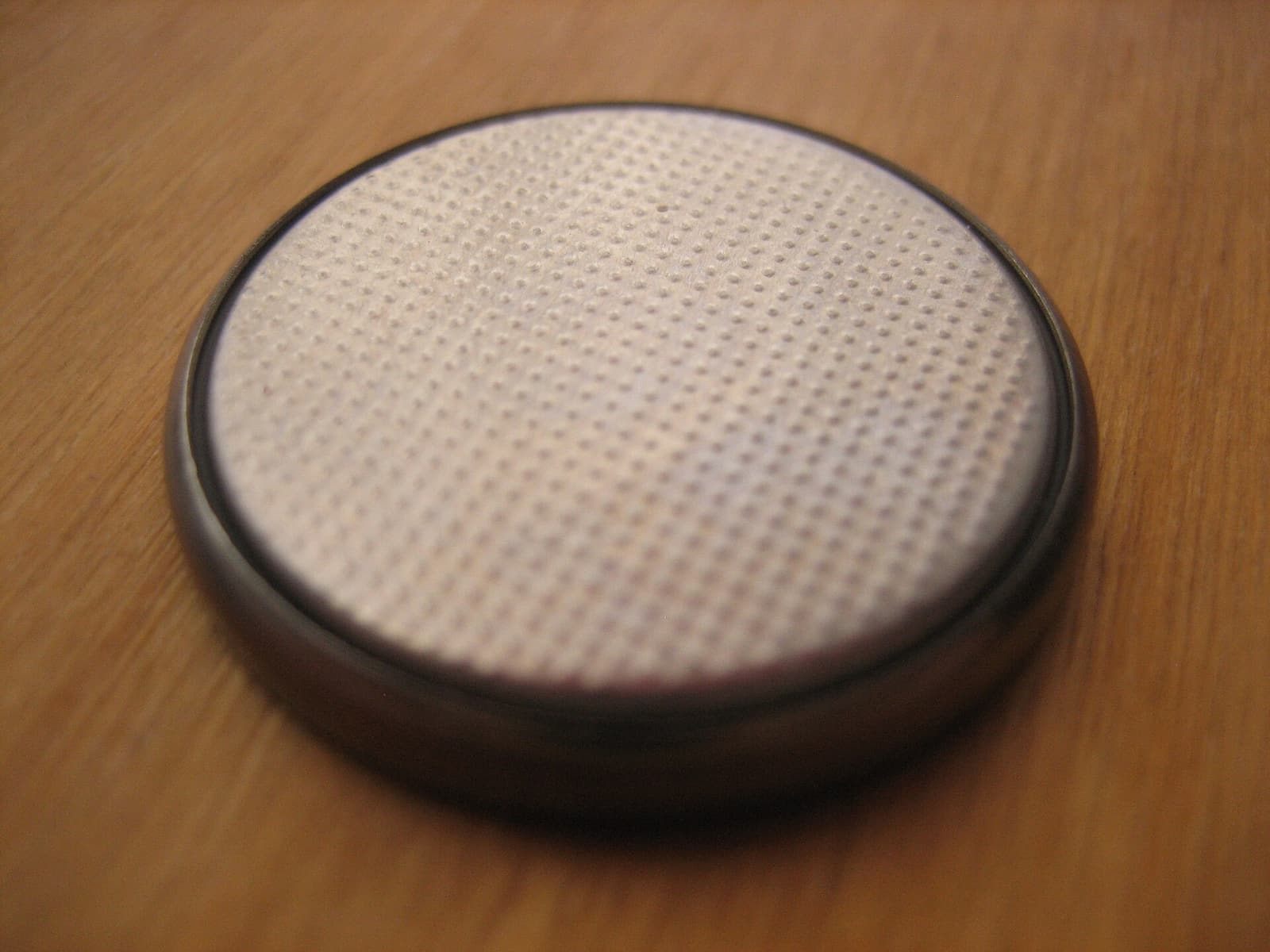
Image context: the cover uses a real Wikimedia Commons photograph of button cell batteries, originally posted to Flickr and reviewed as CC0.[6] The image is deliberately plain. The point is not drama; it is recognition. The object that can cause the emergency often looks like an ordinary spare part.
The injury is electrical before it is chemical
The common phrase "battery acid" points in the wrong direction. Button-battery esophageal injury is often not about acidic leakage. The more important pathway is electrochemical: a battery caught against moist tissue produces an external current, and the local reaction generates hydroxide. That raises pH at the contact surface and causes caustic alkaline injury.[1][2] Alkaline burns are especially destructive because they can penetrate tissue rather than staying as a shallow surface injury.
This is why location matters so much. A battery that has already passed into the stomach in an asymptomatic older child can sometimes be managed very differently from a battery stuck in the esophagus.[1][2] The esophagus is narrow, soft, close to the airway and major vessels, and not built to tolerate a current source pressed against it. The same object can therefore move from "monitor passage" to "emergent endoscopic removal" depending on where the x-ray places it.[1]
The worst mistake is to treat a swallowed button battery as if it were simply a coin. Poison Control tells clinicians to suspect a button battery in every presumed coin or foreign-body ingestion and to look for the double-rim or halo effect on frontal x-ray and the step-off on the lateral view.[1] ACEP similarly recommends two-view radiographs of the neck, chest, and abdomen when ingestion is suspected.[2] The imaging step is not procedural fussiness. It is how the care team finds out whether the child's esophagus is currently acting as part of the circuit.
The first two hours are not the whole risk
The two-hour warning is useful because it forces urgency, but it can create a second misunderstanding: that the risk neatly ends once the battery is out. Poison Control's guideline warns about delayed complications after esophageal injury, including perforation, tracheoesophageal fistula, vocal cord paralysis, strictures, and bleeding from proximity to major vessels.[1] ACEP makes the same point in plainer emergency-language terms: post-removal surveillance matters because damage can continue and delayed symptoms can be dangerous.[2]
That is the brutal part of the mechanism. The battery starts the injury; the injured tissue may keep declaring itself later. A child who looks better immediately after removal can still need observation, imaging, diet limits, repeat assessment, or specialty follow-up depending on the depth and location of injury.[1][2] The event is not finished at the moment the metal disc is retrieved. It is finished when clinicians are confident the esophagus, airway, and nearby vessels are not evolving toward a delayed complication.
The honey and sucralfate recommendations also make more sense through this mechanism. Poison Control advises honey only under defined conditions: the child is at least 12 months old, a lithium coin cell may have been swallowed, ingestion occurred within the prior 12 hours, the child can swallow, and honey is immediately available; the dose listed is 10 mL every 10 minutes, up to 6 doses, while en route to emergency care.[1] The same guideline is explicit that honey is not a substitute for immediate removal of an esophageal battery and should not delay going to the emergency department.[1] ACEP describes honey and sucralfate as adjuncts that may reduce tissue injury, not as definitive treatment.[2]
That boundary is essential. The home action is not "treat it yourself." It is "call Poison Control or emergency services, do not induce vomiting, and do not delay x-ray and removal if the battery is lodged."[1][2] The mechanism allows a temporary protective step in narrow circumstances, but the definitive intervention is still finding and removing the battery before the burn deepens.
The burden is large enough to justify product rules
The epidemiology explains why this is not just a rare emergency-room curiosity. Nationwide Children's Hospital's 2022 release on the Pediatrics study reported that, from 2010 to 2019, a U.S. child younger than 18 visited an emergency department for a battery-related injury about every 75 minutes, more than twice the frequency found in the prior 1990-2009 study window.[3] Among cases where battery type was known, button batteries were involved in about 85%; 84% of patients were age 5 or younger; ingestions accounted for 90% of battery-related ED visits; and 12% of exposures required hospitalization, up from 7% in the earlier comparison period.[3]
Those numbers matter because household exposure is diffuse. The battery may sit in a remote control, thermometer, key fob, tea light, hearing aid, bathroom scale, greeting card, toy, watch, glucose meter, or tracker. A caregiver may not know which object opened, which battery is missing, or when the ingestion happened. That is why both clinical and regulatory guidance focus on uncertainty. Poison Control's rule for children 12 years and younger is immediate x-ray when ingestion is suspected.[1] CPSC's product rules focus on compartments and warnings because the safest esophageal battery is the one a child never accesses.[4]
Reese's Law translates that clinical logic into design. CPSC's business guidance says covered products containing or designed to use button cell or coin batteries must meet ANSI/UL 4200A-2023, with replaceable battery compartments secured by a tool or by two independent simultaneous hand movements, abuse testing that prevents access or liberation, warnings on packaging, warnings on the product where practicable, and warning language in instructions and manuals.[4] Separate packaging rules require child-resistant packaging for button cell or coin batteries sold or included separately with products.[4]
The Federal Register rule explains the target plainly: reduce the risk of ingestion injury in children six years old and younger.[5] It also gives the warning sentence that captures the emergency mechanism for consumers: a swallowed button cell or coin battery can cause internal chemical burns in as little as 2 hours.[5] That sentence is not there to make packaging look cautious. It is an attempt to put the esophageal clock on the box before the box enters a kitchen drawer.
The practical lesson is recognition plus friction
Button-battery safety has two layers. The first is recognition under uncertainty. If a child may have swallowed a button battery, especially a young child or any child with drooling, vomiting, cough, chest discomfort, trouble swallowing, noisy breathing, refusal to eat, or a presumed coin ingestion, the safer assumption is that this needs urgent expert guidance and imaging.[1][2] Symptoms can be vague, and serious ingestions are often unwitnessed.[1][2]
The second layer is friction before the event. Product compartments that require a tool or two coordinated motions are not perfect, but they convert curiosity into a harder task.[4] Child-resistant packaging does the same for loose replacement cells.[4] Safe storage of spare and spent batteries matters because used lithium coin cells can still hold enough charge to injure tissue. The household habit should be boring and strict: know which devices contain coin cells, secure the compartments, store spares out of reach, and dispose of spent cells promptly.
The causal chain is short enough to remember. Access creates opportunity. Swallowing creates uncertainty. Lodging in the esophagus creates a circuit. Current creates hydroxide. Hydroxide creates alkaline burn. Delay creates deeper injury. X-ray breaks uncertainty; endoscopic removal breaks contact; surveillance watches for the injury that may keep unfolding.[1][2]
That is why a button battery should not be filed mentally beside beads, coins, or small toy parts. It is a powered object that can turn tissue into part of its electrical path. The danger is not its size alone. The danger is that its smallness makes it easy to lose, easy to swallow, and easy to underestimate until the clock is already running.[1][3][5]
Sources
- National Capital Poison Center, "Button battery ingestion triage and treatment guideline" - clinical triage, x-ray, honey/sucralfate, removal, and delayed-complication guidance.
- American College of Emergency Physicians, "Button Battery Ingestions: Small Object, Big Danger" (July 22, 2025) - pediatric emergency mechanism and management overview.
- Nationwide Children's Hospital, "New Study Finds Battery-Related Injuries in Children More than Doubled in Recent Decade" (Aug. 29, 2022) - accessible summary of the Pediatrics 2010-2019 ED-visit study by Safe Kids Worldwide and Nationwide Children's Hospital researchers.
- U.S. Consumer Product Safety Commission, "Button Cell and Coin Battery Business Guidance" - Reese's Law implementation, ANSI/UL 4200A-2023, secured compartments, testing, warnings, and packaging requirements.
- Federal Register, "Safety Standard for Button Cell or Coin Batteries and Consumer Products Containing Such Batteries" (Sept. 21, 2023) - rule text and Reese's Law warning-label rationale.
- Wikimedia Commons, "File:Button Cell Battery Grid (30089491251).jpg" - source page for the real button-cell photograph used as the article image.