The question "where did the 1918 influenza pandemic begin?" sounds crisp because it compresses three different problems into one sentence: the earliest recognizable spring outbreak, the place where the virus acquired pandemic fitness, and the transport system that turned local transmission into a global event. Once those layers are separated, the debate becomes less theatrical and more historically useful.[1][3][5]
That is why the literature never really converged on one clean birthplace. Kansas, northern France, and a few wider wartime routes all remain in the conversation, but they do not all claim the same thing. Some arguments identify the first traceable human outbreak; others try to identify an earlier staging ground where avian and mammalian influenza viruses mixed under wartime crowding before 1918 entered the record as a named pandemic.[1][3]
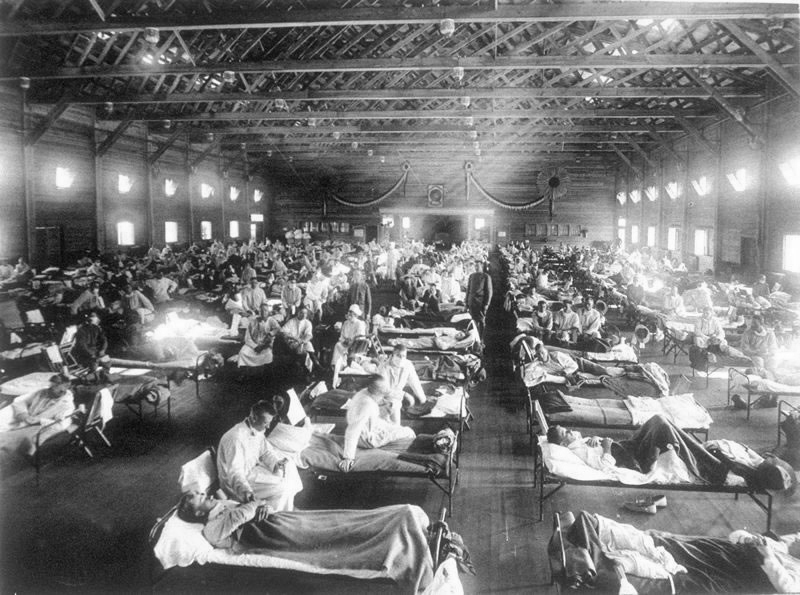
Image context: the cover photograph shows the emergency hospital at Camp Funston, Kansas, during the 1918 influenza outbreak. It fits this article because Camp Funston remains the strongest candidate for the first well-documented spring 1918 amplification point, even though the deeper origin of the pandemic virus still sits beyond firm proof.[6]
Timeline anchors: the argument changes depending on where the clock starts
- Winter 1915-1916: severe respiratory disease appeared in the crowded military camp and hospital complex at Etaples in France; later historians treated that episode as a candidate precursor rather than a proven pandemic origin.[3]
- 1916-1917: similar discussion attached to British military outbreaks such as Aldershot, again as possible warning signals rather than settled starting points.[3]
- Late January to February 1918: John M. Barry's reconstruction places an unusual influenza-like outbreak in Haskell County, Kansas, before the Army's large spring wave.[1]
- March 4, 1918: the first officially recorded Camp Funston influenza cases appeared; within weeks, the Army camp's scale and troop movement gave the outbreak national and transatlantic reach.[1][2]
- Late August to September 1918: the far more lethal autumn wave emerged, making clear that the spring outbreak had been only one phase of a larger pandemic process.[2][5]
Those anchors matter because they expose the core historiographical split. If origin means the first large, documented, exportable human outbreak, Kansas is hard to beat. If origin means an earlier ecological or military staging ground where a pandemic-capable virus was taking shape, the record becomes murkier and France enters more forcefully.[1][3][5]
Interpretation A: Kansas and Camp Funston are the strongest claim for the first documented pandemic wave
Barry's Kansas argument remains influential because it is built on traceable public-health and local-reporting links rather than retrospective romance.[1] He reconstructs a chain running from Haskell County, where physician Loring Miner noticed an unusually severe influenza-like illness in early 1918, to Camp Funston, where tens of thousands of soldiers were moving through one of the largest Army training sites in the United States.[1] Once the disease reached that scale, the war provided the rest of the machinery: troop trains, embarkation ports, and transatlantic movement.
The CDC's own 1918 history preserves the operational side of that case.[2] Camp Funston's March 1918 outbreak sits at the head of the recognized U.S. wave, and the spring spread moved rapidly through military camps before appearing in Europe. That does not prove Kansas was the place where every relevant viral change occurred. It does show that Kansas is the best-documented point where an outbreak clearly entered a transmission network capable of continental export.[1][2]
This interpretation is strongest when the historian defines origin as the first outbreak that can be followed with real epidemiological confidence. It weakens when the question shifts from "where was the first documented spring wave?" to "where did the pandemic virus become pandemic?" That deeper virological question does not yield as easily to county reports and Army logs.[1][5]
Interpretation B: Etaples may preserve an earlier precursor environment, not a settled birthplace
The Etaples argument stays alive because the camp had many of the ingredients later historians look for in influenza emergence: huge troop density, nearby pigs and poultry, stressed hosts, and recorded respiratory disease with cyanosis and severe pulmonary involvement before 1918 became globally legible.[3] Oxford and colleagues argue that these wartime camp outbreaks deserve attention because the clinical descriptions and ecological setting look unusually compatible with an influenza precursor.
That is a serious claim, but it remains a precursor claim rather than a solved origin.[3] The gap is evidentiary. Historians and virologists do not have preserved viral material from Etaples in 1916 that can be sequenced against the 1918 pandemic virus. What remains are case descriptions, military context, and retrospective reasoning from compatible symptoms and conditions. That is enough to keep Etaples in the frame. It is not enough to push Kansas out of it.
The practical difference is important. Camp Funston has clearer outbreak documentation in the pandemic year itself. Etaples has a plausible ecological and clinical setup for earlier emergence, but the paper trail does not connect that setting directly to the spring 1918 chain with the same degree of confidence.[1][2][3]
Why the China-labour-corps route no longer carries the same weight
A third line of argument gained attention when Mark Humphries linked the Chinese Labour Corps and a severe 1917 respiratory episode in northern China to the eventual 1918 pandemic. That interpretation mattered because it offered a wartime migration route that could bridge East Asia and Europe without forcing the story through Kansas.[4][5]
The later pushback has been substantial. Shanks's review in the Journal of the Chinese Medical Association concluded there is no convincing evidence that Chinese laborers or soldiers in France were the source of the 1918 pandemic virus.[4] More recent broader reviews still treat the pandemic's geography as unresolved, yet they no longer give the China-labour-corps theory the same standing as the Kansas documentation or the Etaples precursor hypothesis.[4][5] In historiographical terms, the idea did useful work by widening the map, but it no longer functions as one of the two strongest interpretations.
What "origin" means in 2026: first signal and true origin have to be kept apart
The most durable lesson from the debate is definitional discipline. Taubenberger and Morens emphasize that the ancestral path of the 1918 virus remains obscure even after decades of molecular and archival work.[5] Modern influenza scholarship can say a great deal about the virus's exceptional lethality, its avian links, and its later descendants. It says much less with certainty about the exact place where the crucial reassortment or adaptation steps occurred.[5]
That is why a narrow 2026 judgment works better than a grand one. Kansas remains the strongest answer to the question of the first well-documented, spring 1918 outbreak that entered a global war transport network.[1][2] Etaples remains a serious candidate for an earlier precursor environment that helps explain how such a virus could have been incubated under wartime conditions.[3] The deeper evolutionary origin still sits outside clean proof.[5]
The historiography is therefore less a contest over one pin on a map than a contest over the level of explanation. Public memory often wants a birthplace. The sources support a layered answer: first documented amplification in Kansas, credible precursor discussion in wartime France, and no final closure on the older virological origin.[1][3][5]
Sources
- John M. Barry, The site of origin of the 1918 influenza pandemic and its public health implications (Journal of Translational Medicine, 2004) — the Haskell County to Camp Funston reconstruction.
- Centers for Disease Control and Prevention, "1918 Pandemic (H1N1 virus)" — CDC historical overview anchoring the March 1918 Camp Funston outbreak and later wave structure.
- J. S. Oxford, R. Lambkin, A. Sefton, R. Daniels, P. Elliot, N. Brown, and D. Gill, A hypothesis: the conjunction of soldiers, gas, pigs, ducks, geese and horses in northern France during the Great War provided the conditions for the emergence of the 'Spanish' influenza pandemic of 1918-1919 (Vaccine, 2005) — the Etaples precursor argument.
- G. Dennis Shanks, No evidence of 1918 influenza pandemic origin in Chinese laborers and soldiers in France (Journal of the Chinese Medical Association, 2016) — critique of the Chinese Labour Corps origin theory, via PubMed.
- David M. Morens and Jeffery K. Taubenberger, The mother of all pandemics is 100 years old (and going strong)! (American Journal of Public Health, 2018) — why the pandemic's deeper evolutionary origin remains unresolved even after modern molecular work.
- Wikimedia Commons, "File:CampFunstonKS-InfluenzaHospital.jpg" — archival photograph of the Camp Funston emergency hospital used as the article image.