Cortisone entered medical memory as a miracle shot for rheumatoid arthritis. That memory preserves something true, but not enough. In September 1948, when Philip Hench and colleagues at Mayo gave Compound E to a young woman with severe rheumatoid arthritis, the result was dramatic because the disease suddenly looked reversible on a timescale many clinicians had not seen before.[1][2][3] Pain, stiffness, and swelling that had seemed baked into the patient's ordinary life began to recede over days, not months.[1][2]
The more useful reconstruction is sharper and less triumphant. Cortisone changed the field twice. First, it made inflammatory suppression visible with unusual speed. Second, almost immediately, it forced a harder question: what happens after the first astonishment? Rheumatoid arthritis is a chronic disease. A drug that can produce spectacular early relief still has to survive dose planning, supply limits, toxicity, tapering, comparison against older treatments, and the politics of publicity.[1][3][4] By 1954, that second question had become impossible to ignore. British trialists could report that in early cases there was "surprisingly little to choose" between cortisone and aspirin as long-run management tools, a line that did not erase the breakthrough but did puncture the simpler miracle story.[4]
That is why this episode still reads clearly in 2026. Cortisone's importance lies less in proving that inflammation can be switched off, we now take that for granted, than in showing how fast a dramatic biological effect can run ahead of a durable treatment strategy.[1][3][4][6]
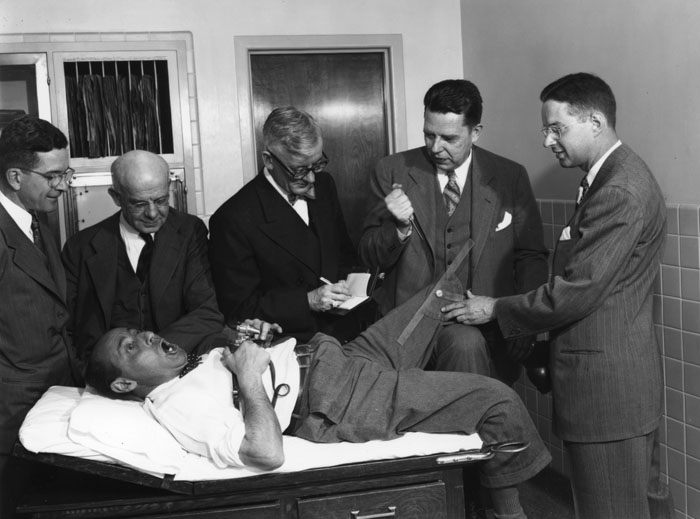
The cover image keeps the story attached to that threshold. It uses the May 11, 1949 Saint Mary's Hospital photograph preserved by the McGovern Historical Center: Hench, Edward Kendall, Charles Slocumb, Howard Polley, and colleagues staging a cortisone-era mobility examination for a Life photographer.[5] The image belongs here because the cortisone event was never only chemical. It was clinical theater, joint measurement, media attention, and the first public realization that rheumatoid arthritis might move backward.
Timeline anchors before the legend hardens
- 1929: Hench observed a striking temporary remission of rheumatoid symptoms in a patient who developed jaundice, the beginning of his long search for an "antirheumatic substance" that could reverse inflammation rather than merely soothe pain.[2][3]
- 1931 onward: he extended the same line of observation to pregnancy, noting that rheumatoid symptoms could soften there too, which pushed him toward a hormonal explanation rather than a simple liver-specific one.[2][3]
- September 4, 1948: Hench wrote to Merck seeking permission to use what researchers still called Compound E in a patient with severe rheumatoid arthritis.[1]
- September 21, 1948: Hench and Charles Slocumb gave 100 mg of Compound E to the 29-year-old patient later referred to as Mrs. G, the first therapeutic use of the substance in rheumatoid arthritis.[1][2]
- September 23-24, 1948: retrospective accounts record visible improvement within about 48 to 72 hours, the moment the Mayo team knew they were looking at more than a routine fluctuation.[1][2]
- May 11, 1949: the Mayo group staged the now-famous Saint Mary's Hospital demonstration photograph during the first wave of national media fascination with cortisone.[5]
- 1950: Hench, Edward Kendall, and Tadeus Reichstein received the Nobel Prize in Physiology or Medicine for work on adrenal cortex hormones and their biological effects, with rheumatoid arthritis treatment central to the public meaning of the award.[6]
- May 29, 1954: a British Medical Research Council and Nuffield Foundation report comparing cortisone with aspirin in 61 early rheumatoid cases concluded that there was little practical difference between the two in first-year management, shifting attention toward boundaries and tradeoffs.[4]
Those dates show why 1948-1954 is the right frame. The real story is not one injection on one day. It is the short sequence in which cortisone moved from startling bedside reversal to a much rougher argument about chronic treatment.
1. Before cortisone, Hench was hunting reversibility itself
Rheumatoid arthritis had long been treated as a condition to be endured, moderated, and observed rather than rapidly reversed. The disease hurt, deformed joints, and narrowed ordinary motion over years. Within that older frame, Hench's first real breakthrough was conceptual before it was pharmacologic.[2][3] He became convinced that rheumatoid inflammation could, under some circumstances, retreat quickly.
The BMJ remembrance by John Glyn captures the hinge cleanly. Hench began in 1929 after watching one patient's rheumatism subside during jaundice, then kept seeing variants of the same pattern in later years.[3] The Clinical Methods chapter preserves Hench's own retrospective language from that period: contrary to the belief of centuries, rheumatoid arthritis appeared "potentially reversible, and rapidly so."[2] That sentence matters because it defined the target long before cortisone was available. Hench was not merely waiting for any anti-inflammatory compound to fall into his lap. He was trying to identify the physiologic condition under which the disease seemed to withdraw.
Pregnancy complicated and strengthened the hunch.[2][3] When rheumatoid symptoms also improved there, the explanatory field widened. The key factor could not be something unique to diseased livers if women with pregnancy remissions showed a similar pattern. Hench gradually turned toward the adrenal cortex and toward the possibility that some hormone state might suppress both inflammatory and allergic phenomena.[2][3]
That long prehistory is easy to flatten once the word cortisone arrives. It should not be flattened. The dramatic effect of Compound E in 1948 mattered because Hench had spent nearly 19 years training himself to recognize a reversible pattern and to treat rapid remission as biologically plausible rather than as coincidence.[2][3]
2. September 1948 changed what doctors could see at the bedside
The first treatment scene was shaped by scarcity as much as by insight. Kendall's adrenal-cortex work had yielded only tiny amounts of usable material for years, and Mayo's own 1950 historical summary still presents the moment as contingent: Hench wrote to Merck on September 4, 1948, asking permission to use the experimental compound in a patient disabled by rheumatoid arthritis, and permission was granted.[1] Enough of the substance finally existed to try the hypothesis in a clinic rather than only in thought.
The first patient was Mrs. G, a 29-year-old woman with severe rheumatoid arthritis.[1][2] On September 21, Hench and Slocumb administered 100 mg of Compound E.[1][2] The striking part of the episode is not simply that the drug worked, but how quickly the meaning of "worked" became visible. The Mayo historical account says that by the third day only a few symptoms remained.[1] The Clinical Methods chapter gives the scene even more texture through Polley and Slocumb's recollection: by the evening of September 23 the first patient felt better, and the effect held strongly enough that Hench had to see her before leaving Rochester for England.[2]
This was the first threshold. Cortisone turned rheumatoid arthritis from a slow observational disease into something that could change in front of the team. Swollen joints, painful range of motion, and exhausted posture were no longer only baseline descriptors. They became variables that could move fast under one intervention.[1][2][3]
It is worth resisting modern hindsight here. The first observation did not yet prove safe chronic treatment, and it certainly did not amount to cure. But it did something just as consequential for the field's intellectual history. It made inflammatory disease look experimentally governable at the bedside. The body stopped behaving as if rheumatoid suffering could only be measured in decline curves and convalescent plateaus. Suddenly it had an off-switch, or something close enough to one to scramble the expectations of everyone in the room.[1][2]
3. The miracle label arrived before the treatment problem was solved
The second phase began almost immediately: publicity. Glyn says Hench tried to hold the story inside Mayo until the implications and complications were better understood, but that effort failed because dramatic responses are difficult to contain.[3] Long-bedridden patients attempted to dance. One woman reportedly took multiple baths in a single day to make up for years of physical restriction.[3] Those stories were irresistible because they converted hormone chemistry into visible human release.
By May 1949, the event had become photographic as well as clinical. The McGovern Historical Center's Saint Mary's Hospital image shows the Mayo group measuring joint movement on a Life magazine photographer as part of cortisone's early public staging.[5] That picture matters because it reveals the exact form of persuasion at work. Cortisone did not first persuade by laboratory abstraction. It persuaded by motion regained, angle measured, swelling reduced, and authority figures gathered around a body that could now do what it could not do before.
Yet the Mayo 1950 account already hints at the deeper instability. More patients followed, but so did "increasing refinement" in how the drug had to be administered and how its side effects had to be controlled.[1] That phrase is the whole post-miracle problem in miniature. Once a treatment is dramatic, the next task is discipline. Who should receive it, at what dose, for how long, at what cost in adverse effects, and with what expectations when the disease is chronic rather than acute?[1][4][6]
This is why the title uses the phrase "steroid threshold." The early cortisone story was not a simple finish line. It was the crossing into a new therapeutic era whose rules had not yet been stabilized.
4. By 1954 the argument had shifted from astonishment to management
The British Medical Research Council and Nuffield Foundation trial is historically valuable because it forced the field to live beyond the first glow.[4] Instead of asking whether cortisone could produce dramatic improvement in some patients, the trial asked how cortisone compared with aspirin as an adjuvant in the management of early rheumatoid arthritis under first-year conditions. That is a stricter and more chronic question.
The result was sobering in exactly the way a mature field needs. The report said there was "surprisingly little to choose" between cortisone and aspirin in these early cases.[4] In other words, the short-run spectacle of steroid response did not automatically settle the longer-run comparative problem. A drug can be biologically spectacular and strategically limited at the same time.
That conclusion did not prove cortisone had been overhyped in a trivial sense. The article should not be read that way. The first Mayo patients and the later British trial were not asking identical questions.[1][4] The 1948-1949 episodes were threshold events that made a new type of inflammatory control visible. The 1954 comparison was a management question inside a chronic disease, where dose maintenance, tapering, side effects, and practical equivalence against older therapies mattered. Those are different evidentiary tasks.
What changed between them was the unit of judgment. In 1948, the relevant unit was: can severe rheumatoid inflammation fall quickly under this hormone? By 1954, the relevant unit had become: can this hormone carry ordinary long-run rheumatoid care better than the best available alternatives, and at an acceptable price?[4] The history grows clearer, not weaker, when those units stay separate.
Why the cortisone threshold still matters in 2026
Cortisone remains such a sharp health story because it shows medicine discovering a powerful mechanism before it fully masters the consequences of using it.[1][3][4][6] The first rheumatoid-arthritis treatments worked well enough to transform clinical imagination and public expectation almost overnight. They also forced clinicians to learn, quickly, that chronic inflammatory disease cannot be governed by drama alone.
That pattern has repeated across modern medicine. A therapy can announce itself through astonishing early responses, then spend years being resized by dose discipline, comparative trials, toxicity, and better definitions of who actually benefits. Cortisone did not fail because later medicine became more cautious about steroids. It succeeded so dramatically that caution became unavoidable.[1][4][6]
The best way to remember the first cortisone moment, then, is not as the day rheumatoid arthritis was solved. It is as the week rheumatoid arthritis stopped looking irreversible, and the next six years in which physicians had to figure out what to do with that revelation.
Sources
- Mayo Clinic, "1950: Mrs. G Gets Compound E" - official Mayo history of the first rheumatoid-arthritis cortisone treatment, including Hench's September 4, 1948 request to Merck, the September 21 first 100 mg administration to Mrs. G, the rapid early response, and the immediate need to refine dosing and side-effect control.
- Charles Stewart Roberts, "The Musculoskeletal System: Hench at the Mayo Clinic" in Clinical Methods (NCBI Bookshelf) - historical chapter preserving the 19-year reversibility hypothesis, the role of jaundice and pregnancy observations, and Polley/Slocumb's retrospective account of the first patient's response.
- John H. Glyn, "The discovery of cortisone: a personal memory" (BMJ, 1998; PMC full text) - retrospective narrative on Hench's 1929 jaundice observation, the search for an "antirheumatic substance X," the dramatic early patient responses, and the later British challenge.
- Joint Committee of the Medical Research Council and Nuffield Foundation, "A Comparison of Cortisone and Aspirin in the Treatment of Early Cases of Rheumatoid Arthritis" (British Medical Journal, 1954; James Lind Library PDF) - first-year comparative report on 61 early rheumatoid cases concluding there was surprisingly little to choose between cortisone and aspirin in practical management.
- McGovern Historical Center, "Cortisone" - archival note identifying the May 11, 1949 Saint Mary's Hospital photograph of Hench, Kendall, Slocumb, Polley, and colleagues demonstrating cortisone-era joint assessment for a Life photographer.
- Nobel Prize Outreach, "Philip S. Hench - Facts" - official Nobel record on the 1950 prize motivation and the role of adrenal-cortex hormones in late-1940s rheumatoid-arthritis treatment.