Over-the-counter continuous glucose monitors have made one medical graph newly portable. A person can now buy a sensor, stick it on an arm, and watch a phone fill up with glucose points all day long. The seductive story is obvious: at last the body is speaking plainly. Breakfast becomes a curve. A workout becomes a dip or rebound. A late dinner becomes a trace you can screenshot and judge. The harder truth is that a CGM was not built as a general-purpose lie detector for metabolism. It was built first for diabetes care, where the question is not whether glucose moves after eating, but how to manage a condition in which glucose regulation is impaired.[1][2]
That difference sets the boundary for healthy or merely curious users in 2026. A CGM can be a useful pattern-feedback device. It can show timing, direction, and variability better than an occasional finger-stick. It can also tempt people into reading too much certainty into an estimate that comes from interstitial fluid rather than direct blood, into treating any short-lived rise as pathology, or into assuming that consumer access proves a health benefit that the literature has not yet established outside diabetes.[1][2][4][5]
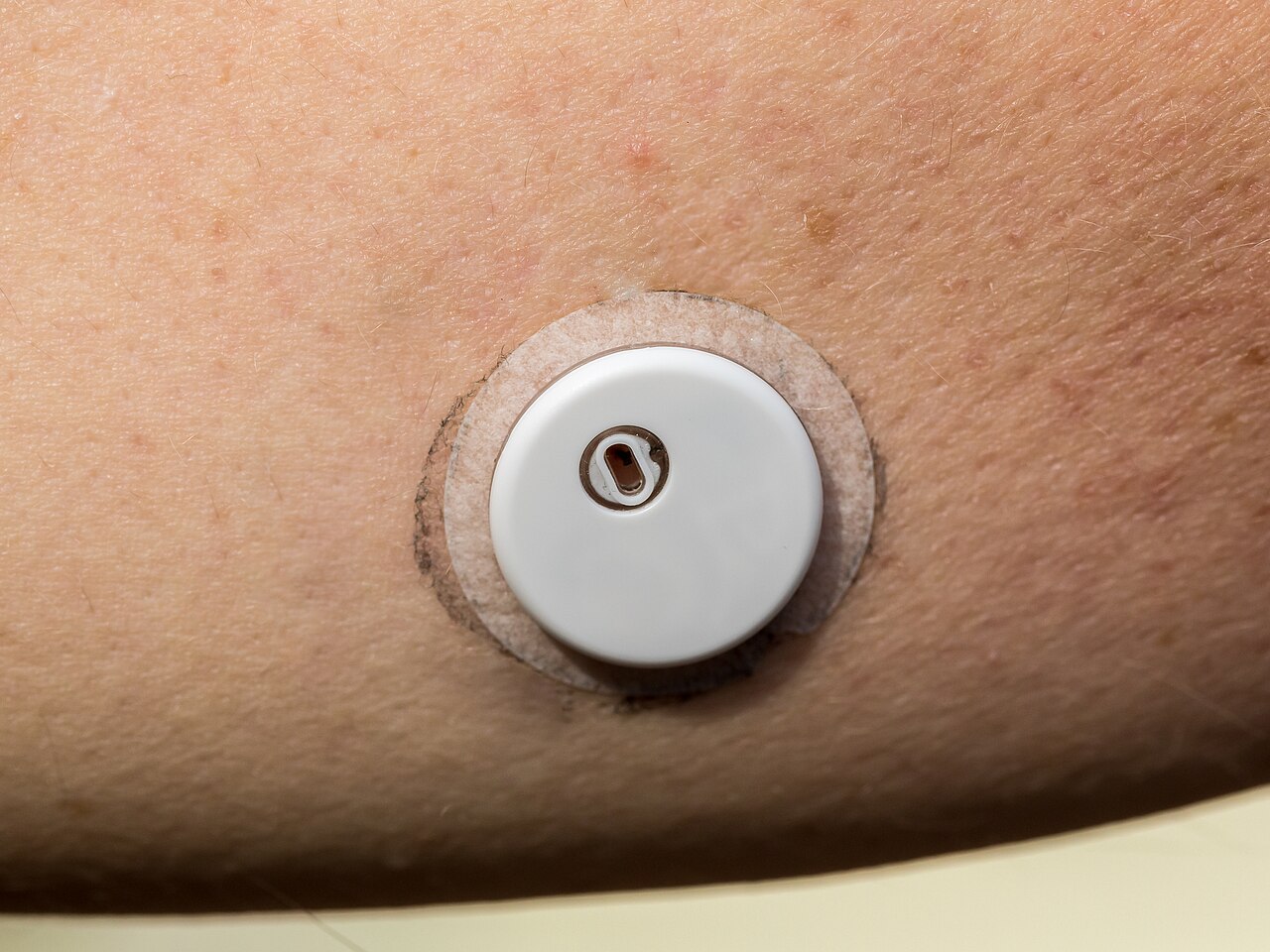
Image context: the cover uses a real Wikimedia Commons photograph of an Abbott Freestyle Libre 3 sensor worn on an upper arm.[6] That choice matters because the article is about the authority of a specific object. CGMs persuade people by being physically attached, always on, and numerically precise-looking, even when the interpretation still depends on physiology, timing, and the question being asked.
Time anchors before the myths
- June 2023: NIDDK's CGM explainer described the core mechanism plainly: these devices estimate glucose every few minutes from the fluid between cells, not from direct blood sampling, and users may still need finger-stick comparison for safety in some situations.[1]
- March 5, 2024: FDA cleared the first over-the-counter CGM, Dexcom Stelo, for adults 18 years and older who do not use insulin, including people without diabetes who want to understand how diet and exercise affect glucose. FDA also said the system is not for people with problematic hypoglycemia and that users should not make medical decisions from the output without talking to a clinician.[2]
- January 2025: a systematic review on CGM use in people without diabetes concluded that data in this population are still scarce and that effects on cardiovascular outcomes remain unclear.[4]
- August 12, 2025: a healthy-adult observational study using one week of CGM, actigraphy, and food diaries found moderate correlations between meal glycemic load and several CGM metrics in 48 participants, showing that the trace can reflect diet patterns without turning those patterns into a diagnosis by itself.[5]
Those dates matter because they keep the conversation in the right order. Access broadened first. Physiologic interpretation was already complicated. Outcome evidence outside diabetes is still catching up.
Myth 1: "The number on the screen is my blood sugar, directly and in real time"
It is an estimate, and the site of measurement matters.
NIDDK says a CGM estimates glucose every few minutes from the fluid between your cells, which is "very similar" to the glucose level in your blood.[1] "Very similar" is not the same thing as identical, and it is not the same thing as laboratory measurement. FDA's broader blood-glucose guidance makes the practical point from another angle: results from sites away from the fingertip can become inaccurate when glucose is changing rapidly, such as just after eating or exercising.[3] That is one reason NIDDK says users may sometimes need to compare a CGM reading with a finger-stick result if accuracy is in doubt.[1]
This does not make a CGM useless. It clarifies what kind of tool it is. CGMs are excellent at showing direction, pace, and pattern density across a day. They are less useful when a wearer mistakes a single plotted point for an unquestionable piece of direct blood chemistry. The first thing a healthy user should understand is not how colorful the app is, but that the device is reading a nearby physiologic compartment and converting that signal into a glucose estimate.[1][3]
FDA's OTC clearance notice reinforces the same boundary in consumer language. The Stelo system records and displays glucose values every 15 minutes in an app, yet FDA still says users should not make medical decisions from that output without consulting a healthcare provider.[2] A graph can arrive frequently and still remain an estimate whose meaning depends on context.
Myth 2: "If I see a spike, I have discovered a harmful food or a broken metabolism"
A rise after eating is not news by itself. Human glucose is supposed to move.
FDA's blood-glucose page states that for an adult without diabetes, fasting blood glucose is below 100 mg/dL, and the level is below 140 mg/dL two hours after meals.[3] That reminder matters because many first-time CGM users meet normal physiology as if it were pathology. They see movement and assume malfunction. But the body is not designed to produce a flat line after food, stress, sleep loss, or exercise. The better question is not whether a line rose; it is how far, for how long, under what conditions, and in whom.
The 2025 healthy-adult diet-monitoring study is useful precisely because it stays modest.[5] Across a week of monitoring in 48 healthy participants, glycemic-load estimates from food diaries showed only moderate positive correlations with several CGM metrics, including area under the curve and variability measures.[5] That is enough to say the device can register something real about meal composition. It is nowhere near enough to say that one tall breakfast curve means a specific food is universally "bad," or that an isolated excursion amounts to a diagnosis.
What a healthy trace often reveals is variation, not disease. One night's poor sleep, a hard workout, a larger meal, or a delayed lunch can all change the picture. A CGM can expose that life is dynamic. It cannot, by itself, decide which fluctuations are clinically meaningful and which are ordinary metabolic traffic.
Myth 3: "Because CGMs are now sold over the counter, the benefit for healthy users must already be proven"
Regulatory access and clinical-outcome proof are different achievements.
FDA cleared OTC access in 2024 for a defined consumer group: adults 18+ not using insulin.[2] That decision says the agency found the product suitable for marketing within its labeled use. It does not mean randomized trials have already shown broad health improvement in otherwise healthy users. FDA's own announcement is careful: the system is not intended for people with problematic hypoglycemia, and users should not make medical decisions from the readings without professional input.[2]
The published evidence base remains narrower than the marketing atmosphere around these devices. The 2025 systematic review on people without diabetes says the data are scarce and that the effect on cardiovascular outcomes is unclear.[4] That is a fair summary of the current boundary. There is interest, feasibility, and a plausible behavior-feedback mechanism. There is not yet a mature body of evidence proving that widespread CGM use by healthy adults produces durable outcome gains on the far side of curiosity.
This is also where the phrase "diabetes-first evidence" matters. NIDDK's own CGM page is framed around diabetes management and identifies the clearest beneficiaries as people using insulin or otherwise adjusting diabetes care.[1] That is where the strongest target structures, action thresholds, and clinical decision pathways already exist. Once the sensor moves into the general wellness market, the numbers keep arriving faster than the interpretation standards do.
Myth 4: "Since this is just wellness data, there is little downside to overreading it"
The downside is not usually acute danger. It is false certainty.
Medical-seeming numbers can reorganize behavior even when the underlying conclusion is weak. A healthy user may start fearing fruit, stacking walks after every meal to flatten every visible rise, or treating app feedback as if it were more authoritative than long-run markers, symptoms, family history, or a clinician's actual assessment. None of that follows automatically from wearing a CGM, but the design of the device encourages it: constant sampling, sharp graphs, and alert-like visual logic make ordinary physiology feel actionable.
The higher-value use case is narrower. If a clinician is evaluating dysglycemia, if someone with known diabetes or prediabetes is trying to understand timing and adherence, or if a wearer is using the data as one modest clue among many, a CGM can be informative.[1][2] The lower-value use case is turning each curve into a moral score. The device is best at patterns. People get into trouble when they ask it to produce verdicts.
What the evidence-backed boundary actually is
A CGM is neither a gimmick nor a metabolic oracle. It is a sensor-driven estimate of glucose trends in interstitial fluid, with real utility in diabetes care and still-uncertain payoff in people without diabetes.[1][2][4] It can show that meals, activity, sleep, and timing matter. It cannot by itself tell a healthy person that a specific food is toxic, that a normal excursion is disease, or that consumer access equals proven health benefit.[2][3][5]
That is the durable correction to the new CGM enthusiasm. The device is strongest when it answers a bounded question. It becomes misleading when it is asked to play judge, diagnosis, and treatment plan all at once.
Sources
- National Institute of Diabetes and Digestive and Kidney Diseases, "Continuous Glucose Monitoring" - official explainer covering interstitial-fluid measurement, diabetes-first use context, and situations where finger-stick comparison may still be needed.
- U.S. Food and Drug Administration, "FDA Clears First Over-the-Counter Continuous Glucose Monitor" (March 5, 2024) - OTC clearance for adults 18 and older not using insulin, plus the limits on problematic hypoglycemia and clinician-free medical decision-making.
- U.S. Food and Drug Administration, "Blood Glucose Monitoring Devices" - general glucose ranges for adults without diabetes and FDA's warning that rapidly changing glucose states can make non-fingertip measurements inaccurate.
- Wilczek F, van der Stouwe JG, Petrasch G, Niederseer D, "Non-Invasive Continuous Glucose Monitoring in Patients Without Diabetes: Use in Cardiovascular Prevention-A Systematic Review" (Sensors, 2025) - review concluding that data in healthy non-diabetic populations remain scarce and outcome effects are unclear.
- Ong L, Lamoth CJ, van Beek A, Cao M, Verkerke GJ, Wilhelm E, "Continuous Glucose Measurements for Diet Monitoring in Healthy Adults" (Journal of Diabetes Science and Technology, 2025) - one-week observational study in 48 healthy adults showing moderate correlations between glycemic load and selected CGM metrics.
- Wikimedia Commons, "File:Abbott Freestyle Libre 3 Glukosesensor in situ-1145.jpg" - photographic file page for the upper-arm CGM image used in this article.