Migraine prevention used to lean heavily on borrowed medicines. Beta blockers, antiseizure drugs, antidepressants, and botulinum toxin could help many patients, but much of the logic was indirect: dampen excitability, alter vascular tone, change neurotransmission, reduce muscle or nerve signaling, and see whether the attack count falls. CGRP-targeted therapy changed the center of gravity because it was designed around a migraine-linked pathway rather than around a drug class discovered elsewhere.[2][3]
That does not make CGRP blockers magic, universal, or free of tradeoffs. It makes them mechanistically important. Calcitonin gene-related peptide, or CGRP, sits in the trigeminovascular biology of migraine: trigeminal activation can release CGRP and related mediators, CGRP can participate in vasodilation and neurogenic inflammation, and blocking the ligand or receptor can reduce attack frequency in some patients.[3][4] The practical advance was to turn that pathway into a preventive target that could be dosed before the next attack rather than chased after pain had already arrived.
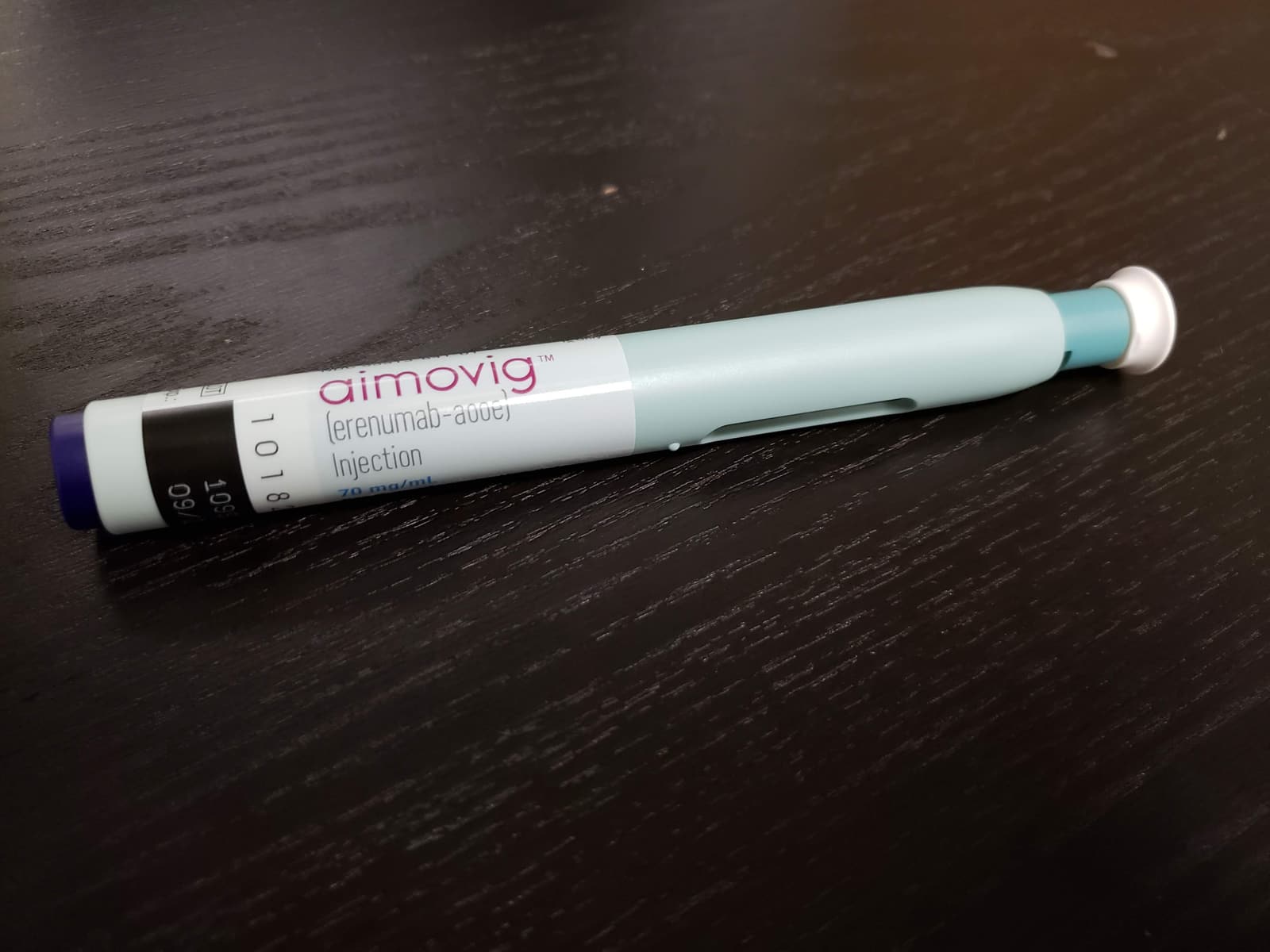
Image context: the cover photograph shows a standard 70 mg/mL Aimovig autoinjector. It fits because the article's main point is about translation from pathway biology into a durable treatment format: receptor blockade, monthly dosing, self-administration, and adverse-effect monitoring all have to hold together for prevention to become practical.[6]
Timeline anchors
- 2018: FDA approval of Aimovig made erenumab the first approved CGRP-pathway monoclonal antibody for adult migraine prevention in the United States.[1][4]
- 2019-2020: reviews of erenumab's development framed it as the first FDA-approved antibody against a G-protein-coupled receptor and as a proof that migraine biology could be targeted more directly than older preventive classes allowed.[4]
- 2024: the American Headache Society updated its position, stating that CGRP-targeting therapies are a first-line option for migraine prevention rather than only a late step after multiple older failures.[2]
- March 2025: the current U.S. Aimovig label added a recent major warning update for Raynaud's phenomenon, a reminder that pathway specificity does not remove postmarketing safety surveillance.[1]
The mechanism starts before the pain day
The crucial distinction is prevention versus rescue. A triptan taken during an attack tries to interrupt an event already underway. A CGRP monoclonal antibody is meant to change the probability or frequency of future events by occupying part of the signaling system over time. Aimovig's U.S. label is clear on that scale: erenumab is indicated for the preventive treatment of migraine in adults, with a recommended dose of 70 mg once monthly and some patients benefiting from 140 mg once monthly.[1]
The label also states the mechanism in narrow pharmacologic terms: erenumab is a human monoclonal antibody that binds to the CGRP receptor and antagonizes receptor function.[1] That sentence is the hinge of the article. The drug does not numb the head, sedate the patient, or work as an all-purpose analgesic. It blocks a receptor-level step in a pathway associated with migraine attacks. Other CGRP monoclonal antibodies target the peptide itself rather than the receptor, but the shared strategic move is the same: treat migraine as a pathway disease that can be prevented upstream.[2][3]
This is why the dosing rhythm matters. Erenumab's effective half-life is listed as 28 days, and trough concentrations approach steady state by about 3 months of monthly dosing.[1] In ordinary language, the drug is built for a slow preventive layer, not for a "take it when the aura starts" logic. The treatment question becomes: over several months, does blocking CGRP signaling reduce the number of migraine days enough to justify staying on the therapy?
The trial signal was not "no migraines"; it was fewer migraine days
The first public misunderstanding to avoid is cure language. The pivotal episodic-migraine trial did not show that erenumab erased migraine. It showed a larger reduction in monthly migraine days than placebo over a defined prevention window.
In the STRIVE trial, adults with episodic migraine had a baseline mean of 8.3 migraine days per month. During months 4 through 6, migraine days fell by 3.2 days in the 70 mg erenumab group and 3.7 days in the 140 mg group, versus 1.8 days with placebo.[5] That is clinically meaningful for many patients, especially if the lost days are work days, parenting days, school days, or recovery days. But it is not the same claim as migraine disappearance.
This difference between cure and burden reduction is central to reading CGRP prevention honestly. A person moving from eight migraine days to four or five may still have migraine disease. They may still need acute medicine, trigger management, sleep regularity, and a plan for breakthrough attacks. Yet the same person may have regained a large part of the month. Prevention often succeeds by moving the baseline rather than by producing a dramatic one-day rescue.
The chronic-migraine evidence carries the same logic. In chronic migraine, the disease definition starts at a much heavier burden: at least 15 headache days per month, including at least 8 migraine days. Trials and labels treat that population separately because a small monthly-day change can mean something different when the starting point is near-daily disability.[1] The useful question is not whether every patient becomes attack-free. It is whether the attack burden falls enough, consistently enough, to change life and justify cost, injections, and monitoring.
Why first-line status changed the policy meaning
The 2024 American Headache Society position update matters because it changed the treatment map around CGRP therapies.[2] Earlier access patterns often made patients fail older preventives first. That made economic sense to payers, but it also treated migraine-specific drugs as if specificity were a luxury rather than part of the evidence case.
The AHS update argues that the evidence for CGRP-targeting therapies is substantial and supports their use as a first-line option for prevention.[2] That does not mean every patient should start there automatically. It means the category no longer belongs only at the end of a forced staircase. For a patient whose migraine burden justifies prevention, a clinician can now read CGRP therapy as one legitimate starting lane among others, not merely as a rescue option after older drugs fail.
This is a policy shift as much as a pharmacology shift. Once a therapy becomes first-line in a professional position statement, insurance rules, prior authorization scripts, and clinician-patient conversations all face a different burden of explanation. The question becomes less "Why have you not failed enough older drugs yet?" and more "Which preventive is the best fit for this patient's attack pattern, comorbidities, pregnancy plans, adverse-effect tolerance, cost constraints, and preference about injections or pills?"
The boundaries are part of the mechanism
Pathway specificity can create a false sense of cleanliness. The Aimovig label prevents that mistake. The current prescribing information lists hypersensitivity reactions, constipation with serious complications, hypertension, and Raynaud's phenomenon among warnings and precautions.[1] It also notes that safety and effectiveness in pediatric patients have not been established, and that pregnancy data are limited.[1] Those are not footnotes to be waved away. They define the population and monitoring boundaries of a preventive therapy used month after month.
The route also matters. A monthly autoinjector can be liberating for a patient who hates daily pills, but it can be a barrier for a patient who dislikes injections, struggles with storage, has dexterity limits, or cannot tolerate injection-site reactions. The device format solves adherence in one way and creates adherence work in another. A forgotten tablet and a missed monthly injection fail differently.
The more subtle boundary is responder variability. CGRP is important in migraine biology, but migraine is not one uniform pathway in every person. Hormonal cycling, sleep disruption, medication overuse, vestibular symptoms, aura, comorbid depression or anxiety, neck pain, sensory sensitivity, and vascular risk can all change the clinical picture. A CGRP blocker may reduce attack frequency while leaving other pieces of the migraine ecology intact. That is still success if the goal was fewer attacks. It is disappointment only if the therapy was mis-sold as a complete rewiring of the disorder.
The durable lesson
CGRP-targeted prevention changed migraine care because it made mechanism, evidence, and format line up more tightly than older borrowed preventives often did. The pathway was biologically plausible. The drug class was designed for that pathway. The trials measured migraine-day reduction. The device and half-life supported monthly prevention. The 2024 AHS position then moved the category into first-line consideration.[1][2][3][4][5]
The strongest reading is therefore balanced. CGRP blockers are not a cure, not an acute rescue, and not a universal first choice. They are a major preventive lane because they turn a migraine-linked signaling pathway into a practical treatment system. The right question is not whether they end migraine as a disease. The right question is whether, for a particular patient, pathway blockade can buy back enough days to make prevention worth the ongoing bargain.
Sources
- DailyMed / FDA label, "AIMOVIG (erenumab-aooe) injection" (revised March 2025) - indication, monthly dosing, mechanism of action, pharmacokinetics, clinical-study framing, and warning boundaries.
- Charles A, Digre KB, Goadsby PJ, et al., "Calcitonin gene-related peptide-targeting therapies are a first-line option for the prevention of migraine: An American Headache Society position statement update" (Headache, 2024; PubMed record).
- American Headache Society, "Basic Considerations for the Use of Monoclonal Antibodies in Migraine" (Headache, 2018; PMC) - CGRP pathway rationale, trigeminal activation, and preventive-use framing.
- Shi L, Lehto SG, Zhu DXD, et al., "Discovery of the Migraine Prevention Therapeutic Aimovig (Erenumab), the First FDA-Approved Antibody against a G-Protein-Coupled Receptor" (ACS Pharmacology & Translational Science, 2020; PMC).
- Goadsby PJ, Reuter U, Hallstrom Y, et al., "A Controlled Trial of Erenumab for Episodic Migraine" (New England Journal of Medicine, 2017) - STRIVE trial baseline and monthly migraine-day reduction results.
- Wikimedia Commons, "File:Aimovig Autoinjector.jpg" - photographic source page for the cover image, described as a standard 70 mg/mL Aimovig autoinjector.