
As of 2026-06-05 UTC, the most useful way to watch FDA's "How to Safely Dispose of Unused or Expired Medicine" video is as a sorting lesson, not as a generic cleanup reminder.[1] The clip is short, but its structure is strict. It begins with the risk of unused or expired medicine sitting in ordinary household places, then turns that concern into an ordered sequence: use a take-back option if possible, use a prepaid mail-back envelope where available, check the FDA flush list only for certain high-risk medicines, and use household trash instructions only when the earlier options do not fit.[1][2]
That order matters because medicine disposal sits between two competing anxieties. One is immediate household harm: a child, pet, visitor, or household member takes a drug that was not meant for them, takes too much, or mistakes an old container for something current.[1][2] The other is environmental release: pharmaceuticals can move into waste streams, landfills, or water systems when households treat sinks, toilets, and garbage cans as interchangeable exits.[2][3] The FDA video works because it refuses to make either anxiety do all the work. It gives households a hierarchy instead of a slogan.
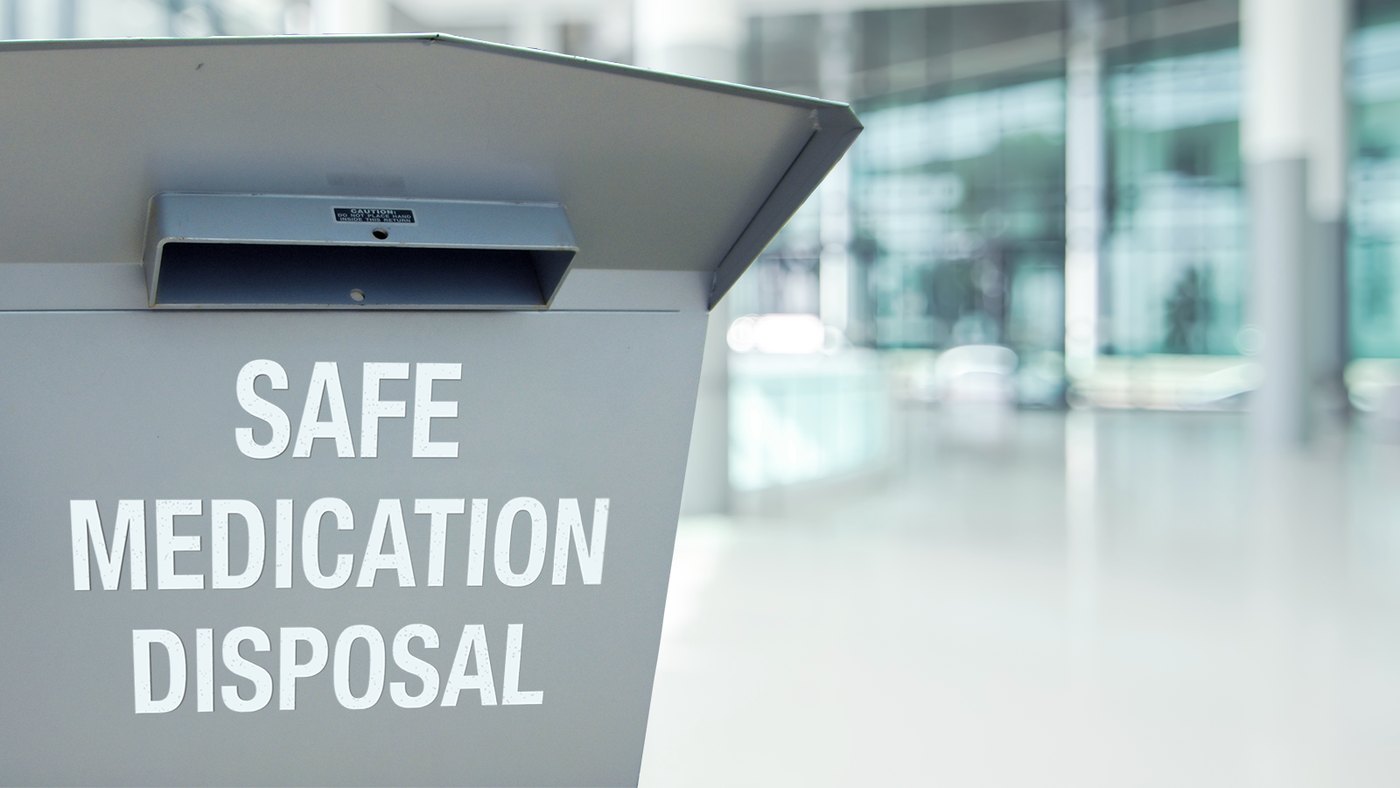
The drop-box photograph attached to this article makes the first branch of that sequence concrete.[4] It shows the preferred exit route before a household starts improvising with sinks, toilets, or garbage cans: a designated collection point built for unused or expired medicine. Once pills are separated from the original reason they were prescribed, they can become background clutter: a just-in-case pain medicine, a half-used antibiotic, an old sleep aid, an expired tablet whose label no longer feels urgent. The FDA video is best read as a way to restore decision structure to that clutter.[1][2]
The first move is not the trash can
The video's strongest public-health choice is that it does not begin with home improvisation.[1] The Indian Health Service's patient guidance says take-back programs are a safe, responsible way to remove expired, unwanted, or unused medicines from a home, especially controlled substances.[2] EPA's household medication disposal page also encourages pharmaceutical take-back programs for unwanted household medicines.[3]
That agreement is important because many households default to the disposal method that is closest at hand. The FDA video resists that impulse. It asks the viewer to look for a formal collection route before turning to the sink, toilet, or kitchen garbage.[1][2] In practice, that makes the first decision logistical rather than moral: is there a permanent collection box at a pharmacy, police station, clinic, or other authorized site? Is a mail-back envelope available? If yes, the medicine leaves the household through a system designed for it.[2][3]
This is also why the video is health communication rather than just housekeeping advice. A bottle left in a cabinet is still available to the wrong person. A bottle put directly in ordinary trash may still be retrievable or may enter a waste path that was not chosen with pharmaceuticals in mind. Take-back turns "I should clean this out someday" into a concrete removal channel.[1][2][3]
The flush list is narrow by design
The most easily misunderstood part of medicine disposal is flushing. Many older household habits treated the toilet as the safest way to make dangerous pills disappear. Current federal patient-facing guidance is narrower. IHS tells patients to check FDA's list of medicines that are safe to flush and to flush accordingly only if the item is on that list.[2] The video states the same boundary: do not flush any medicine unless it is on the flush list.[1]
The reason is risk triage. FDA's video describes flush-list medicines as products that may be especially dangerous after just one dose if taken by someone for whom they were not prescribed, including children or pets.[1] The logic is not "flushing is harmless." It is that a small set of medicines creates such immediate household danger that fast removal can outweigh the usual preference to keep pharmaceuticals out of wastewater.[1][2] EPA's page helps explain why the distinction matters: unwanted medicine is a waste stream with environmental consequences, not just a private cabinet problem.[3]
For a viewer, the practical takeaway is not to memorize the list from the video. The safer takeaway is procedural: check the current FDA list and the product-specific instructions before flushing.[1][2] This article is not a substitute for a pharmacist, prescriber, poison-control specialist, or emergency response in an urgent exposure. The annotation point is simpler: the video teaches that "flush" is a named exception, not a general disposal habit.
Household trash is the fallback with steps
The third branch in the FDA sequence is household trash. Here again, the video avoids a vague instruction. If a take-back option is not available and the medicine is not on the flush list, IHS's patient guidance gives the same practical steps: remove the medicine from its original container, mix tablets or capsules that are not crushed or opened with an undesirable substance such as cat litter, used coffee grounds, dirt, or sawdust, put the mixture into a lidded container or sealable bag, remove personal information from medication bottles, and place the sealed container and empty medicine containers in the trash.[1][2]
Those details carry more meaning than they first appear to. Mixing with an unappealing substance is not about chemical neutralization in the home. It is about making the medicine less recognizable and less attractive to people or animals who might encounter it later.[1][2] Sealing the mixture limits loose pills and leakage. Leaving pills uncrushed avoids creating powder exposure and avoids making the contents easier to misuse. Removing label information separates disposal from privacy risk.[1][2]
The video therefore turns the trash option into a last branch with guardrails. It does not present the garbage can as equivalent to a take-back kiosk. It says, in effect: if you must use household trash for medicines that are not on the flush list and have no specific disposal instructions, do it in a way that reduces recognition, access, and personal-data exposure.[1][2]
The real subject is household time
What makes unused medicine risky is not only the drug's pharmacology. It is time. A medicine can outlive the infection, surgery, pain episode, prescription change, or household member it was meant for. It can move from a labeled treatment into a vague reserve. It can be transferred into organizers, purses, drawers, travel bags, or bathrooms, then lose the context that once made its use obvious.[1][2]
FDA's video is useful because it gives that drift a stop rule.[1] The household does not have to decide from scratch whether an old bottle is "probably fine" to keep. It can sort by disposal path: take-back or mail-back first; flush-list exception only when indicated; trash fallback only with the specific mixing, sealing, and label-scratching steps.[1][2] IHS and EPA sources reinforce the same public-health shape: formal collection is preferred when available, and household disposal should not be treated as a casual environmental or safety afterthought.[2][3]
The best reading of the clip is therefore not "throw old pills away." It is "remove leftover medicine from ordinary household circulation through the safest available channel." That is a more disciplined message. It accounts for accidental ingestion, misuse, privacy, environmental release, and the simple fact that old medicine becomes easier to ignore the longer it sits in a familiar drawer.[1][2][3]
Sources
- U.S. Food and Drug Administration, "How to Safely Dispose of Unused or Expired Medicine," YouTube video.
- Indian Health Service, "Medication Disposal," patient and clinician guidance on take-back, mail-back, flushing, pouches, and trash disposal.
- U.S. Environmental Protection Agency, "Household Medication Disposal," last updated June 1, 2026.
- U.S. Food and Drug Administration, "Drug Disposal: Drug Take-Back Options" - FDA page whose safe-medication-disposal drop-box image is used as the article cover.