The Cardiac Arrhythmia Suppression Trial's preliminary report opens with a qualification: premature ventricular beats after a heart attack predict danger, but whether drug treatment reduces it “is not known.” In the New England Journal of Medicine on August 10, 1989, the investigators placed an unanswered question inside what might otherwise sound like a treatment rationale.[1]
The distinction is easy to lose. A recording can show fewer abnormal beats after a medicine is given. That is a visible, countable response. CAST asked whether people whose recordings improved would also live longer. Reading the papers closely means keeping those two achievements separate, even when the same word—success—seems available for both.
What the pilot meant by efficacy
The earlier Cardiac Arrhythmia Pilot Study, reported in March 1988, enrolled 502 patients at ten centers. Participants had recently survived myocardial infarction, the medical term for a heart attack. Investigators tested whether drugs could substantially reduce premature ventricular complexes: electrical activations arising early in the heart's lower chambers.[2]
The pilot's response targets were at least 70% suppression of these individual premature beats and more than 90% suppression of runs of them. As first treatments, encainide and flecainide achieved reported efficacy rates of 79% and 83%, respectively. The abstract also described tolerability as favorable.[2]
“Efficacy” therefore needs its object supplied. Here it describes success at suppressing recorded arrhythmias under the study's criteria. It does not establish a reduction in deaths. The pilot answered a necessary practical question: could researchers find drugs that changed the signal sufficiently to test the larger hypothesis? Treating that answer as proof of longer life would skip the experiment for which the pilot was preparing.[2]
The patients had already passed a response test
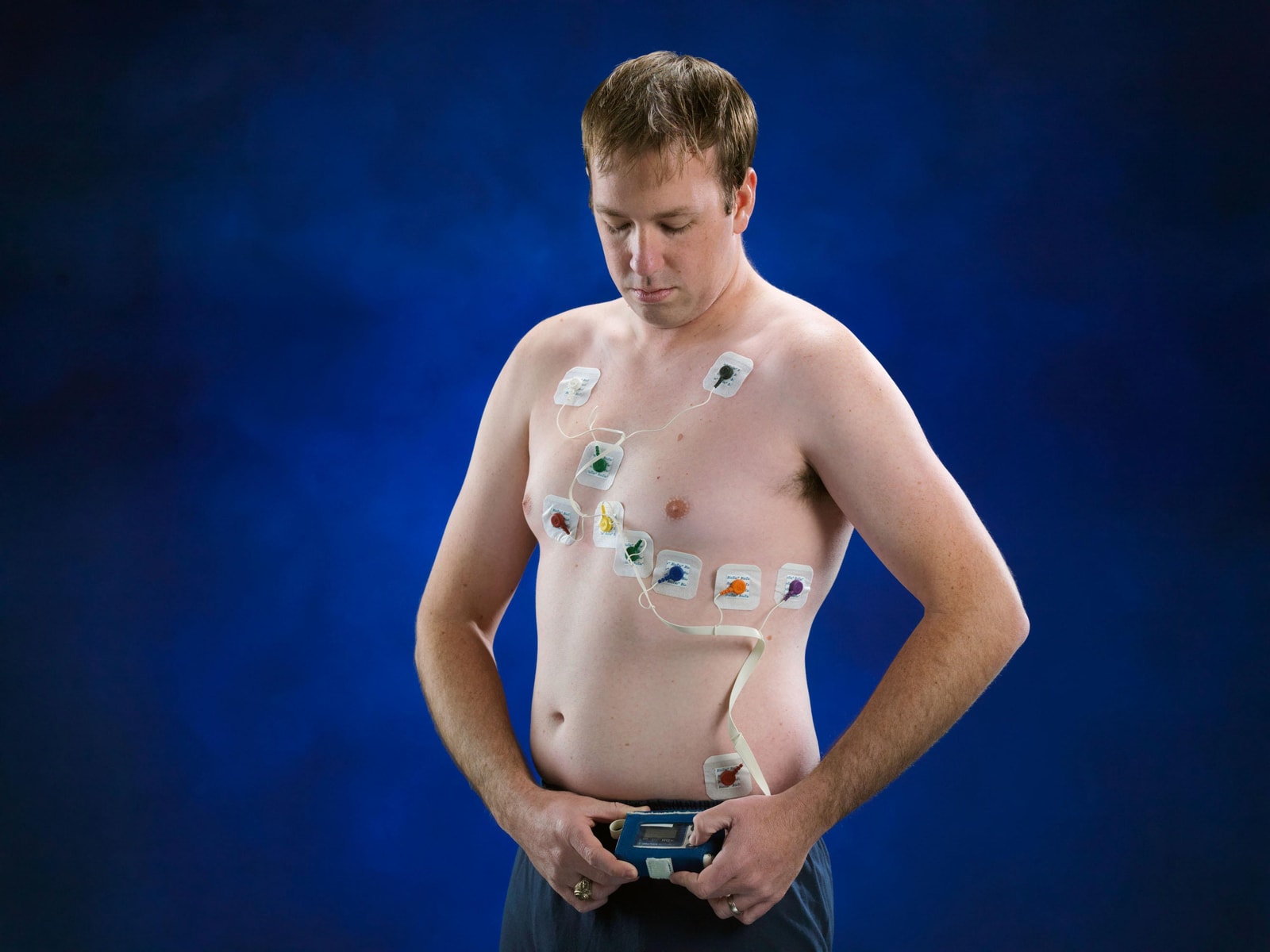
The full trial began enrolling in 1987, focusing on people with no or only mild symptoms from their ventricular arrhythmias. NHLBI's study archive describes screening with ambulatory electrocardiography, commonly called Holter recording: electrical activity collected while a person goes about life, rather than only during a brief examination. Eligibility combined frequent premature beats with limits on the heart's pumping function.[3]
There was another filter before randomization. During an initial open-label phase, clinicians adjusted treatment to identify people who tolerated a drug and whose recordings met suppression thresholds: at least 80% fewer premature ventricular depolarizations and 90% fewer runs of nonsustained ventricular tachycardia. Eligible responders were then randomly assigned to active treatment or placebo.[3]
That order matters to the interpretation. CAST was testing continued treatment in people who had already demonstrated the desired electrical response. A disappointing result could not simply be explained away by saying the medicine had never changed their recordings. Randomization moved the question from whether the signal could be altered to what happened to patients after it was altered.
Count the deaths before explaining them
The 1989 preliminary report recorded 56 deaths among 730 people assigned to encainide or flecainide, against 22 among 725 assigned to placebo, over an average follow-up of ten months. These were all-cause mortality figures: 7.7% versus 3.0%, with a reported relative risk of 2.5 and a 95% confidence interval of 1.6–4.5.[1]
Using the rounded percentages, that is an absolute difference of about 4.7 percentage points during the reported follow-up. It is not a lifetime estimate or a forecast for every person prescribed an antiarrhythmic. The encainide and flecainide portions of the trial were stopped.[1]
Read alongside the entry criteria, the result changes the meaning of an improved recording. Suppression had established that the drug did something measurable. The mortality comparison established that this response was insufficient evidence of benefit in these patients.
The later paper kept the mechanism open
Debra Echt and colleagues' March 21, 1991 report presented the final analysis of the encainide and flecainide comparison, covering 1,498 patients. Its denominator differs from the preliminary report; figures from the two publications should not be spliced into a single calculation.[4]
The later analysis recorded 43 arrhythmic deaths in the active-drug groups and 16 in the placebo groups. There were also more deaths from nonarrhythmic cardiac causes. Yet reported nonfatal events, including fainting and several rhythm complications, did not show corresponding between-group differences.[4]
The authors explicitly left the mechanism of excess mortality unresolved. That restraint is part of the paper's force. The randomized comparison supplied evidence of harm before investigators could provide a complete physiological explanation. A tidy account of how the deaths occurred was not required to recognize that continuing the same treatment strategy was dangerous.[4]
What can stand in for survival?
The FDA's explanation of surrogate endpoints gives this distinction a wider vocabulary. A surrogate is a measurement used in place of a clinical outcome such as symptoms, function, or survival. Validation requires evidence that a treatment's effect on the substitute predicts the relevant patient benefit in its intended setting.[5]
The practical attraction is substantial: a measurement available sooner can make trials shorter and feasible with fewer participants. The evidentiary burden travels with that convenience. A marker's association with danger and its responsiveness to treatment do not, by themselves, establish that changing it delivers the hoped-for benefit.[5]
CAST's boundary also deserves preservation. Today's flecainide labeling retains the mortality warning while listing selected uses, including prevention of disabling paroxysmal atrial fibrillation or flutter in patients without structural heart disease. Atrial rhythm disorders in that population are a different clinical setting from the post-infarction ventricular arrhythmias studied here. The label also states that controlled trials have not established a survival benefit.[6]
The lasting demand of these papers is precise: name what improved, name in whom, and name the outcome that still needs testing. A quieter recording can be real. Its promise to the patient remains a separate claim.
Sources
- CAST Investigators, preliminary report on encainide, flecainide, and mortality after myocardial infarction, New England Journal of Medicine 321:406–412 (August 10, 1989) — primary report and its stated population boundary.
- Cardiac Arrhythmia Pilot Study Investigators, effects of four drugs on ventricular arrhythmias after acute myocardial infarction, American Journal of Cardiology 61:501–509 (March 1, 1988) — pilot design, suppression targets, and response rates.
- National Heart, Lung, and Blood Institute, BioLINCC study archive for the Cardiac Arrhythmia Suppression Trial — screening, treatment titration, and randomization criteria.
- Debra S. Echt et al., mortality and morbidity in patients receiving encainide, flecainide, or placebo, New England Journal of Medicine 324:781–788 (March 21, 1991) — final mortality analysis and the unresolved mechanism of harm.
- U.S. Food and Drug Administration, “Surrogate Endpoint Resources for Drug and Biologic Development” — clinical outcomes, surrogate validation, and context of use.
- DailyMed, flecainide acetate tablets prescribing information — indications, CAST mortality warning, and limits of survival evidence; accessed September 23, 2026.
- NASA, Matthew Roper demonstrating Holter Monitor 2 hardware (2011), photograph jsc2011e215471, preserved on Wikimedia Commons — source and provenance of the article image.