The shortest version of Buck v. Bell is a legal horror line. Oliver Wendell Holmes Jr. writes "three generations of imbeciles are enough," the Supreme Court blesses forced sterilization, and the case enters memory as proof that American law once said the quiet part out loud.[4] That version is true, but it starts too late. By the time Holmes wrote, Virginia had already done the harder work. It had taken a foster-family accusation, a pregnancy after rape, a commitment proceeding, and a new sterilization statute, then arranged them into a record that made custody look like diagnosis and diagnosis look like heredity.[1][2][3][5]
That is the event worth reconstructing. The case did not move from laboratory certainty to legal application. It moved the other way. Administrative control came first. A young woman was classified, confined, and selected. Only then did the state ask courts to treat that selection as if it were the natural output of medical knowledge.[1][3][5] Read from that angle, Buck v. Bell is not only a shameful opinion. It is a public-health warning about what happens when institutions turn social judgment into clinical fact.
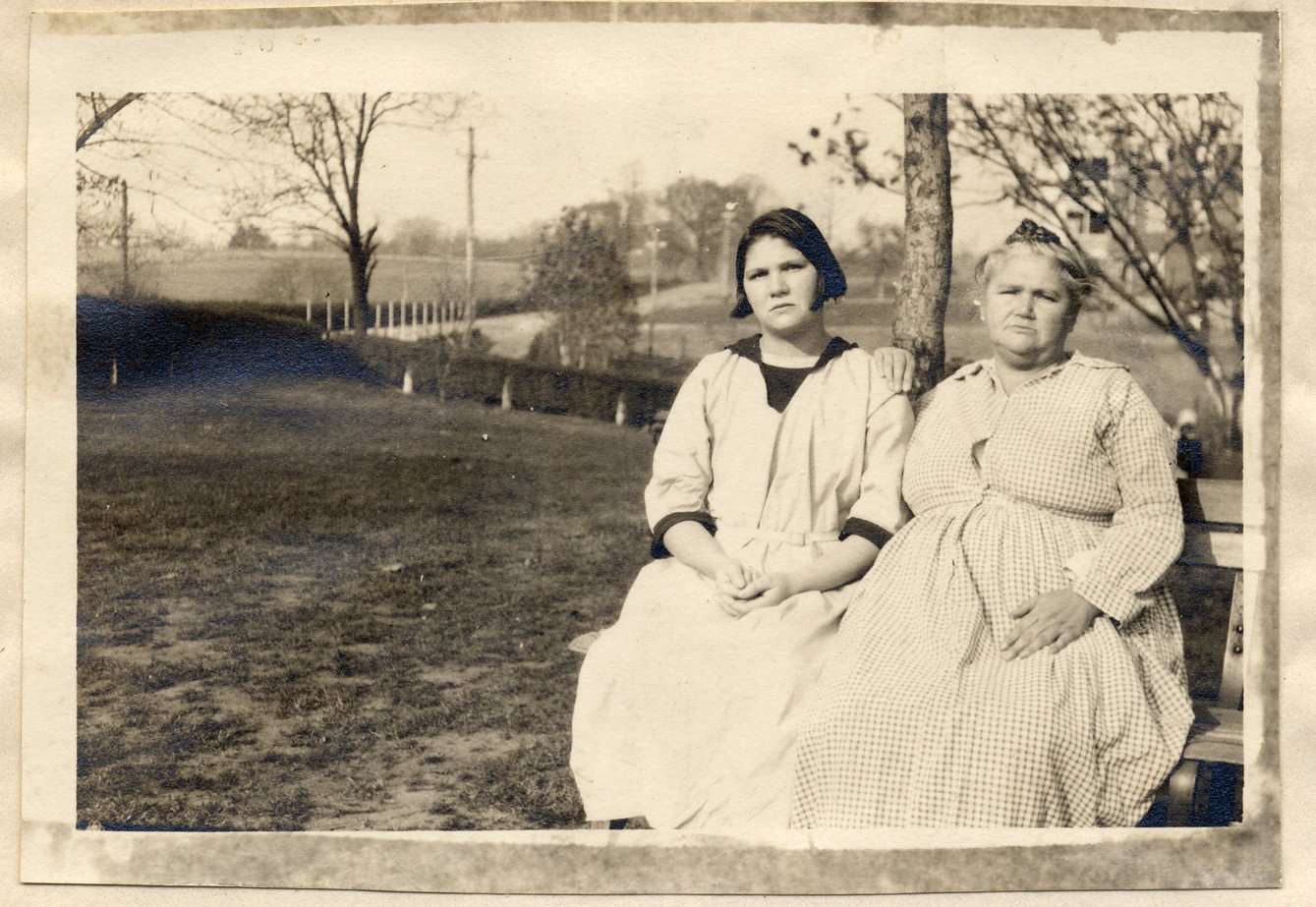
Image context: the archival photograph of Carrie and Emma Buck on the colony grounds matters because it refuses abstraction. The case was built from real bodies under state custody, presented inside an institution whose routines made one family line look like biological evidence rather than coerced circumstance.[7]
Timeline anchors before the ruling
- January 23, 1924: a Charlottesville proceeding adjudged the pregnant Carrie Buck "feebleminded" and committed her to the Virginia State Colony for Epileptics and Feeble-Minded.[1][3]
- March 20, 1924: Virginia approved the Eugenical Sterilization Act, authorizing superintendents to petition for vasectomy or salpingectomy when they judged it best for the patient and for society.[2]
- June 4, 1924: after giving birth in March, Carrie Buck entered the colony where her mother, Emma Buck, was already confined.[1]
- April 22, 1927: the U.S. Supreme Court heard oral argument in what had become Buck v. Bell.[1][5]
- May 2, 1927: the Court upheld Virginia's law and the order authorizing Buck's sterilization.[4][5]
- October 1927: Carrie Buck was sterilized, and Virginia's program moved from test case to routine practice.[1][6]
Those dates matter because they show the decision was the middle of the process, not the beginning. The state first secured custody, then a statutory route, then appellate approval.
1. The case began with supervision, not science
Encyclopedia Virginia's biography makes the sequence plain. Carrie Buck was removed from her mother at age three and placed with a foster family. School records later showed ordinary progress, but the family withdrew her from school for housework before she completed sixth grade.[1] In 1923 she became pregnant and said the foster family's nephew had raped her. The pregnancy was then reread by adults around her as evidence of sexual and mental defect, not as evidence of violence.[1]
That interpretive reversal is the first mechanism in the story. Virginia did not discover an inherited disease in Carrie Buck and then design a legal response. Local authorities and caretakers reclassified dependence and vulnerability into a period diagnosis, using the language of "feeblemindedness" to shift attention from coercion to supposed biological weakness.[1][3] The commitment record from January 23, 1924 shows the state speaking in exactly that register. It declares Buck a suitable subject for institutional care and orders the colony superintendent to receive her into custody.[3]
In other words, the record that later reached the courts already carried the answer it needed. If pregnancy outside marriage could be treated as proof of hereditary defect, then the institution did not need strong science. It needed a socially legible story about degeneracy, dependency, and public burden.
2. The 1924 law turned diagnosis into an administrative pipeline
Virginia's sterilization statute is revealing because of how little it asks before giving power to the institution. The act allowed a superintendent, once of the opinion that sterilization served "the best interests of the patients and of society," to petition the special board of the hospital or colony for an order.[2] The statute also laid out the specific operations: vasectomy for men, salpingectomy for women.[2] It presented the procedure as orderly, medically manageable, and surrounded by safeguards.
That legal design matters more than the rhetoric around it. The law did not wait for a neutral scientific body to establish heredity in any modern sense. It began with confinement. Only people already inside named state institutions were reachable by the statute's machinery.[2][6] The superintendent's opinion opened the process; the board formalized it; appeals then reviewed a record the institution had largely assembled itself.[2][5]
This is why Buck v. Bell belongs in health history as much as in constitutional history. It is a case about how administrative medicine can define the patient population first and ask questions later. The state did not sterilize all Virginians it claimed were unfit. It sterilized those it could already hold. Custody was the hidden denominator.
3. Carrie Buck was chosen because the record could be staged
Carrie Buck's biography states directly that superintendent Albert S. Priddy selected her as the test case for the constitutionality of the new law.[1] That single fact changes the emotional temperature of the entire file. She was not merely swept along by a neutral system that happened to encounter her. She was chosen because her mother was already at the colony, because her daughter could be folded into a three-generation narrative, and because the institution believed the courts would find her legible.[1][5]
The event reconstruction of the litigation confirms how narrow the defense became. According to Encyclopedia Virginia's case entry, Aubrey Strode argued that the law did not impose cruel and unusual punishment, that it provided due process, and that it represented valid police power in the name of public health and safety.[5] The same entry notes that Buck's lawyer, Irving Whitehead, conceded the central diagnosis while objecting to bodily invasion and unequal treatment.[5] That concession is devastating. Once the label itself remained intact, the case could shift from "Is the diagnosis true?" to "Has the state followed the right procedure?"
That shift is the second mechanism that made the case work. The appellate record did not seriously test the scientific basis of the hereditary claim; it mostly tested whether Virginia had built enough procedural shape around a predetermined decision.[4][5] The law looked careful because it had hearings, guardianship, a board, and appeals. But those forms sat on top of a record built inside the same institutional world that wanted the operation performed.
4. Holmes treated a staged record as a public-health solution
The U.S. Reports opinion shows how fully the Court accepted that transformation. Holmes summarized the act as one meant to promote "the health of the patient and the welfare of society," treated the statutory procedures as careful protections, and affirmed the judgment ordering salpingectomy.[4] The opinion did not ask whether Buck's life story had been translated into heredity through prejudice, sexual policing, and administrative convenience. It accepted the state's categories and then reasoned outward from them.
That is why the famous comparison to vaccination is so important.[1][4] Holmes did not merely say Virginia could perform this one operation. He placed sterilization inside the larger police-power tradition of public health. Once there, the case ceased to look like a dispute over one coerced woman and began to look like population management. The patient disappeared into the category.
Oyez's summary captures the same logic in compressed form: the Court thought a hearing, the presence of a guardian, and the availability of appeal were enough to satisfy the Constitution.[5] The result was not scientific certainty. It was procedural laundering. A thin and biased record gained legitimacy because the Court mistook reviewability for truth.
5. What the program became after the test case
Virginia's own historical summary makes clear that the case opened a long administrative lane. Legal sterilizations peaked between 1933 and 1944; compulsory sterilization officially ended in 1972; the law remained on the books until 1974; and later state estimates put the total number of people sterilized in Virginia at roughly 8,000 or more, depending on the counting frame.[1][6] The afterlife matters because it shows Buck v. Bell was never only about one plaintiff. It converted a controversial experiment in power into routine institutional work.
The later apology record matters for the same reason. Virginia issued a formal statement of regret in 2002, and in 2015 created a compensation program for surviving victims.[6] Those acts acknowledge harm, but they also reveal the scale of the lag. The state could apologize only after decades in which the category system behind the case had already done its work.
That delay also sharpens the article's central point. The real scandal was not simply that elite jurists once believed bad biology. It was that public institutions knew how to turn ordinary dependency into evidence. Carrie Buck's school record, later adult life, and her daughter Vivian's honor-roll performance all cut against the image of congenital incapacity that the state needed.[1] Yet the machinery of commitment, classification, and appeal proved strong enough to make the false diagnosis govern anyway.
6. Why this reconstruction still matters in health history
The easiest way to remember Buck v. Bell is as a quote. The more useful way is to remember it as a workflow. First, a vulnerable person was placed under supervision. Then a period diagnosis gave moral judgment a clinical name. Then a law routed that diagnosis through a board and appeal structure that looked protective while leaving the underlying premise mostly untouched. Finally, the Supreme Court ratified the result as if procedure had purified the evidence.[2][3][4][5]
That sequence belongs squarely in health history because medicine and public health still rely on categories that decide who is visible, who is burdensome, and who can be acted upon in the name of collective welfare. The lesson of Buck v. Bell is not only that eugenics was wrong. It is that institutions become dangerous when they mistake confinement for observation and paperwork for proof.
Sources
- J. David Smith and the Dictionary of Virginia Biography, "Carrie Buck (1906–1983)" — background on Buck's school record, pregnancy, commitment, test-case selection, later life, and the program's duration.
- Encyclopedia Virginia, "Chapter 46B of the Code of Virginia § 1095h-m (1924)" — text of the Virginia sterilization statute authorizing superintendent petitions, board review, and salpingectomy/vasectomy.
- Encyclopedia Virginia, "Carrie Buck Committed (January 23, 1924)" — commitment record showing how Buck was adjudged and transferred into institutional custody.
- Library of Congress, U.S. Reports: Buck v. Bell, 274 U.S. 200 (1927) — primary opinion used for the Court's public-health framing, procedural reasoning, and salpingectomy order.
- Oyez, "Buck v. Bell" — case summary on the argument, question presented, and the Court's due-process and equal-protection holding.
- Elizabeth Catte, "Eugenic Sterilization in Virginia" — statewide implementation, program scale, repeal, apology, and compensation history.
- Encyclopedia Virginia, "Carrie and Emma Buck" — source page for the 1924 archival photograph used as the article image.