Sara Josephine Baker is often remembered through the side door of her career: the woman doctor who helped identify Typhoid Mary, the administrator who wore tailored jackets to move through a male bureaucracy, the unusually public female physician of early twentieth-century New York.[1][2] Those facts are real, but they are not the sharpest way to read her importance. Her stronger public-health achievement was more structural and more durable. She helped turn infant survival from a private household gamble into a municipal delivery system.
That claim sounds larger than a biography, so it helps to be precise about what changed. In 1908, Baker became director of New York City's new Bureau of Child Hygiene, described by the National Library of Medicine as the first such bureau in the country.[1] The program she led did not depend on one vaccine, one laboratory result, or one regulatory ban. It depended on a chain: birth registration, nurses, breastfeeding instruction, safe milk for families who would not breastfeed, school follow-up, and the practical recognition that older sisters were already doing childcare work in crowded households.[1][2] Read that sequence carefully and Baker's career looks less like heroic medicine than like infrastructure.
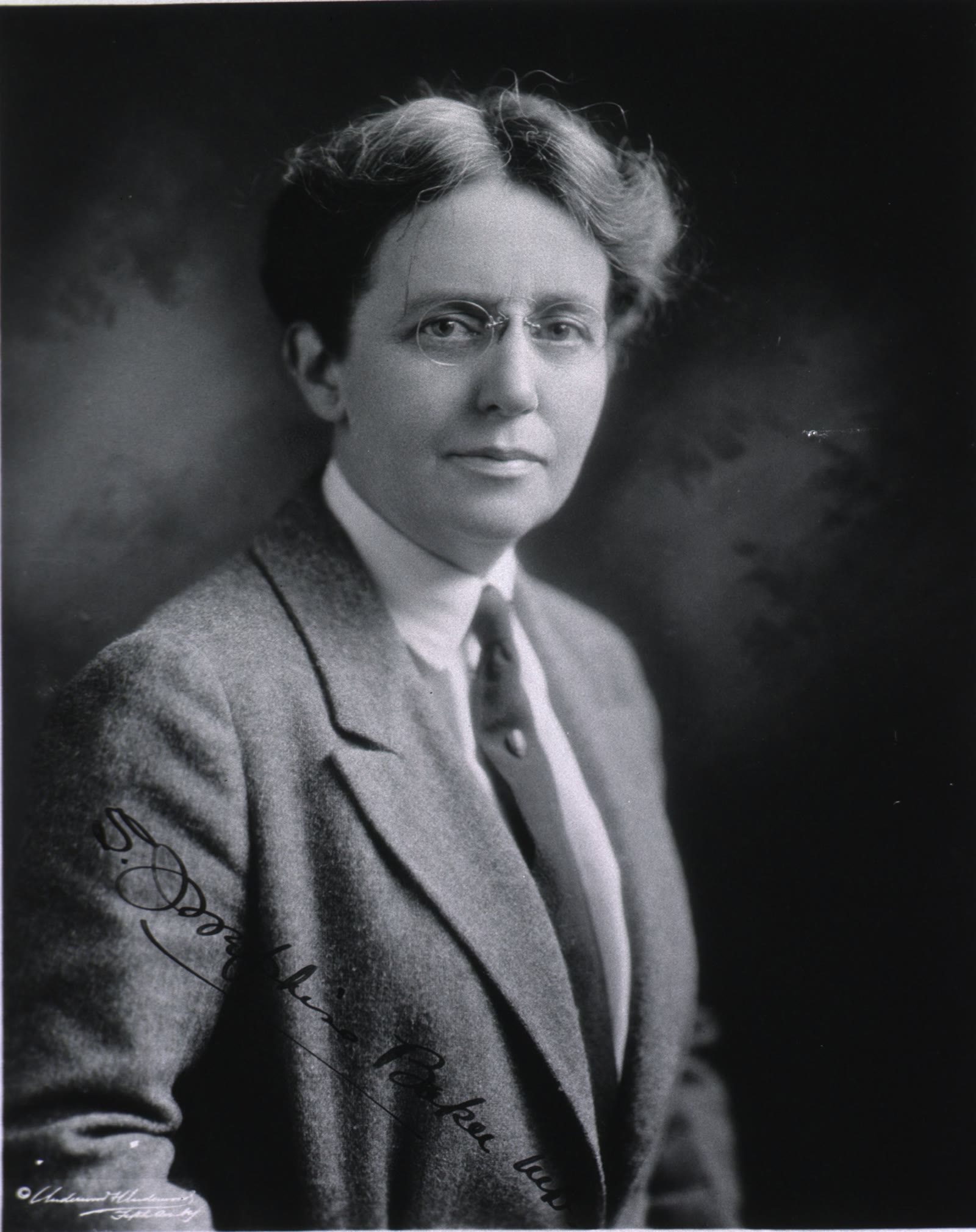
The portrait used here keeps that argument attached to a person rather than an abstraction. It is a real 1922 archival image from the U.S. National Library of Medicine via Wikimedia Commons, and it fits because this article is not about a generic "public health pioneer." It is about a city official who understood that child mortality could fall only when the health department reached the apartment door before the hospital stretcher did.[5]
Timeline anchors before the reputation hardens
- 1873: Sara Josephine Baker was born in Poughkeepsie, New York.[1]
- 1894-1898: she studied at the Woman's Medical College of the New York Infirmary and then took an internship at the New England Hospital for Women and Children in Boston, where she came to see the connection between poverty and illness as a governing fact rather than background scenery.[1]
- 1899: she opened a private practice in New York while also doing part-time inspection work for the city, her first sustained step into public health administration.[1]
- 1907: Baker became assistant commissioner of health and worked on high-profile cases including smallpox vaccination and Mary Mallon.[1][2]
- 1908: she was appointed director of the city's new Bureau of Child Hygiene, the institutional hinge of her career.[1][2]
- 1909-1910: the department founded 71 Little Mothers' Leagues to train girls who were already caring for babies at home.[2]
- 1911: city infant milk stations dispensed more than 538,000 quarts of milk.[2]
- 1914: the Bureau of Child Hygiene had expanded to 697 employees, and the infant death rate had fallen from 167.7 per 1,000 in 1908 to 99 per 1,000.[2]
- 1917: Baker became the first woman to earn a doctorate in public health from New York University and Bellevue Hospital Medical College.[1]
- 1923: when she retired, New York had the lowest infant mortality rate of any major American city, according to the National Library of Medicine's summary of her tenure.[1]
Those dates matter because they keep the story from collapsing into a single invention myth. Baker's achievement took shape over years of administrative build-out.
1. Baker's real unit of action was the household
The origin point is easy to miss because it does not look glamorous. Baker's medical training brought her into contact with slum medicine in Boston and then urban inspection work in New York, and what she seems to have learned early was that disease did not arrive alone.[1] It arrived tied to housing density, work schedules, unsafe milk, limited parental time, weak prenatal guidance, and the practical absence of trustworthy instruction for families who were already stretched thin.
That is why her later public-health work reads differently from a biography of one discovery. The fact that Baker would later codify the field in a book simply titled Child Hygiene captures the scale of the shift.[3] She was not narrowing herself to pediatric bedside care. She was building a preventive system around the life cycle of the child and the working reality of the family. The household, not the lecture hall or the operating room, was her real unit of action.
This is also the best way to understand why Baker's famous link to Typhoid Mary can mislead. Mallon made Baker legible to the public as a forceful health official.[1][2] But the enduring work of her career lay elsewhere. It lay in child welfare programs that had to function every day, at scale, across immigrant neighborhoods where the health department could not wait for families to arrive voluntarily at institutions designed by other people.[1][2]
2. The 1908 bureau treated birth as a trigger for a visit
The early structure of the Bureau of Child Hygiene shows Baker at her clearest. New York City's historical booklet on the Department of Health describes the summer of 1908 baby-care program in practical terms. Baker assigned 83 nurses to visit mothers of newborn babies and instruct them in feeding, bathing, clothing, airing, and general infant care.[2] These were not occasional charity calls. The nurses received daily birth lists from the Bureau of Vital Statistics and then went to the homes where those births had just occurred.[2]
That detail is the whole theory in miniature. Baker did not wait for a crisis, and she did not assume that information would travel by rumor or private physician alone. A recorded birth became an administrative signal. The signal triggered a visit. The visit carried instruction, observation, and an early check on whether a baby was already sick.[2] In public-health terms, this is a move from passive availability to active delivery.
The breast-feeding campaign fits the same pattern. The department urged mothers to breastfeed and circulated the blunt slogan, "Ten Bottle-fed Babies Die to One that is Breast Fed."[2] Taken alone, that line can sound moralizing. Set back inside the system Baker was building, it reads as one part of a larger risk-reduction package. The department was trying to move families away from dangerous feeding practices while also accepting that many would still need an alternative. Advice without supply would not hold.
3. Milk stations and Little Mothers made child health a logistics system
That is where Baker's practical intelligence becomes easiest to see. For mothers who would not breastfeed, the city established milk depots in Manhattan and Brooklyn to distribute safe milk.[2] By 1911, these infant milk stations had dispensed more than 538,000 quarts, and by 1914 there were 55 such stations.[2] This is the opposite of symbolic reform. The department was not merely urging better maternal behavior. It was changing what was physically available.
The same realism appears in the Little Mothers' Leagues. Here Baker's work has sometimes been flattened into a charming historical curiosity. That misses the harder point. New York's own history explains that the leagues were created to reach older girls who were often forced to assume care of babies' lives.[2] In 1909 and 1910, the department organized 71 clubs to teach these girls how to feed and care for infants.[2] Baker's system worked because it began from the actual labor map of the tenement household. Childcare was already being delegated downward inside the family. The health department decided to intervene at the same point.
This is where the "doorstep system" description becomes more than rhetoric. Birth records, visiting nurses, milk stations, and Little Mothers' Leagues all belong to one administrative logic. Baker treated infant mortality as something produced by sequences of ordinary life: what the baby drank, who watched the child while the mother worked, whether a nurse reached the home early enough, whether the family had access to safer food, whether schools and home visits could reinforce one another.[1][2] Her work did not bypass poverty. It moved through it.
4. The numbers matter, but the meaning of the numbers matters more
The strongest statistic in the New York booklet is the one most likely to be oversimplified. Between 1908 and 1914, the death rate for children under one year of age dropped more than 40 percent, from 167.7 per 1,000 population, with 10,493 deaths, to 99 per 1,000, with 7,929 deaths.[2] By 1914, the Bureau of Child Hygiene employed 697 people.[2] Those are not small movements, and they justify treating Baker as a major builder of municipal health.
But the better reading is not that Baker alone "saved" a city by force of personality. Public-health gains on this scale are always composite. They move through administration, nursing labor, statistical surveillance, maternal behavior, milk quality, translation across immigrant communities, and a health department willing to do repetitive work without treating repetition as beneath its dignity.[1][2] Baker's significance lies in how clearly her bureau made those components visible.
That is why the endpoint in 1923 still matters.[1] When the National Library of Medicine says New York had the lowest infant mortality rate of any major American city by the time she retired, the statement does not describe a single miracle intervention.[1] It describes a city where the administrative chain around infants had become denser, earlier, and more routine than it had been before. Baker's achievement was to make prevention operational.
Why Baker still reads sharply in 2026
Sara Josephine Baker remains useful because she helps correct a recurring mistake in how public health gets narrated. We like episodes with one villain, one discovery, one law, or one dramatic rescue. Baker's real career points in another direction. Child survival improved because the city learned how to show up repeatedly: at birth registration, in the apartment, at the milk station, through the school nurse, and through the older sister already carrying responsibility inside the home.[1][2][3]
That makes her biography more than a pioneering-woman story, though it is that too.[1] It is a lesson in state capacity at domestic scale. Even the title of her later memoir, Fighting for Life, preserves the sense that this work was not decorative reform but sustained municipal combat over whether poor babies would live.[4] Baker did not wait for perfect conditions or ideal compliance. She built a system sturdy enough to move through the conditions New York actually had. That is why her work belongs at the center of health history. She made infant survival something the city could deliver.
Sources
- National Library of Medicine, "Biography: Dr. S. Josephine Baker" - used for Baker's career chronology, the Bureau of Child Hygiene's national first, her 1917 doctorate, and the claim that New York had the lowest infant mortality rate of any major American city by 1923.
- New York City Department of Health and Mental Hygiene, Protecting Public Health in New York City: 1805-2005 - used for the 1908 nurse-home-visit program, the breastfeeding circular, milk-station scale, Little Mothers' Leagues, bureau staffing, and the 1908-1914 infant-mortality decline.
- Sara Josephine Baker, Child Hygiene. Harper & Brothers, 1925 - used as Baker's own field-defining book title and for the broader framing of child hygiene as a system rather than a narrow clinical specialty.
- Sara Josephine Baker, Fighting for Life. Macmillan, 1939 - used as Baker's retrospective memoir and for the biographical frame that later public memory attached to her work.
- Wikimedia Commons, "File:S Josephine Baker MD.jpg" - source page for the 1922 National Library of Medicine portrait used as the article image.