Henry K. Beecher's 1966 article, Ethics and Clinical Research, is often remembered as if it were a birth certificate for modern informed consent.[1][2][3] That memory is not exactly wrong, but it is too neat. A close reading shows that Beecher was making a sharper and more uncomfortable claim. His target was not a fringe world of secret abuse cut off from mainstream medicine. His target was published, prestigious, postwar clinical research that already looked respectable to its own profession.[1][3][4]
That difference matters because it changes what the paper is really doing. Beecher did care about consent, and later historians are right to place the article near the rise of modern bioethics.[2][3][6] But the 1966 paper is not mainly a procedural manual. It is a moral alarm aimed at physicians reading the leading medical journal in the United States. Beecher's central warning is that unethical human experimentation can live comfortably inside ordinary professional success if publication, ambition, and therapeutic hope go unexamined.[1][3][4]
The strongest way to read the article in 2026 is therefore not as a finished doctrine, but as a document of transition. It sits between the postwar language of the Nuremberg Code and the later world of IRBs, federal oversight, and consent governance. Beecher's paper still expects reform to come first from the medical profession looking at itself in public.[1][3]
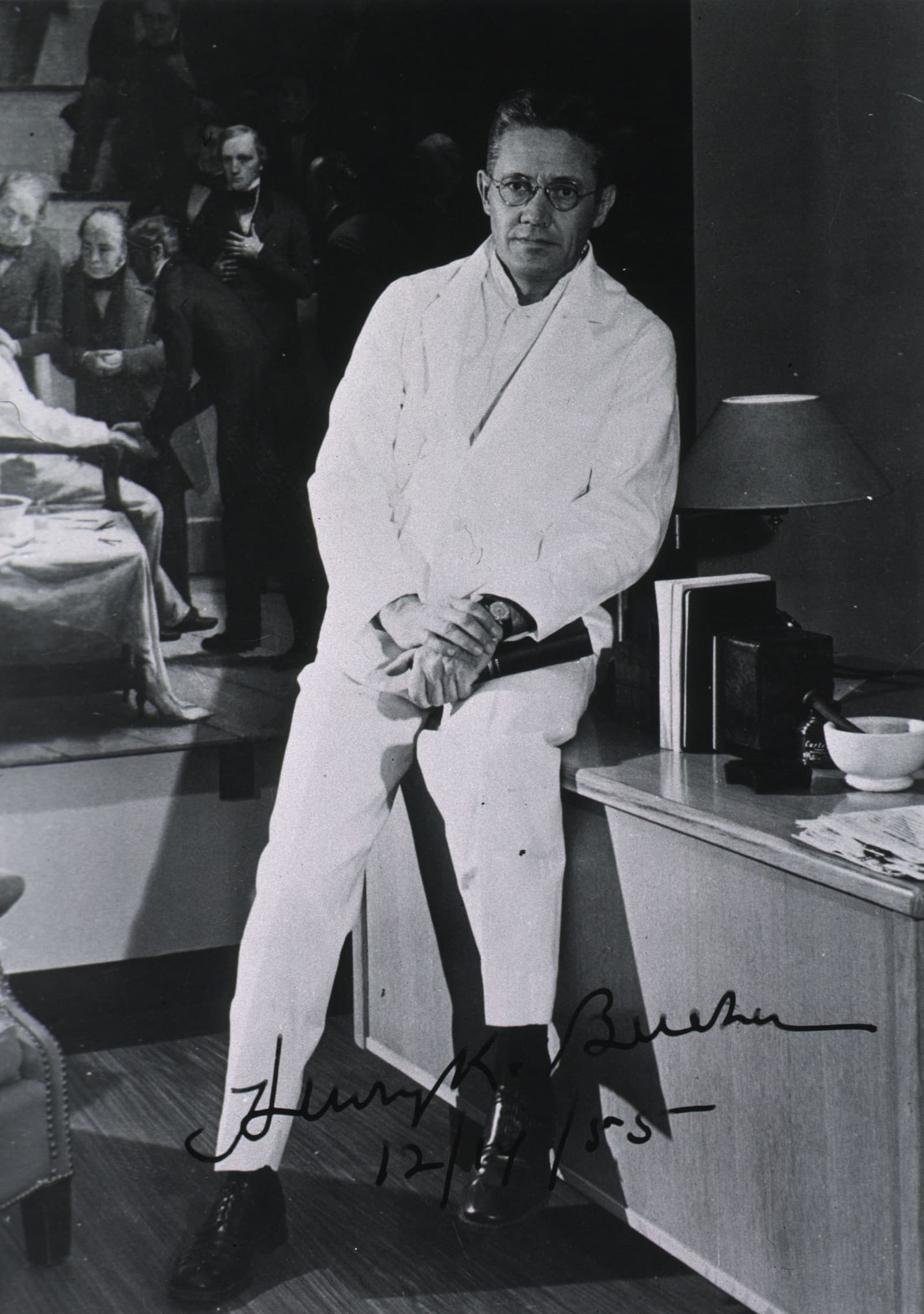
Image context: the cover uses a real 1955 portrait of Beecher from the National Library of Medicine's digital collections.[5] That date helps. The article is about the authority of an insider voice. Beecher's warning carried force precisely because it came from a figure already installed inside elite American medicine rather than from an outsider attacking it from the margins.
Timeline anchors
- 1947: the Nuremberg Code framed voluntary consent in reaction to coercive Nazi human experimentation, creating the postwar background against which Beecher later wrote.[4]
- 1966 (early): Beecher published a short JAMA piece on the gap between formal consent language and actual clinical reality, showing that his concern was already broader than signatures alone.[2]
- 1966-06-16: Ethics and Clinical Research appeared in The New England Journal of Medicine with 22 published examples of ethically troubling research.[1][4]
- 1968: Beecher followed with another NEJM essay on "hopelessly unconscious" patients, showing that his ethical concerns extended beyond research design into the boundaries of medical authority itself.[3]
- 1979: the Belmont Report helped move U.S. research ethics toward a more formal principles-and-oversight architecture than Beecher's article had itself supplied.[3][4]
1. The paper's first move is to relocate the scandal
Beecher's most durable move was spatial. He relocated the problem from the distant and monstrous to the familiar and accomplished. Fischer's summary of the paper notes that Beecher presented 22 examples of ethically problematic human studies and did so in order to expose research that had appeared in ordinary professional circulation rather than in hidden archives.[4] Scher and Kozlowska likewise describe the article as influential because it used actual examples to show failures to inform patients of risk inside modern clinical research.[3]
That is why the article still has force. It does not ask readers to condemn obvious villains first and then congratulate themselves for being different. It asks physicians to recognize that the profession's own journals, departments, and routines had already normalized studies whose subjects received little real protection.[1][3][4] The scandal in Beecher's paper is not only injury. It is recognizability.
This is also the point where the paper stops being a simple consent story. If the problem were merely that one or two rogue investigators forgot to obtain permission, the article could be solved by a cleaner form. Beecher's examples imply something wider: vulnerable patients, therapeutic authority, scientific ambition, and prestige can combine into a setting where ethical alarm weakens before anyone explicitly calls themselves abusive.[1][4]
2. Beecher's ethics are broader than paperwork and narrower than later regulation
The paper is often flattened in two opposite directions. One reading reduces it to "get informed consent." Another treats it as though it already contained the full later apparatus of research governance. Neither reading fits very well.
Miller's critical re-examination is useful here because it traces Beecher's changing view of consent and shows that even Beecher's own position was more complicated than his iconic afterlife suggests.[2] The article matters in part because Beecher did elevate disclosure and subject protection, but he did not write as if a signed permission ritual could redeem any study design whatsoever.[1][2] His examples are chosen to ask whether the experiment itself respects the patient's situation, not simply whether a sentence was spoken beforehand.[1][4]
At the same time, Beecher had not yet arrived at the later administrative world that many readers now project backward onto him. Scher and Kozlowska's history chapter states this with unusual clarity: Beecher expected the profession itself to act after seeing the problem exposed, and he still treated the most reliable safeguard as the presence of an intelligent, informed, conscientious, compassionate, responsible investigator.[3] That is a high moral demand, but it is not the same thing as an oversight system with external review boards, standardized monitoring, and enforceable federal rules.
So the paper stands in a narrow historical position. It is broader than a form and narrower than a bureaucracy.
3. The paper is really about self-policing in public
Beecher chose The New England Journal of Medicine for a reason.[1][3] The paper's audience was not the general public first. It was fellow physicians and clinical researchers. Scher and Kozlowska note that Beecher published in the country's leading medical journal, identified problems concretely, and expected the medical profession to respond.[3] The article therefore works as a public act of professional self-policing.
That helps explain the tone. Beecher is severe, but he is not writing a criminal indictment. He is writing as a physician trying to force medicine to admit what it has begun to tolerate.[1][3][4] The method is exposure through recognizable cases. Once the cases are visible, the profession is supposed to feel shame, draw lines, and correct itself.
Read this way, the article belongs to a moment when elite medicine still hoped that internal discipline could absorb an ethical shock without yet handing the whole problem over to external governance. That hope was historically important, but also limited. Later bioethics and federal regulation grew in part because professional conscience alone was not a stable enough defense.[3][4]
4. What the later memory gets wrong
Later summaries often turn Beecher into a single heroic role: the doctor who invented research ethics by insisting on informed consent.[2][3][6] The historical record is more demanding than that.
First, the paper does not begin from abstract principle. It begins from examples inside respectable research culture.[1][4] Second, Beecher's preferred safeguard was still character-driven and profession-centered rather than strongly institutional.[3] Third, later historians now read Beecher himself inside a more complicated Cold War and academic-medicine setting than older heroic sketches allowed.[2][6] That does not erase the paper's importance. It clarifies it.
The article's real legacy is that it made mainstream medicine harder to sentimentalize. It showed that scientific seriousness and ethical failure are not natural opposites. A study can be well designed in one technical sense, affiliated with a major center, and still fail the people enrolled in it.[1][3][4] That insight still travels.
Why this 1966 paper still reads sharply
The cleanest conclusion is narrower than the legend and stronger than the cliché. Beecher's 1966 paper mattered because it forced a profession to see that unethical research was not hiding only in discredited regimes or secret laboratories. It was already present inside reputable medicine's own published record.[1][3][4] Consent is part of that story, but not the whole of it. The deeper argument is about what happens when prestige, therapeutic authority, and scientific aspiration run ahead of moral scrutiny.
That is why the paper still feels alive. It does not let medicine solve its ethical problem by locating evil somewhere else. It puts the burden back inside the ordinary places where ambitious research wants to look legitimate.
Sources
- H. K. Beecher, "Ethics and clinical research" (The New England Journal of Medicine, 1966) - PubMed record for the original June 16, 1966 article, with journal, date, pagination, DOI, and article link.
- Franklin G. Miller, "Henry Beecher and Consent to Research: a critical re-examination" (Perspectives in Biology and Medicine, 2016) - PubMed abstract on the evolution of Beecher's view of consent and its implications for later research ethics.
- Stephen Scher and Kasia Kozlowska, "The Rise of Bioethics: A Historical Overview" (Rethinking Health Care Ethics, NCBI Bookshelf, 2018) - history chapter framing Beecher's 1966 article as an early bioethics turning point and preserving the paper's profession-centered notion of the "reliable safeguard."
- Bernard A. Fischer IV, "A Summary of Important Documents in the Field of Research Ethics" (Schizophrenia Bulletin, 2006; PMC full text) - overview of the Nuremberg Code, Beecher's 1966 paper, and the article's use of 22 ethically troubling published studies.
- National Library of Medicine Digital Collections, "(Henry Knowles Beecher)" - 1955 portrait record used for the article image, with contributor and image metadata.
- Joseph M. Gabriel and Sukumar P. Desai, ""The Warmth of His Continuing Interest": Henry K. Beecher, the Bioethics Revolution, and Pharmaceutical Industry Funding of Academic Medical Science in Cold War America" (Journal of the History of Medicine and Allied Sciences, 2023) - PubMed abstract situating Beecher's 1966 article inside a broader historical and institutional context.