Modern popular culture treats the defibrillator as a dramatic reset button. A patient collapses, paddles land on the chest, the body jumps, and the heart is somehow started again. The real history is both more technical and more revealing. Defibrillation did not become clinically important all at once, and it did not begin as a general-purpose answer to sudden collapse. It first worked on an exposed heart in a surgical wound. Only later did it become a through-the-chest intervention that could leave the operating table and enter emergency medicine.[1][2][3][4][5]
That is the comparison that matters. Claude Beck's 1947 case proved that a human heart in ventricular fibrillation could be brought back with electrical countershock during surgery. Paul Zoll's 1956 work mattered for a different reason: it showed that the same physiologic goal could be pursued without reopening the chest.[1][2][3] Beck answered whether defibrillation could save a person at all. Zoll answered whether it could become a practical rescue method outside the narrow world of open-heart access.
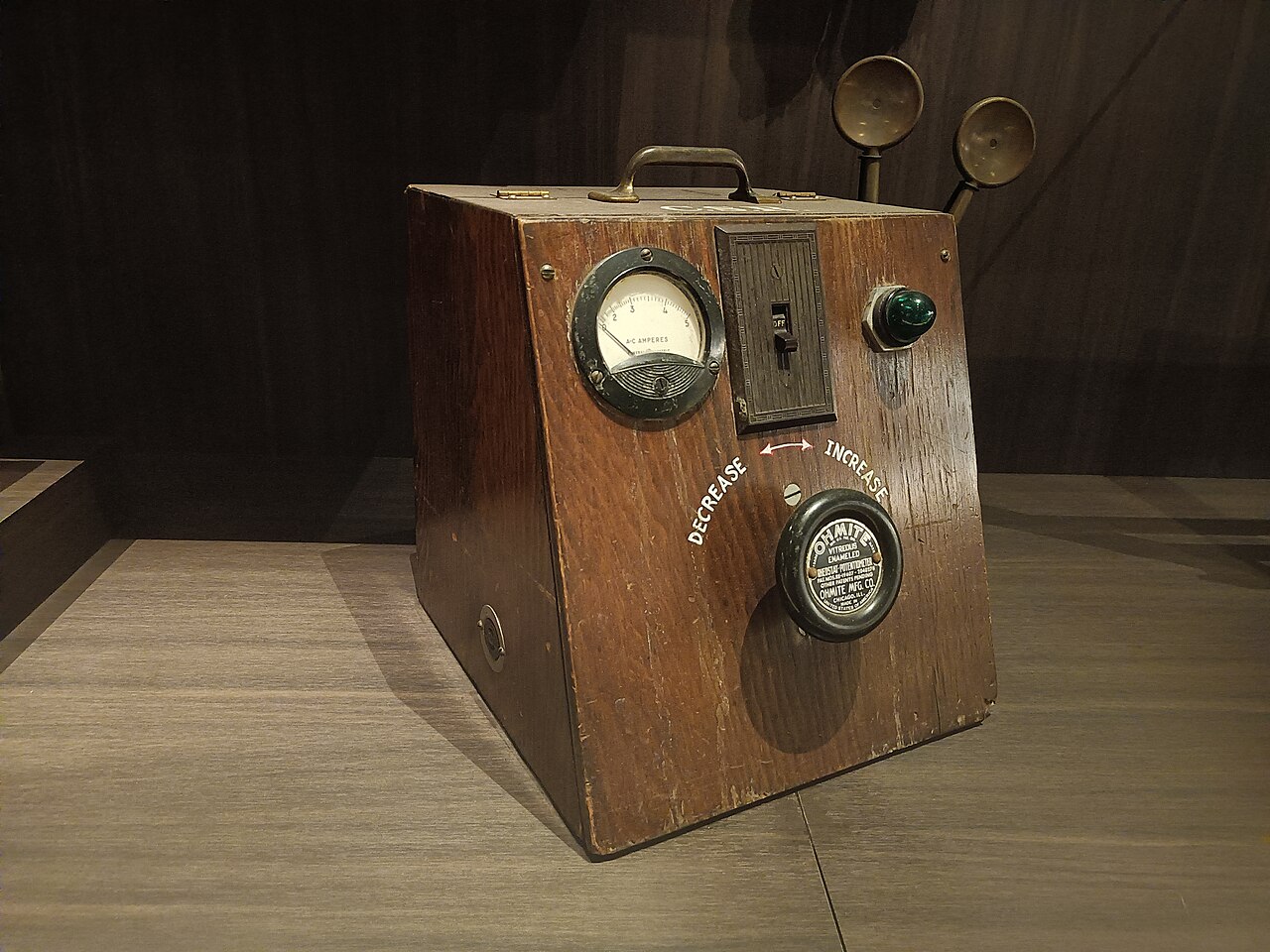
Image context: the cover uses a real museum photograph of Beck's 1947 defibrillator prototype. That choice keeps the article anchored in machinery and method. Defibrillation history is not mainly a story about the symbolism of electric shock. It is a story about what kind of apparatus, access, and team had to exist before shock could become timely treatment.[6]
Timeline anchors
- 1933: the Johns Hopkins group led by Hooker, Langworthy, and Kouwenhoven terminated ventricular fibrillation in a dog with a second shock, giving later clinicians the countershock model.[3]
- 1936: Ferris and colleagues reported closed-chest defibrillation in sheep, showing that external shock was imaginable in animals before it became usable in humans.[3]
- December 13, 1947: Beck, Pritchard, and Feil published the first complete human recovery after intraoperative defibrillation of an exposed heart.[1][4]
- 1956: Zoll and colleagues published work on external electric currents and rhythm control, while the broader external-countershock turn brought successful closed-chest defibrillation into human medicine.[2][3][5]
- 1960: as summarized in later historical review, automatic external defibrillator-pacer design began to appear, showing that the therapy was already moving toward faster, less bespoke deployment.[3]
1. What Beck actually proved in 1947
Beck's famous case was not a street rescue. It was a surgical catastrophe turned into a physiologic experiment under extreme pressure. The patient was a 14-year-old boy undergoing sternal resection for severe funnel chest. During wound closure, the pulse suddenly disappeared. The chest wound was reopened, the heart was directly massaged, and an electrocardiogram confirmed ventricular fibrillation.[1]
The details of the rescue show both the brilliance and the limit of the moment. Beck's report says the heart was massaged for roughly 45 minutes before successful defibrillation was achieved.[1] A first shock failed. After intracardiac procaine and further massage, a second shock restored an organized supraventricular rhythm. Within about 3 hours the patient was responding rationally, and after a stormy but neurologically intact recovery he left the hospital on the 31st day.[1] This was extraordinary medicine, but it was also unmistakably operating-room medicine.
Beck's team used direct access, direct observation, and direct compression. The report describes placing the heart between electrodes and applying brief alternating current across the myocardium itself.[1] Even in success, the method depended on a thoracotomy-level environment: a surgeon already inside the chest, assistants, an electrocardiograph, the ability to reopen immediately, and enough manual circulation to keep the myocardium and brain viable while the rhythm problem was being solved.[1][3][4]
This is why the 1947 case deserves precision. It did not yet prove that sudden cardiac death in ordinary settings had found its answer. It proved something narrower and foundational: ventricular fibrillation in a human being was not automatically irreversible if the heart could be reached and perfused long enough for countershock to work.[1][4]
2. Why that was not yet emergency medicine
Beck's own paper gives the clue. Before this complete recovery, he and his colleagues had already defibrillated human ventricles at the table five other times, but those patients later died without regaining consciousness.[1] So even at the moment of breakthrough, the method remained slow, exposed, and unforgiving. Success depended on access and on sustaining circulation during the interval before normal rhythm returned.
The larger scientific background, summarized in the later PMC history review, makes the same point from another angle. Beck inherited a laboratory tradition shaped by Wiggers and others, in which ventricular fibrillation could be studied on an exposed heart and treated with direct massage plus countershock.[3] That tradition was physiologically rich, but operationally narrow. It fit the laboratory and the open chest. It did not yet fit the unwitnessed collapse in a ward, a home, or a street.
That limitation matters because the practical bottleneck in cardiac arrest is usually time, not only theory. A method that requires reopening the chest can rescue a patient already on the table. It cannot easily help the person whose fibrillation begins behind an intact sternum. Beck solved the first problem with heroic clarity. The second problem remained.
3. What Zoll changed in 1956
Zoll's contribution was not simply to continue Beck's work with newer equipment. It changed the route. The 1956 Circulation paper by Gibson, Linenthal, Norman, Paul, and Zoll is titled around the effect of external electric currents on the heart and the control, induction, and termination of arrhythmias.[2] The later historical review states the practical consequence more directly: in 1956, Paul Zoll demonstrated successful closed-chest defibrillation in humans using an alternating-current shock.[3] ZOLL's own company history preserves the institutional memory in blunt form, calling him the first physician to use external defibrillation successfully to regulate heart rhythms in patients.[5]
That phrasing can sound like branding until one puts it next to Beck. Beck's shock crossed the heart because the chest had already been opened. Zoll's shock crossed the chest wall. That is the real threshold. Defibrillation stopped being a maneuver for the exposed myocardium alone and became a transthoracic therapy. Once that happened, the question changed from "Can the fibrillating human heart be shocked?" to "How quickly can shock be delivered through ordinary body barriers?"[2][3][5]
This did not instantly produce the modern AED. External alternating-current systems were still cumbersome, painful, and technically crude by present standards.[3][4] But the therapeutic geography had shifted. The patient no longer had to be in the middle of surgery for defibrillation to be imaginable. The heart could be reached from outside.
4. The stronger comparison
Seen side by side, Beck and Zoll were not doing the same thing at different levels of polish.
Beck's 1947 rescue solved a proof-of-principle problem. If ventricular fibrillation appeared in a heart that was otherwise salvageable, direct massage plus direct countershock could reverse a rhythm that had looked terminal.[1][4]
Zoll's 1956 work solved an access problem. The life-saving shock no longer depended on a surgical incision as its route to the myocardium.[2][3][5]
That division explains why the later world of emergency-room defibrillators, ambulance defibrillators, and public-access AED cabinets descends more directly from the second threshold than from the first. Beck made defibrillation believable. Zoll made it deployable.
Why the distinction still matters
The history matters because it corrects a common misunderstanding about what defibrillation is for. The machine does not work by theatrically "restarting" any motionless heart. Its historical target was ventricular fibrillation, a rhythm disorder that needed fast interruption before circulation failed beyond recovery.[1][2][3] Beck and Zoll stand on either side of the moment when clinicians learned not only that electric countershock could end fibrillation, but that the therapy had to become physically reachable before it could reorganize survival at scale.
So the cleanest summary is this: Beck's open-chest success made defibrillation clinically real, and Zoll's closed-chest turn made it logistically relevant. Without Beck, there is no proof that a human heart in fibrillation can come back. Without Zoll, there is no practical path from rare operating-room heroics to ordinary emergency care. Modern defibrillation needed both thresholds, but the second is the one that let the shock leave the wound and enter medicine's faster public spaces.[1][2][3][4][5]
Sources
- Claude S. Beck, W. H. Pritchard, and H. S. Feil, "Ventricular Fibrillation of Long Duration Abolished by Electric Shock" (JAMA, December 13, 1947) - the original report of the 14-year-old funnel-chest patient, prolonged cardiac massage, direct countershock, and complete recovery.
- W. Gibson, A. J. Linenthal, L. R. Norman, M. H. Paul, and Paul M. Zoll, "The effect of external electric currents on the heart; control of cardiac rhythm and induction and termination of cardiac arrhythmias" (Circulation, 1956; PubMed record) - primary bibliographic source for Zoll's 1956 external-current work in humans.
- Antonis S. Catanchin and Anand G. M. Cheng, "Cardioversion: Past, Present, and Future" (Current Problems in Cardiology, 2009; PMCID: PMC2782563) - accessible historical review covering the 1933 dog countershock, Beck's 1947 open-heart case, Zoll's 1956 closed-chest turn, and the early automatic-device era.
- H. D. Esperer and H. U. Klein, "50 years of successfull human defibrillation. A history of continuing progress" (Herzschrittmachertherapie & Elektrophysiologie, 1997; PubMed record) - historical review describing the circumstances and significance of Beck's first successful human defibrillation.
- ZOLL Medical Corporation, "History" - company history page summarizing Paul Zoll's 1952 pacing milestone and 1956 external-defibrillation breakthrough.
- Wikimedia Commons, "File:1947 defibrillator.jpg" - source page for the museum photograph of Claude Beck's 1947 defibrillator prototype used as the article image.