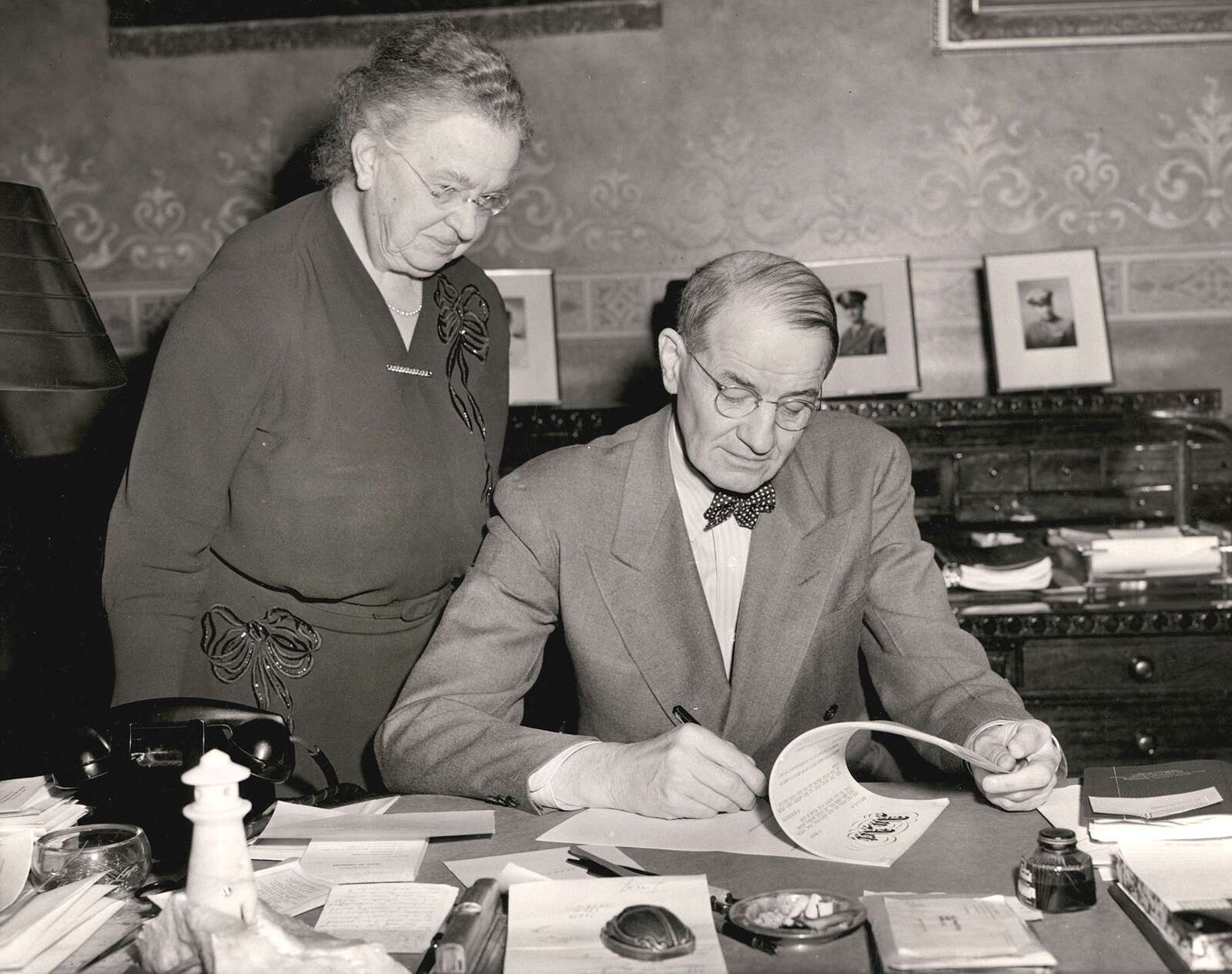
In the 1947 photograph, Florence Sabin is standing, not signing. Colorado governor Lee Knous sits at the desk while she looks over his shoulder. The arrangement suits the kind of power she had built. Sabin did not hold elected office. She made a public-health program difficult for officeholders to ignore.[7]
The familiar biography presents a procession of firsts: the first woman to become a full professor at the Johns Hopkins School of Medicine, the first woman elected to the National Academy of Sciences, the first woman to become a full member of the Rockefeller Institute. Her last career is less easily reduced to a first. In her seventies, after retiring from laboratory research, she helped turn a diagnosis of Colorado’s weak health administration into a statewide political campaign.[3][6]
From 1944 through the legislative session of 1947, Sabin’s contribution was a sequence of handoffs: commission an outside survey, convert statewide findings into county-specific evidence, carry that evidence through local meetings, turn a coalition’s demands into bill text, and give counties legal machinery for building services. The work did not end at passage. Money, trained personnel, local votes, and implementation remained its weakest links.[1][2][3]
The scientist returned to a problem with no laboratory boundary
Sabin had spent her research career making biological structures visible. At Johns Hopkins she worked on the development of the lymphatic system; at Rockefeller, beginning in 1925, she led cellular studies of immunity and tuberculosis. She retired in 1938, then joined Colorado’s postwar planning work in 1944. That sequence matters, but it should not be romanticized as if laboratory authority automatically conferred political wisdom. The transferable habit was narrower: define a system, locate its missing connections, and organize evidence so other people can inspect it.[3][6]
Colorado’s health problem was administrative as well as clinical. In Sabin’s own 1947 account, the state health division sat under the governor, had been vulnerable to political appointments, and received state appropriations of less than ten cents per resident per year. Of Colorado’s 63 counties, only four had full-time health services. Denver’s charter also insulated its health department from some state influence. The state possessed medical knowledge, but much of it had no durable route into local inspection, nursing, disease control, or sanitation.[1]
Institutional histories date Sabin’s appointment to Colorado’s postwar planning work to 1944; in her own 1947 account, she places the governor’s appointment of its health committee in 1945. With Sabin as chair, the committee secured Commonwealth Fund support for the American Public Health Association to survey the state under field director Carl E. Buck. Issued in January 1946, the Buck report used vital statistics and organizational review to compare Colorado with other states and to identify preventable deficiencies. A later official state history summarizes its most arresting estimate: 8,245 deaths between 1940 and 1944 might have been prevented if existing preventive knowledge had been applied throughout Colorado.[1][2][3][6]
That figure was a counterfactual estimate, not a ledger of 8,245 individually proven causes. Its political force came from converting absence—services never built, inspections never made, prevention never delivered—into a quantity the state could debate. The survey’s deeper diagnosis was institutional: Colorado could not reliably act on what public health already knew.[1][2]
The campaign ran on two tracks
Sabin described two kinds of work proceeding together. An executive committee studied the report, drafted legislation, and negotiated technical details. A public campaign carried Buck’s findings and the committee’s developing program to residents around the state. Either track alone would have been fragile. A technically polished bill could die quietly; public alarm without legal design could dissipate.[1]
The meetings were built around local rather than generic evidence. Teams from the state health division, the medical school, schools, and other services brought county data; Sabin wrote that they avoided set speeches as new findings emerged. Every county meeting attracted people from at least two counties, some driving 75 to 100 miles. One meeting would seed another—the committee’s running observation was, “How your program is growing.”[1]
This was not simply a lone scientist touring with a lecture. The Colorado State Medical Society helped draw and jointly sponsor common bills, even giving up its tax-exempt status so it could lobby more actively. Dairy representatives and public-health experts negotiated standards for milk production and processing. Women’s clubs, parent-teacher groups, chambers of commerce, lawyers, ministers, universities, newspapers, and radio stations carried the argument into different constituencies. The coalition was deliberately broad, and its executive committee invited affected groups into discussion without promising any industry a statutory seat on the Board of Health.[1]
The method also let local action outrun the state package. Sabin recalled one town organizing a sewage-disposal fund after residents saw its own conditions, while another improved its milk supply after a local inspection discussion. Those anecdotes do not establish population-level effects. They show what the campaign was trying to do: make statewide capacity legible through a problem people could see at home.[1]
Eight bills had to work as a package
Sabin’s contemporary account counted eight bills. Five concerned services and appropriations; three targeted tuberculosis and bovine brucellosis, then commonly called Bang’s disease. Read together, they were not eight cures. They were parts of a working public-health apparatus.[1]
The State Reorganization Bill created a Department of Public Health with a nine-member board and an executive division. The enacted law gave the department responsibility for administering state health laws rather than leaving health as a small gubernatorial division. A second measure allowed county, city-county, and multicounty health units to form. Another funded the state department and aid to counties, raising the proposed biennial state-aid grant from nothing to $150,000. An enabling act let Colorado participate in the federal hospital-construction program, and a further appropriation supported the medical school’s plan to train more general practitioners with public-health experience.[1][4]
The disease bills reveal the compromises hidden by a victory label. The allowance for hospitals caring for indigent tuberculosis patients rose from $4 to $6 per day. A request for a new 100-bed tuberculosis wing yielded support for 30 beds instead. The cattle-health bill, which would have required quarantine and reporting for infected dairy cows but not compulsory testing or slaughter, was buried in committee after livestock opposition. Sabin called it the only complete defeat in the package.[1]
Even the package’s score is not perfectly stable across later accounts, but the difference can be traced. Colorado’s official history follows Sabin’s eight-bill frame and says seven passed. The National Academy of Sciences memoir defines a narrower six-measure program: it leaves out the general and medical-school appropriations that Sabin counted separately, treats the state tuberculosis hospital and brucellosis bills as failures, and therefore reports four initial passages. Sabin’s contemporary account, by contrast, treats the reduction from a 100-bed tuberculosis wing to 30 beds as a limited gain and calls the cattle bill the only complete defeat. The defensible conclusion is structural, not numerical: reorganization, local health units, federal hospital participation, and important funding provisions survived; the tuberculosis plan was reduced; the 1947 cattle-control bill failed before a compromise measure passed in 1949; and appropriations never fully matched the program’s ambition.[1][2][3][4]
A five-county unit shows what “permissive” law could do
The multicounty measure was permissive: it made cooperation possible but did not command counties to cooperate. County commissioners still had to vote, budgets still had to be assembled, and workers still had to be found. Sabin reported that, immediately after the legislature adjourned in April 1947, four groups of counties were already planning district health units.[1]
Southwestern Colorado supplies a concrete afterimage. Archuleta, La Plata, Montezuma, Dolores, and San Juan counties began organizing the San Juan Basin Health Unit in September 1947; the official state history lists it among the local departments established in 1948. The unit began with 13 staff members and a budget of $50,120. In 1948 its work included inspections of 92 restaurants, 30 dairy barns, and eight milk-processing plants. None of those activities was glamorous, which is precisely the point: the law’s achievement was to make routine capacity possible across county lines.[2][7]
The unit does not prove that every district worked equally well, or that the Sabin program alone produced later health gains. It does show the mechanism between a state statute and a local service. Legal permission lowered one barrier; county agreement, shared financing, and personnel had to clear the rest.[1][7]
The numbers did not prove that milk explained Colorado
The campaign’s clarity came with a risk. Historian Elizabeth Cullen Dunn argues that Sabin made unsafe milk a particularly powerful symbol of a state unable to regulate health hazards. Milk joined mothers, children, small dairies, industrial processors, inspection, and expert authority in one politically vivid object. But a vivid object is not the same as a complete causal explanation.[5]
Sabin’s own 1947 paper is broader than a milk-only story: it discusses raw sewage, hospital capacity, tuberculosis, medical training, local staffing, and the organization of government. The Buck estimate of preventable deaths likewise did not demonstrate that unpasteurized milk caused each difference between Colorado and better-performing states. Dunn’s critical reading goes further, arguing that water and sewage hazards may have been more important in some places and that the campaign’s emphasis helped legitimate a more technocratic state.[1][2][5]
The boundary matters. Public-health statistics can reveal a pattern of avoidable loss without identifying a single exposure responsible for it. Professional administration can reduce patronage and improve technical capacity while also shifting power toward credentialed experts and larger regulated organizations. Sabin’s achievement was political as well as scientific; therefore it should be evaluated as a choice about institutions, not treated as neutral data finally defeating ignorance.[1][4][5]
Passage exposed the next bottleneck
The closing paragraph of Sabin’s 1947 paper refuses a tidy ending. New district units needed workers, yet wartime refusals to use federal training grants had left Colorado without a reserve of public-health personnel. “Personnel is now the major problem,” she wrote. The later National Academy memoir adds that implementation remained incomplete because legislative appropriations did not fully follow the authorizations.[1][3]
That is the most useful scale for Sabin’s Colorado microhistory. A survey did not itself prevent disease. It made deficiencies arguable. County meetings did not themselves create services. They built demand and local ownership. Bills did not themselves inspect milk, control sewage, staff clinics, or trace tuberculosis. They created authority and financing routes through which workers might do those things.
Sabin made Colorado’s health statistics travel—from a professional report to a blackboard, from one county meeting to the next, from committee rooms into statutory language, and from state law back into multicounty offices. The photograph at the governor’s desk records one hinge in that journey, not its finish.[1][7]
Sources
- Florence R. Sabin, “The People Win for Public Health in Colorado,” American Journal of Public Health, 1947 — Sabin’s contemporary account of the survey, county campaign, coalition, eight bills, compromises, and personnel shortage.
- Colorado Department of Public Health and Environment, History of Public Health in Colorado — official history of the Buck report, its preventable-death estimate, the 1947 legislative package, and the early district-health system.
- Philip D. McMaster and Michael Heidelberger, “Florence Rena Sabin, 1871–1953,” National Academy of Sciences, 1960 — biographical memoir covering Sabin’s research career, Colorado organizing, legislative program, and implementation limits.
- Colorado General Assembly, “Relating to Public Health, Providing for the Creation of a State Department of Public Health and for the Administration of the Public Health Laws,” Chapter 208, 1947 — catalog and full text of the state-reorganization act.
- Elizabeth Cullen Dunn, “The pasteurized state: milk, health and the government of risk,” Endeavour, 2011 — historical analysis of milk, expertise, political organization, and risk in Sabin’s campaign.
- U.S. National Library of Medicine, “Biography: Dr. Florence Rena Sabin” — institutional biography of Sabin’s Johns Hopkins and Rockefeller research careers and her later Colorado public-health work.
- Reuben M. Schafir, “End of an era: 75 years of San Juan Basin Public Health,” Durango Herald, 2024 — the 1947 bill-signing photograph and local history of the five-county health unit created after the Sabin legislation.