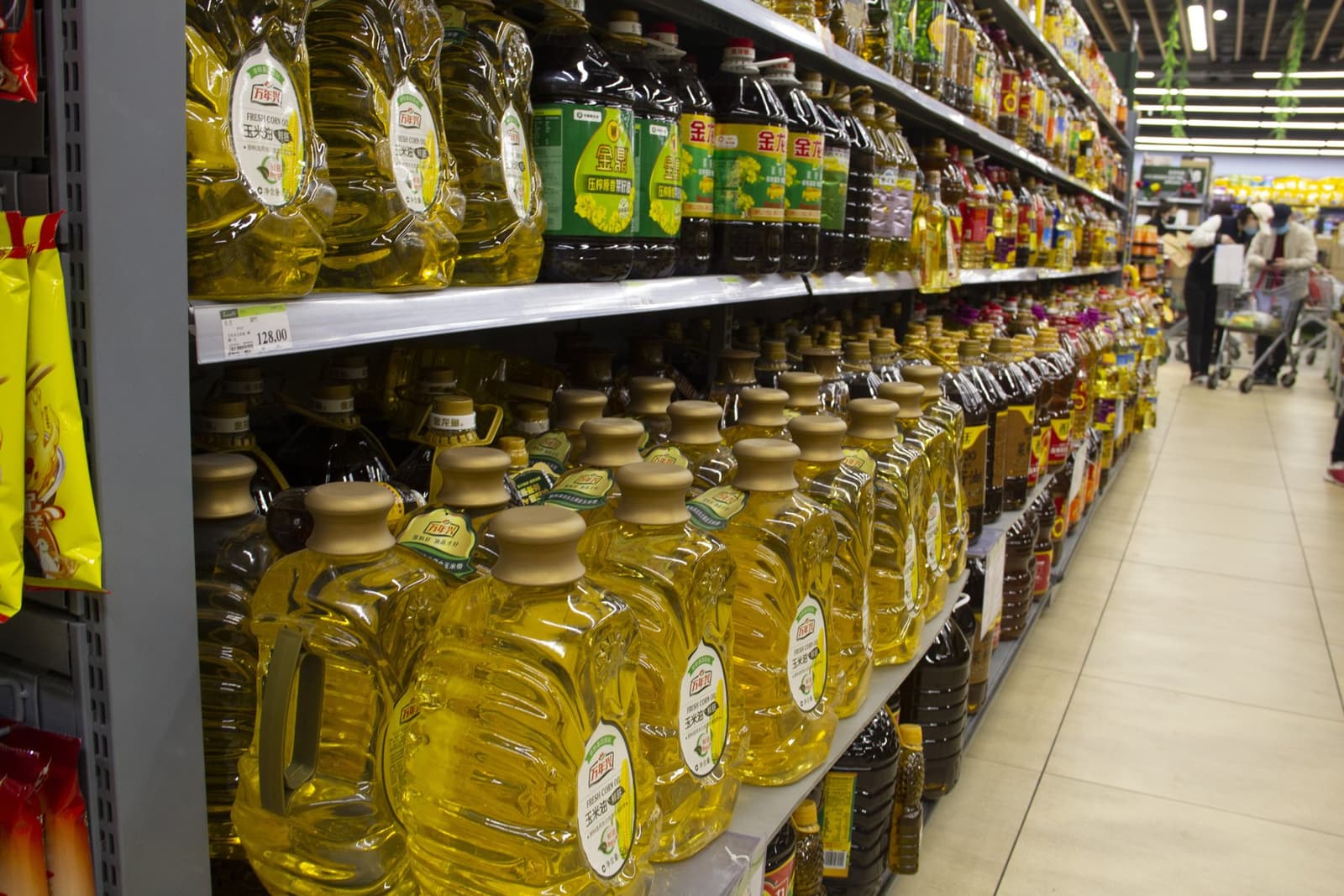
The myth now travels faster than the evidence: seed oils cause chronic inflammation, so replacing them with butter, beef tallow, or “seed-oil-free” eating is a health upgrade by default. It feels intuitive because the foods people distrust most—fast food, packaged snacks, deep-fried convenience meals—often contain soybean, corn, canola, sunflower, or safflower oil.
That observation is real. The conclusion usually attached to it is much weaker.
When the question is framed precisely—does higher intake of linoleic-acid-rich unsaturated oils, in ordinary diets, reliably raise inflammatory markers or worsen cardiovascular outcomes compared with the fats they usually replace?—the strongest evidence does not support the inflammatory-villain story.[1][2][3][4] If anything, long-run outcome data more often point in the opposite direction, especially when unsaturated oils replace butter or other saturated-fat-heavy choices.[3][4][5][7]
Image context: the hero image shows a supermarket shelf of cooking oils because the public argument often treats the entire category as one unified threat. This article stays narrower: substitution evidence, inflammatory evidence, and the line between the oil itself and the ultra-processed foods that often surround it.
What the myth gets right
The myth survives because it starts from a pattern people can see.
By 2024, umbrella-review evidence linked greater ultra-processed food exposure to worse cardiometabolic outcomes across a huge evidence base—45 pooled analyses spanning 9,888,373 participants, with “convincing” evidence for higher cardiovascular-disease-related mortality (risk ratio 1.50, 95% CI 1.37–1.63) and type 2 diabetes risk in some analyses.[6] Many ultra-processed foods contain seed oils because those oils are cheap, neutral-tasting, and industrially convenient.
So the everyday intuition is understandable: people notice unhealthy industrial food, then identify one visible ingredient and promote it to the entire causal explanation.
That is where the argument usually outruns the data. The strongest evidence does not show that the presence of linoleic-acid-rich oil in a diet, by itself, behaves like a reliable inflammation trigger in humans.[1][2]
The core evidence problem: inflammation claims keep failing direct tests
The inflammatory argument usually runs through a plausible biochemical story. Linoleic acid is an omega-6 polyunsaturated fat. Omega-6 fats can feed into arachidonic-acid pathways, and arachidonic acid can generate inflammatory mediators. The leap is from can participate in one biochemical pathway to therefore routine dietary intake raises whole-body chronic inflammation in real people.
That leap has repeatedly struggled in direct human evidence.
A 2012 systematic review of randomized controlled trials identified 15 clinical trials that could test whether changing dietary linoleic acid meaningfully changed inflammatory biomarkers in healthy humans. The review found essentially no evidence that adding linoleic acid increased CRP, fibrinogen, cytokines, adhesion molecules, or tumor-necrosis-factor markers in a consistent way.[1]
A broader 2017 meta-analysis then pooled 30 randomized controlled studies involving 1,377 subjects. Again, increasing linoleic acid intake showed no significant overall effect on CRP (SMD 0.09, 95% CI -0.05 to 0.24), TNF-α (SMD -0.01, 95% CI -0.19 to 0.17), interleukin-6 (SMD 0.11, 95% CI -0.07 to 0.29), adiponectin, MCP-1, fibrinogen, or adhesion molecules.[2]
That does not prove every oil is harmless in every use-case. It does something more specific and more important: it undercuts the broad consumer claim that ordinary dietary linoleic acid is a reliable driver of chronic systemic inflammation.
Cardiovascular outcome data point away from the myth
If seed oils were generally acting as an inflammatory toxin in human diets, you would expect long-run cardiovascular outcome data to lean negative. Instead, the more durable pattern is that replacing saturated fat with polyunsaturated plant oils tends to look favorable.
A 2014 meta-analysis of prospective cohort studies pooled 13 cohorts, 310,602 individuals, and 12,479 total coronary heart disease events. Higher linoleic acid intake was associated with a 15% lower risk of CHD events (RR 0.85, 95% CI 0.78–0.92) and a 21% lower risk of CHD death (RR 0.79, 95% CI 0.71–0.89). For each 5% of energy increase in linoleic acid replacing saturated fat, CHD events fell 9% and CHD deaths 13%.[3]
A 2017 American Heart Association presidential advisory then summarized broader randomized and observational evidence and concluded that lowering saturated fat and replacing it with unsaturated fats—especially polyunsaturated vegetable oils—reduced cardiovascular disease by roughly 30% in randomized trials, a magnitude the authors compared with statin-era preventive benefit.[4]
The long-run mortality literature is directionally similar. A 2020 systematic review and meta-analysis covering 811,069 participants with dietary intake assessment found that higher linoleic-acid intake was associated with lower total mortality (RR 0.87, 95% CI 0.81–0.94), lower cardiovascular mortality (RR 0.87, 95% CI 0.82–0.92), and lower cancer mortality (RR 0.89, 95% CI 0.85–0.93).[5]
And by 2025, a large JAMA Internal Medicine cohort analysis of 221,054 adults over as much as 33 years reported the same practical substitution signal. Highest butter intake was linked to 15% higher total mortality (HR 1.15, 95% CI 1.08–1.22), whereas highest plant-based-oil intake was associated with 16% lower total mortality (HR 0.84, 95% CI 0.79–0.90). Replacing 10 g/day of butter with plant-based oils was associated with an estimated 17% lower total mortality.[7]
These are not the numbers you expect if the routine public-health advice should be “swap your canola oil for butter and you are automatically moving toward lower inflammation and better survival.”
Where the public argument keeps getting mixed up
The phrase “seed oils” sounds more precise than it really is.
It also compresses oils with meaningfully different fatty-acid profiles, kitchen roles, and food contexts into one villain label. Even before outcome data enter the picture, the category is already doing rhetorical work that chemistry and eating pattern do not neatly support.
It merges several different questions into one accusation:
-
What happens when unsaturated plant oils replace saturated fats in the diet?
This is the question most directly tested by cardiovascular and mortality evidence, and the answer is generally favorable to the plant-oil substitution.[3][4][5][7] -
What happens when people eat a lot of ultra-processed food?
That question usually gives a much darker answer, but the mechanism bundle includes energy density, refined starches, sugar, sodium, low fiber, additives, eating pattern, and overall dietary displacement—not just the oil component.[6] -
What happens in restaurant or industrial frying environments?
That is a different exposure again, involving repeated heating, food matrix, portion size, and the fact that fries, nuggets, chips, and pastries are not equivalent to a measured amount of oil used at home in a broader dietary pattern.
Once those three questions are separated, the mythology loses a lot of force. The bottle on a kitchen shelf is not the same object as the whole ultra-processed food economy.
A cleaner practical rule for 2026
A more evidence-aligned rule is boring, which is usually a good sign.
- If the choice is butter/lard/tallow vs an unsaturated plant oil for routine cooking, outcome data generally favor the unsaturated oil side.[3][4][5][7]
- If the choice is home-cooked food vs ultra-processed snack/fried-food patterns, the bigger public-health win usually comes from reducing ultra-processed exposure and improving total diet quality, not from turning one ingredient into a moral category.[6]
- If the concern is “inflammation”, current randomized evidence does not justify telling healthy adults that ordinary intake of linoleic-acid-rich oils is a proven inflammation driver.[1][2]
The most useful grocery-cart question is therefore not “is this a seed oil?” but “what is this choice displacing, and what food pattern does it travel with?” A bottle used to cook beans, fish, vegetables, or eggs at home is one exposure. An industrial fried snack engineered for overconsumption is another. Collapsing both into one villain category feels emotionally satisfying, but it is exactly the simplification the current evidence keeps resisting.[3][4][6][7]
That is a narrower conclusion than either tribe usually wants. It does not say every industrial food is healthy because it contains plant oil. It says the specific anti-seed-oil inflammatory claim is stronger on social media than in human outcome evidence.
A 30-second grocery heuristic
For everyday decisions, this quick filter is usually more useful than “seed oil / no seed oil” labels:
- What is this replacing? (butter-heavy cooking, whole-food meals, or another processed snack)
- What pattern does it belong to? (home-cooked meal vs ultra-processed convenience loop)
- How often and in what dose? (routine daily base vs occasional exposure)
Those three checks keep the focus on risk structure rather than ingredient branding.
Decision-grade takeaway
The myth confuses an unhealthy food environment with a single fat category.
The best current evidence supports three bounded conclusions:
- Higher linoleic-acid intake has not reliably raised inflammatory biomarkers in randomized human trials.[1][2]
- Replacing saturated fat with polyunsaturated plant oils is generally associated with lower, not higher, cardiovascular risk.[3][4]
- The strongest modern diet harms cluster more credibly around ultra-processed-food exposure and overall dietary pattern than around the mere existence of a seed-oil bottle in the kitchen.[6][7]
What would change this view
This assessment should change if future high-quality evidence shows one of three things:
- Large randomized feeding trials consistently demonstrate higher systemic inflammatory markers or worse clinical outcomes from ordinary linoleic-acid-rich oil intake.
- Long-run cohort or trial evidence reverses and shows plant-oil substitution performing worse than butter or other saturated-fat sources after careful confounder control.
- Mechanistic concerns about ultra-processed or frying contexts are shown to transfer cleanly to ordinary household use in a way current human evidence has missed.
Sources
- Johnson GH, Fritsche K. Effect of dietary linoleic acid on markers of inflammation in healthy persons: a systematic review of randomized controlled trials (J Acad Nutr Diet, 2012, PMID: 22889633)
- Liou YA et al. Dietary linoleic acid intake and blood inflammatory markers: a systematic review and meta-analysis of randomized controlled trials (Prostaglandins Leukot Essent Fatty Acids, 2017, PMID: 28752873)
- Farvid MS et al. Dietary linoleic acid and risk of coronary heart disease: a systematic review and meta-analysis of prospective cohort studies (Circulation, 2014, PMID: 25161045)
- Sacks FM et al. Dietary Fats and Cardiovascular Disease: A Presidential Advisory From the American Heart Association (Circulation, 2017, PMID: 28620111)
- Li J et al. Dietary intake and biomarkers of linoleic acid and mortality: systematic review and meta-analysis of prospective cohort studies (Am J Clin Nutr, 2020, PMID: 32020162)
- Lane MM et al. Ultra-processed food exposure and adverse health outcomes: umbrella review of epidemiological meta-analyses (BMJ, 2024, PMID: 38418082)
- Zhang Y et al. Butter and Plant-Based Oils Intake and Mortality (JAMA Intern Med, 2025, PMID: 40048719)