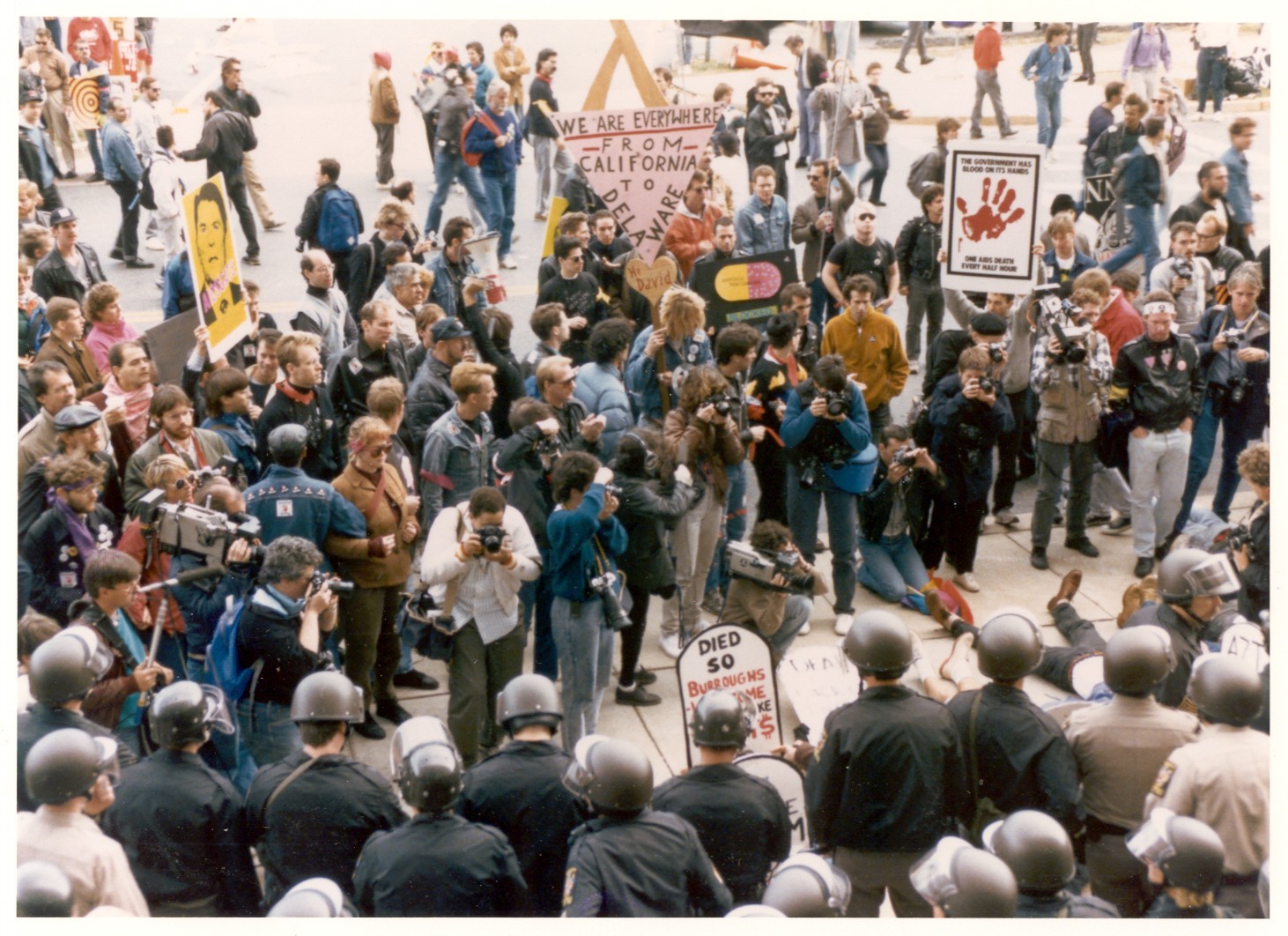
ACT UP's 1988 FDA protest is easy to remember as confrontation: signs, police lines, cameras, mock tombstones, and the blunt theatrical force of a movement refusing to wait politely. That memory is not wrong, but it is incomplete. The deeper health lesson is that ACT UP turned drug access from a private crisis into a public record. The protest made a regulatory timetable visible as a clinical condition.
The epidemic had already forced medicine to move faster than its ordinary language. On June 5, 1981, CDC's MMWR published the Los Angeles report describing five young men with biopsy-confirmed Pneumocystis carinii pneumonia; two had died by publication.[1] By 1987, the National Library of Medicine's AIDS history exhibition notes, more than 46,000 Americans had become infected with HIV and more than 13,000 had died from AIDS.[2] That same year, FDA approved zidovudine, or AZT, as the first antiretroviral drug for AIDS treatment, but price, eligibility, trial design, and the pace of review kept access from becoming simple.[4]
That is the pressure behind the photograph above. It is not just a protest scene. It is a picture of dying time being dragged into administrative space. People with AIDS and their allies were asking why evidence, access, and urgency had to be arranged as if they belonged to separate worlds.
The doorstep mattered
On October 11, 1988, ACT UP's "Seize Control of the FDA" action brought roughly 1,500 activists from around the United States to FDA headquarters in Rockville, Maryland.[3] The ACT UP Oral History Project describes it as the group's first national action, coordinated by ACT NOW, with the demand that FDA speed research, development, and approval of AIDS drugs.[3] The day before, activists had staged a mock trial outside the Department of Health and Human Services; the FDA action then moved the indictment to the agency most visibly associated with the gate between experimental medicine and approved treatment.[3]
The choice of target is the first thing commemoration should preserve. ACT UP was not saying that science did not matter. It was saying that the rules for producing and distributing medical evidence were themselves public-health objects. Trial enrollment criteria, compassionate-use mechanisms, surrogate markers, advisory committees, and disease definitions were not neutral paperwork when people were dying outside the protocol.
NLM's exhibition frames the movement's demand in precisely those terms: activists fought to be included in the scientific process, demanded new drugs, pushed for an expanded definition of AIDS, and insisted that wider inequalities could not be ignored.[2] That is why the protest's visual grammar still matters. Mock tombstones and "blood on its hands" signs did not replace technical knowledge; they gave technical disputes a moral address. The crowd made delay legible to television, to agency staff, and to the future archive.
The afterlife was procedural, not just symbolic
The strongest reason to remember the FDA action as health history is that its afterlife moved into procedure. FDA's own history says the ACT UP protest publicized patient concerns, pushed the agency toward accelerated approval regulations, and accompanied treatment IND rules that had been implemented in 1987 for investigational drugs.[4] The same FDA account notes that the agency created a Division of Antiviral Products in 1988, with principal responsibility for reviewing antiviral and anti-infective drugs to treat HIV/AIDS.[4]
The access mechanisms were contested because they had to solve two problems at once. They had to preserve credible evidence, and they had to acknowledge that some patients could not wait for the ordinary sequence of trial completion, review, labeling, marketing, and reimbursement. The National Academies' historical account of investigational access explains that the treatment IND mechanism applied to serious or life-threatening conditions without satisfactory alternatives, but also records activists' frustration that it remained too narrow.[5] As of March 12, 1990, the account says FDA had approved 18 treatment INDs and almost 20,000 patients had obtained access to drugs not yet approved for marketing; advocates still argued that the mechanism often bridged the gap only late in development.[5]
That tension led to parallel-track thinking. In June 1989, Anthony Fauci presented the concept of a parallel track for selected HIV investigational drugs, aimed at patients who could not join conventional trials and had no therapeutic alternatives, while controlled trials continued.[5] This is the practical policy memory that spectacle alone can obscure: the movement did not merely ask institutions to feel urgency. It forced institutions to design around it.
The later accelerated-approval pathway shows the same bargain in more durable regulatory language. FDA's current accelerated-approval page says that in 1992 the agency instituted regulations allowing drugs for serious conditions with unmet medical need to be approved based on a surrogate endpoint, a marker considered reasonably likely to predict clinical benefit, with further study required to verify benefit.[6] That pathway has since traveled far beyond HIV. Its contested modern life belongs to oncology, rare diseases, and other fields, but its public memory still carries the AIDS crisis argument: evidence standards matter, and so does the human cost of making proof arrive too late.
What the photograph asks us not to simplify
The image is powerful partly because it refuses a tidy division between medicine and politics.[7] The police helmets in the foreground, the photographers gathered around the die-in, the hand-lettered signs, and the institutional setting all show a public-health system being forced to see itself from outside. The activists are not inside a clinic, yet the scene is about clinical survival. They are not inside a regulatory meeting, yet the scene is about the shape of regulatory authority.
That is why commemoration should avoid two easy mistakes. The first is to make ACT UP a simple morality play in which angry patients defeated a faceless agency and progress followed automatically. The record is more demanding than that. The access problem involved real uncertainty: early drugs could be toxic, surrogate markers could mislead, and rushed availability could undermine trials if systems were poorly designed.[5][6] The second mistake is to make regulatory caution sound clean and apolitical. By 1988, caution also had a social distribution. People with money, proximity to research centers, trial eligibility, and insider knowledge could sometimes find options. Others met the epidemic as a closed door.
Memory matters because it keeps that distribution visible. In ACT UP's public-health imagination, expertise did not belong only to agencies, companies, or academic investigators. People living with AIDS learned trial language, read protocols, challenged endpoints, demanded inclusion, and exposed the difference between a rule that is formally equal and a rule that can actually be used.[2][3][5]
The FDA protest also belongs beside later fights over disease definition. NLM notes that ACT UP actions pushed for women with AIDS to receive care and treatment; by 1992, activists had succeeded in getting women officially recognized in the AIDS definition.[2] That detail widens the lesson. Access was not only about faster drugs. It was about who counted as a patient, who counted as evidence, and who could enter the system before dying outside its categories.
The health lesson that survives the anniversary
To remember ACT UP at the FDA is to remember that public health sometimes changes when suffering becomes administratively inconvenient. The protest made a narrow gate visible. Then activists kept pushing until parts of the gate were redesigned: treatment IND, parallel track, accelerated approval, patient participation, and a stronger claim that people facing a fatal disease had standing inside research policy.[4][5][6]
None of that means every demand was easy, every proposed shortcut was sound, or every later accelerated approval has been vindicated. The harder point is better. ACT UP forced American medicine to admit that "more evidence" and "more time" are not ethically neutral phrases when time is what the disease is taking. The movement's lasting public-health memory is not only rage. It is the insistence that regulatory systems must be judged by how they handle uncertainty while people are still alive to benefit.
Sources
- Centers for Disease Control and Prevention, "Pneumocystis Pneumonia - Los Angeles," MMWR, June 5, 1981 - the first CDC report describing the unusual cluster later recognized as part of the AIDS epidemic.
- National Library of Medicine, "Surviving and Thriving: AIDS, Politics and Culture" - exhibition timeline and interpretation of AIDS activism, ACT UP, NIH actions, disease-definition advocacy, and the changing relation between science and society.
- ACT UP Oral History Project, "Seize Control of the FDA" - action page documenting the October 11, 1988 FDA protest, approximate turnout, organizers, demands, and preserved video materials.
- U.S. Food and Drug Administration, "The History of FDA's Role in Preventing the Spread of HIV/AIDS" - FDA history page covering HIV test licensing, AZT approval, ACT UP's FDA protest, antiviral review infrastructure, and patient engagement.
- National Academies / NCBI Bookshelf, "Historical Perspective," in Expanding Access to Investigational Therapies for HIV Infection and AIDS - treatment IND, March 1990 access counts, advocates' criticisms, and the parallel-track proposal.
- U.S. Food and Drug Administration, "Accelerated Approval" - current FDA explanation of the 1992 accelerated-approval regulations, surrogate endpoints, unmet medical need, and confirmatory evidence.
- The U.S. Food and Drug Administration on Flickr, "FDA History - AIDS Protest" - original FDA source page for the archival 1988 ACT UP AIDS protest photograph used as the article image.