Dental sealants are easy to undersell because they look too small for the job. A thin coating painted onto a chewing surface does not feel like a major public-health tool. The mechanism is precisely why it matters: molars are not smooth walls. They are grooved landscapes where food particles and bacterial biofilm can sit beyond the reach of ordinary brushing, especially soon after permanent molars erupt.[1][5]
The sealant does not make a child immune to tooth decay. It changes one high-risk surface before decay has a chance to establish itself. CDC's current oral-health guidance, updated May 15, 2024, puts the timing in plain terms: first permanent molars usually come in around age 6, second molars around age 12, and sealants work best when applied soon after those teeth emerge.[1] That is the causal window. The tooth arrives with anatomy that favors retention of plaque and fermentable carbohydrate. The sealant turns the pits and fissures into a less hospitable surface.
The public-health chain has three links: seal the vulnerable surface, do it while the molar is newly at risk, and deliver the service where access barriers are lowest. That third link is why school sealant programs matter. The clinical object is a small layer of material. The population intervention is a portable workflow that brings that layer to children who are less likely to have regular preventive dental care.[1][2][3]
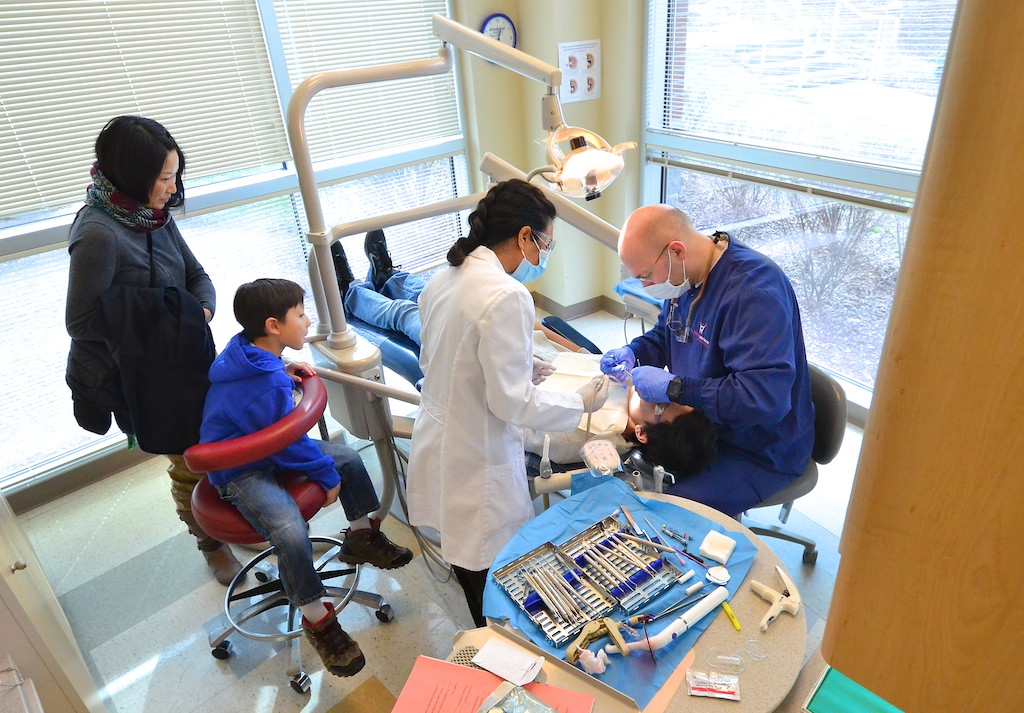
Image context: the cover uses a real 2016 Wikimedia Commons photograph from a free dental clinic in Fredericksburg, Virginia, where students and local dentists provided cleanings, X-rays, sealants, and fluoride treatments for children.[6] It is not a close-up of resin on enamel, but it shows the delivery problem that decides whether the mechanism reaches the children most likely to benefit.
Pits and fissures are a geography problem
Most casual dental advice treats the tooth as if every surface were equally reachable. Sealants begin from the opposite premise. The chewing surfaces of molars have pits and fissures that can trap debris and support biofilm. The ADA/AAPD evidence-based guideline describes caries as an ecological shift in the bacterial biofilm under repeated exposure to fermentable carbohydrates, with demineralization eventually moving toward cavitation.[5] That sequence is not abstract chemistry. It is a surface problem repeated after meals and snacks.
Fluoride still matters. Brushing still matters. Dental visits still matter. But molar fissures are a special weak point. The 2016 CDC MMWR Vital Signs report says about 90% of tooth decay in permanent teeth occurs on the chewing surfaces of the back teeth, where pits and fissures create hard-to-clean niches.[3] That is why sealants are not redundant with toothpaste. Fluoride helps across teeth; a sealant is a physical barrier placed where anatomy concentrates risk.[1][3][5]
The ADA/AAPD guideline makes the same mechanism clinically explicit. It says sealants are effective for preventing and arresting pit-and-fissure occlusal carious lesions in primary and permanent molars, and that they can minimize progression of noncavitated initial lesions when those lesions receive a sealant.[5] In other words, the coating is not cosmetic. It interrupts the surface ecology before a small lesion becomes a drilled cavity.
The timing matters as much as the material
A sealant placed after a cavity has already formed is not the same public-health event as a sealant placed soon after eruption. CDC's current page points to the age windows because newly erupted molars combine fresh exposure with hard-to-clean anatomy.[1] The first molars appear when many children are still learning consistent brushing technique. The second molars arrive near early adolescence, when diets, schedules, sports drinks, and irregular routines can widen the risk window.
That is why the best sealant story is not "more dental material is always better." It is "put the right barrier on the right surface at the right time." CDC summarizes the effect in practical terms: when sealants are applied around these eruption windows, they can prevent up to 80% of cavities for 2 years and continue to protect against 50% of cavities for up to 4 years.[1] The MMWR report gives a similar evidence frame, noting about 81% decay prevention at 2 years, 50% at 4 years, and possible effectiveness up to 9 years through adolescence.[3]
The Cochrane review is useful because it keeps the claim bounded. ODPHP's evidence-resource summary of the review says resin-based sealant is effective for preventing decay in children for up to 4 years when compared with no sealant, while evidence was not sufficient to support ionomer-based sealant compared with no sealant.[4] That is a disciplined conclusion: strong enough to support use, careful enough not to pretend every material question or long-term monitoring question has disappeared.
Schools turn a dental procedure into access infrastructure
The clinical mechanism does not guarantee delivery. A child can have high-risk molars and still miss sealants because the family lacks a regular dentist, transportation, insurance fluency, time off work, or trust in the system. School-based programs matter because they relocate the service from a clinic appointment into a place the child already attends.[1][2][3]
The Community Preventive Services Task Force recommends school-based programs to deliver dental sealants and prevent tooth decay among children.[2] Its review describes two delivery routes: onsite at schools with portable dental equipment or offsite through dental clinics. Programs can target entire schools in low-income neighborhoods or individual students at high risk.[2] The important word is "deliver." Education alone is weaker than service delivery. A flyer about sealants does not seal a molar.
The results show why this distinction matters. The Community Guide reports that school delivery programs increased the share of students receiving sealants by 26 percentage points in the available studies, with larger gains among students from low-income families.[2] Students who received sealants had a median of 50% fewer cavities up to 4 years later than students who did not receive sealants, and the efficacy evidence showed a median 81% caries reduction at 2 years.[2]
That is the population version of the mechanism. The resin barrier blocks a surface pathway. The school program blocks an access pathway. The first keeps plaque and food from settling deep into grooves; the second keeps logistics from deciding which children get the barrier in time.
The equity argument is mechanical, not sentimental
Sealant programs are sometimes described as if their main value were generosity. That misses the engineering. The children least likely to have sealants are often the same children most exposed to untreated decay. CDC's 2016 Vital Signs report used 2011-2014 NHANES data and found that approximately 60% of children aged 6 to 11 from low-income families, about 6.5 million children, did not have sealants.[3] The same report found that children without sealants had almost three times more cavities in permanent first molars than children with sealants.[3]
This is not only a fairness issue. It is a timing issue. If a child misses the first-molar window, the eventual clinic visit may be treating pain or infection instead of preventing the lesion. CDC estimated that providing sealants to those 6.5 million low-income children could prevent 3.4 million decayed and filled first molars over 4 years.[3] On the current CDC page, the estimate is framed as nearly 7 million lower-income children without sealants, more than 3 million cavities preventable, and up to $300 million in treatment costs avoided.[1]
Those numbers make the causal point sharper. The same coating does more public-health work when it reaches children before decay accumulates. Prevention is not merely cheaper than treatment because treatment costs money. It is cheaper because the failure sequence has not yet hardened into pain, missed school, eating difficulty, infection risk, restorative dentistry, and follow-up burden.[3]
Sealants are a layer, not a substitute for care
The main mistake is to treat sealants as a magic varnish. They are a targeted layer in a broader prevention system. CDC says children with sealants can still be at risk for decay, and the MMWR report keeps fluoride toothpaste, fluoridated water or supplements where appropriate, topical fluoride, and regular dental visits in the same prevention frame.[3] A sealed molar can still need monitoring, and other tooth surfaces still need ordinary prevention.
The ADA/AAPD guideline also resists material absolutism. It supports sealant use for preventing and arresting pit-and-fissure lesions, but it could not recommend one sealant material type over all others based on limited comparative evidence.[5] That boundary matters. The best lesson is not brand loyalty or a single perfect product. It is risk-based placement, retention checks, and follow-up.
That is why school programs should not be imagined as a replacement for dental homes. They can identify children who need more care, refer active decay, and connect families to insurance or clinics.[1][3] Their distinct value is that they do not wait for the whole dental-care system to become frictionless before protecting newly erupted molars.
What sealants actually prove
Dental sealants prove that prevention can be physical and logistical at the same time. The physical part is simple: fill the vulnerable grooves before biofilm, sugar exposure, and time turn them into cavities. The logistical part is harder: put a dental team, portable equipment, consent, billing, follow-up, and referral into the places where children already are.[1][2][3]
Read correctly, the sealant is neither a luxury add-on nor a cure-all. It is a small barrier placed at a high-leverage point. It works because molars are grooved, childhood access is uneven, and timing changes the outcome. The coating protects a surface. The program protects the chance to act before repair becomes the only option.
Sources
- Centers for Disease Control and Prevention, "About Dental Sealants" (May 15, 2024) - current CDC overview of what sealants are, eruption timing, school programs, cavity prevention estimates, and cost framing.
- Community Preventive Services Task Force, "Dental Caries (Cavities): School-Based Dental Sealant Delivery Programs" - recommendation, intervention design, systematic review scope, uptake increase, cavity reduction, and economic evidence.
- Susan O. Griffin, Liang Wei, Barbara F. Gooch, Katherine Weno, and Lorena Espinoza, "Vital Signs: Dental Sealant Use and Untreated Tooth Decay Among U.S. School-Aged Children," MMWR 65(41), 2016 - NHANES 2011-2014 sealant-use data, low-income access gap, prevented-cavity estimates, and school-program economics.
- Office of Disease Prevention and Health Promotion, "Pit and Fissure Sealants for Preventing Dental Decay in Permanent Teeth" - Healthy People evidence-resource summary and suggested citation for the 2017 Cochrane review by Ahovuo-Saloranta, Forss, Walsh, Nordblad, Makela, and Worthington.
- American Academy of Pediatric Dentistry and American Dental Association, "Evidence-based Clinical Practice Guideline for the Use of Pit-and-Fissure Sealants," Pediatric Dentistry, 2016 - guideline on sealant use for primary and permanent molars, noncavitated lesions, materials, and clinical decision-making.
- Wikimedia Commons, "Dental hygiene students help kids with free clinic (24255485193).jpg" - 2016 Robert A. Martin photograph of a free dental clinic where students and local dentists provided cleanings, X-rays, sealants, and fluoride treatments for children.