Adeline Harris gave Abraham Lincoln just as much writing room as she gave the poet who used his piece of silk to wish her sweet dreams. Each got a white diamond. Seen from across a room, those diamonds look like the sunlit tops of little boxes, all open to the same light. You have to come close enough to read the handwriting before a president and a poet can tell themselves apart. [1][2]
Harris was seventeen in 1856 when she began the quilt in Rhode Island. She could send a piece of it through the post for someone to sign, then put it aside when it came back. That freedom to wait mattered. She gathered most of the signatures over six years, as the country went from an uneasy peace into civil war. Where a name would sit in the finished quilt was still hers to decide. [1][3]
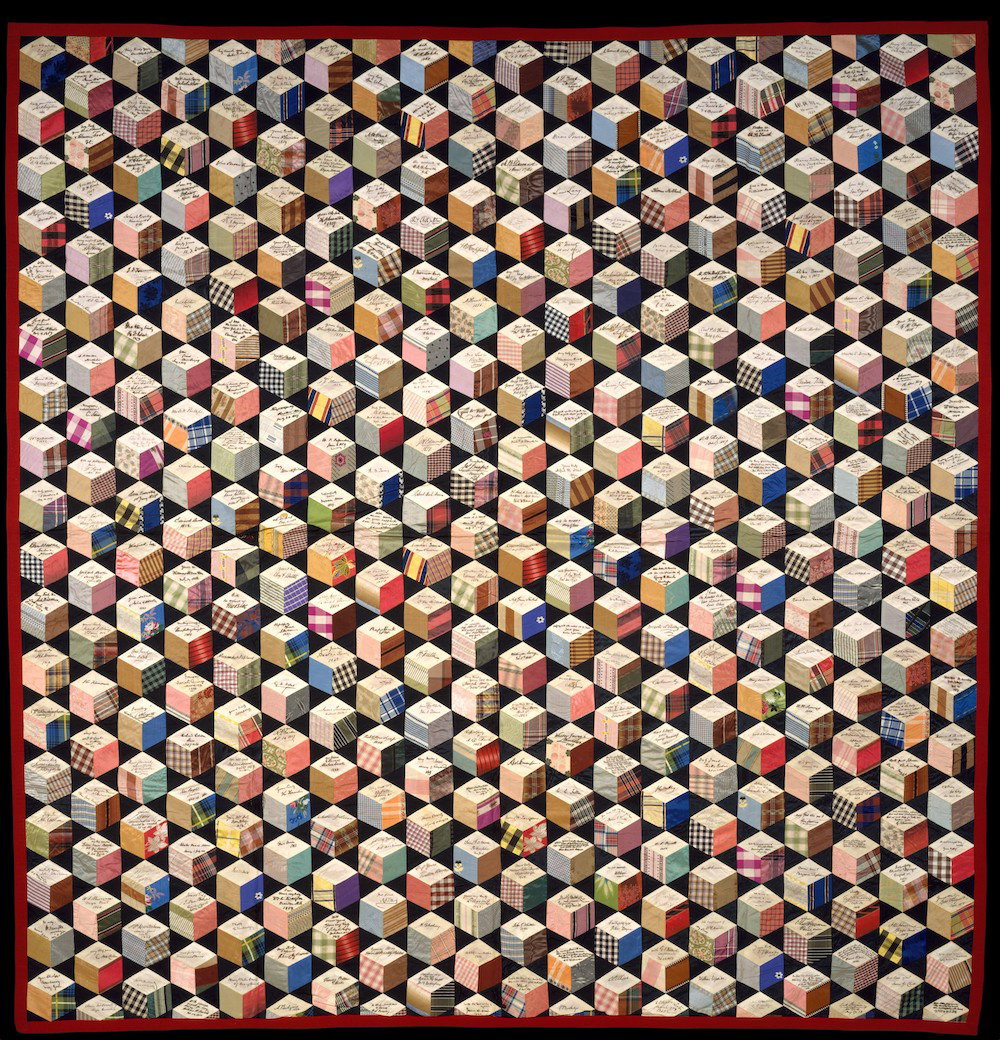
Turn the quilt over, at least in imagination, and the hand holding the needle comes into view. Conservator Elena Phipps examined the inside of the quilt top. She found little lengths of cut thread where Harris had temporarily fastened silk around what were probably stiff paper shapes. The paper could come out once the edges were sewn together. Even where the thread had come away, its needle holes survived. For someone trying to make three sharp points meet hundreds of times, a piece of paper that could hold a slippery silk edge straight was worth the extra sewing. [4]
Some seams owe their existence to the width of a ribbon. Harris could join two narrow lengths to make a piece wide enough to cut a diamond from. On the face of the quilt you see a single side of a cube. Behind it, Phipps could see the finished edges of ribbons tucked into the seams. Harris used the same fabric in several blocks, each time finding it different company. Across more than 150 silks, Phipps found no two blocks with quite the same combination. The illusion holds together because the white face stays on top, even as the fabrics beneath it change at every step. [4]
The seams also preserve the order of the work. Harris assembled the blocks individually, stitched them into long columns, then joined the columns side by side. Follow the seventh column down and you can see what that order allowed her to do. Here she gathered presidents and vice presidents, Lincoln among them. Four columns farther along, Washington Irving, Nathaniel Hawthorne and Ralph Waldo Emerson share a strip. Before two neighboring strips were ever joined, each could already be read as a company of people. [3][4]
Sarah Josepha Hale, the magazine editor who supplied a signature herself, understood the difficulty. Choosing hundreds of colors that would sit well together took taste, she wrote. Deciding which people belonged beside one another took a knowledge of books and of life. The two judgments occupy the very same seam. Follow a bright scrap of silk and you can lose yourself in the pattern. Follow the white tops down a column and you can still read a young woman's idea of who belonged together. [2][3]
As for the poet’s wish, Harris gave her quilt a more public destination than a sleeper’s bed. Small metal rings sewn along the top allowed it to hang. Stand back from it on a wall and the handwriting all but disappears. The thing you can still see from the other end of the room is the part Harris made. [4]
Sources
- The Metropolitan Museum of Art, collection record and photographs of Adeline Harris Sears’s autograph quilt.
- The Public Domain Review, “Adeline Harris Sears’ Autographs Quilt,” including N. P. Willis’s inscription and Sarah Josepha Hale’s accounts.
- Amelia Peck, “A Marvel of Woman’s Ingenious and Intellectual Industry,” including a map and transcription of the signatures, Metropolitan Museum Journal, 1998.
- Elena Phipps, “Technical Report on the Adeline Harris Sears Autograph Quilt,” Metropolitan Museum Journal, 1998.