Suppose a box of papers arrives at an archive with a single blue floppy tucked inside. The label has come unstuck. A PC, an Amiga and an Atari ST could all have written to a disk that shape. Which computer should the archivist look for? Greaseweazle, an open-source USB controller with a set of host tools, lets the archivist postpone that question. An ordinary 3½-inch PC drive can do the first reading for all three machines. The choice that matters at the start is what to keep from that reading. [1][2]
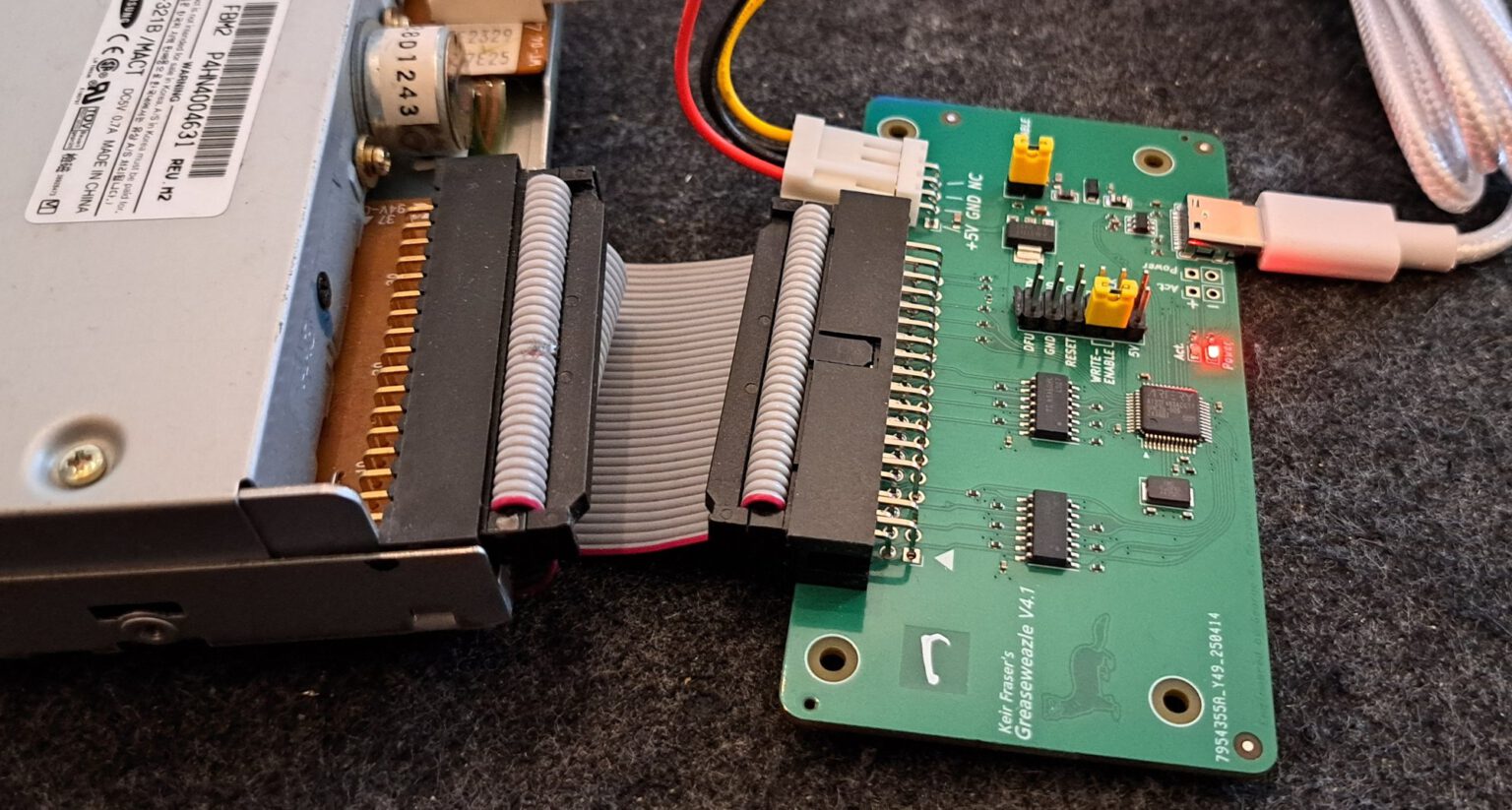
As the disk turns, the drive head detects changes in magnetisation along a circular track. Greaseweazle measures the intervals between those transitions. At this stage a love letter and a spreadsheet look much the same. To get as far as bytes, software has to interpret the timing according to an encoding. To assemble those bytes into a conventional disk image, it also has to recognise the sectors, the individually addressable pieces of a track. A recording of the intervals gives someone a chance to try a different interpretation after the disk goes back in its sleeve. [1][4]
Two copies with the same filename extension
Consider a detail easy to miss in the project's manual. An archivist suspects the blue floppy is a 720 KB PC disk. Greaseweazle knows that layout as ibm.720. It seems sensible to give the reader that hint and ask it to save an SCP file, a format that can hold transition timings for several revolutions of each track. But the hint changes the evidence that goes into the file. [4]
With gw read --format=ibm.720 disk.scp, the software tries to decode the sectors and then generates the transitions that would represent the bytes it recovered. Where a sector is unreadable, it inserts a recognisable filler pattern. Add --raw to the same command and the board's measured timings go into the file. The software can still check how well the proposed layout fits. Both files end in .scp. Only the second gives a future reader the original timing measurements to examine where today's decoder struggled. [4]
There is a place for a much smaller copy. Picture two disks with identical sector contents. On one, sectors one and two sit next to each other. On the other, several sectors pass under the head between them. A plain PC .img file lays out their contents in logical order, so the two disks can produce identical files. A reader interested in the spreadsheet can use that copy. Someone investigating how the original machine spaced sectors around a track needs evidence the conversion discarded. [4]
What an archive keeps
The Churchill Archives Centre in Cambridge documents its own choice. Staff connect original floppy drives to a Greaseweazle and make an HFE image first. HFE keeps a track as a sequence of bit cells, the time slots used to encode bits. The archivist has to choose a bitrate at capture. Greaseweazle's documentation describes HFE as holding one revolution per track. A later reader can revisit the sector layout, though the individual transition timings from successive turns are already gone. [4][5]
Staff then open the image in HxC floppy emulator software. They look for signs of recorded data and inspect how the tracks and sectors are arranged. Sometimes that inspection sends them back to the bench to clean the drive heads and read the disk again. When the capture is good, they can use it to produce a disk image suited to the original computer. [5]
That sequence gives the box of papers a practical advantage. If a note identifying the blue floppy as an Amiga disk turns up in another folder next week, the archivist can try the Amiga interpretation on the saved tracks. Whether the disk has to come out of its sleeve again depends on a decision made while it was still spinning. [1][4][5]
Sources
- Keir Fraser, Greaseweazle project overview and host tools
- Greaseweazle documentation, V4.1 hardware setup and compatible drives
- Stefan Fambach, Greaseweazle 4.1 bench photographs and drive tests
- Greaseweazle documentation, supported image types and raw flux export
- Churchill Archives Centre, disk imaging workflow for floppy disks