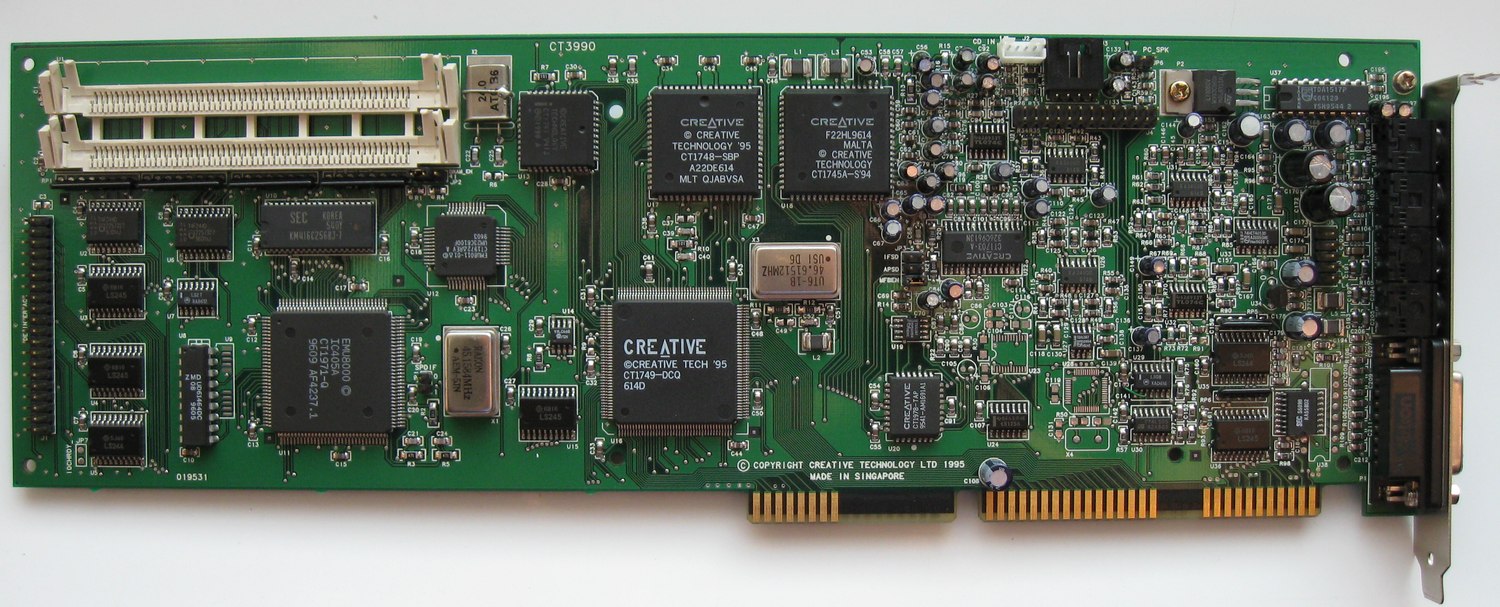
An instrument in Niko Boese’s “Tekkniko” had all but disappeared. S. Christian Collins was preparing the piece for playback on modern computers when a recording made with a Sound Blaster AWE32 gave him something to check his conversion against. He traced the discrepancy to an instrument sounding five octaves below its intended pitch. The fix went into the file that supplied the instruments. Boese’s sequence of notes could stay as written. The open-source synthesizer FluidSynth can play the repaired pair, including a part that someone hearing only the faulty conversion might never have known to miss. [1][2][3]
The second file in the folder
Open the song’s folder in Collins’s collection and two files share a stem. The smaller one, Tekkniko.mid, is roughly 34 kilobytes. Its text credits Boese and dates the composition to 1995. It tells a player when notes begin and end, how hard to strike them and which instrument to select on a channel. A program change can ask for instrument number five in a particular bank. The musician who made the sequence could hear exactly what that meant. On someone else’s machine, the answer depends on what occupies that address. [2][5]
The half-megabyte companion, Tekkniko.sf2, supplies custom instrument presets and their sampled sounds. Look inside its preset directory and numbers five, six and seven have names: NERV, NERV links and NERV rechts. The last two labels are German for left and right. Collins’s conversion note identifies those same three preset numbers as the ones whose pitch he corrected. That gives a listener a fairly precise account of the edit. Transposing the whole sequence to bring back the lost sound would also move every part that was already playing in tune. [2][6]
Giving each instrument its address
FluidSynth takes over the job the sound card once did. It reads the incoming MIDI events, finds the requested presets among its loaded SoundFonts and turns them into audio. Boese drew on two sets of sounds. The song notes call for a General MIDI bank alongside the custom one. Collins’s playback instructions put the general collection at bank zero and the song’s own sounds at bank one. This lets a composer borrow the standard instruments for some parts and bring a handful of homemade ones for the rest. [1][2][3]
That extra bank number matters in practice. FluidSynth keeps loaded SoundFonts in a stack. If two fonts offer the same bank and program number, the most recently loaded one gets the first chance to supply the sound. Simply opening both files can therefore give an existing instrument a new voice while leaving the intended bank empty. In the project’s interactive shell, Collins uses the form load "Tekkniko.sf2" 1 1 after stopping playback. The final 1 shifts the custom font’s bank addresses up by one. When the sequence starts again, a request for a standard voice and a request for Boese’s custom preset can each reach the right place. [1][7][8]
What the recording settled
The two versions of the SoundFont in the archive still carry the same three NERV labels. A directory listing can establish that the presets survived. So can a synthesizer that successfully selects them. Neither check tells a listener how high the part ought to sound. For that, Collins had a piece of evidence outside the files he was repairing: someone had recorded the song playing through the hardware its composer knew. [1][2][6]
Collins invites owners of working cards to send recordings of other pieces in the collection. The distinction is easy to hear in principle. A recording can tell you that a phrase used to be audible at a particular moment. The sequence and SoundFont let you go back to that moment, isolate the instrument responsible and correct its tuning for the next performance. For “Tekkniko,” an old sound card supplied the reference, and the little file of notes still gets to play the song. [1][2]
Sources
- S. Christian Collins, AWE32 MIDI Conversions, collection history, conversion errors and playback instructions
- S. Christian Collins, “Tekkniko,” composer credit, bank requirement and pitch corrections
- FluidSynth project, synthesizer overview and supported uses
- Gona.eu, photograph of a Creative Sound Blaster AWE32 PNP CT3990, Wikimedia Commons
- Library of Congress, MIDI Sequence Data, format description and playback dependencies
- AWE32 MIDI Conversions, Niko Boese song files, including the original and converted “Tekkniko” SoundFonts
- FluidSynth, loading and managing SoundFonts, preset lookup order and bank offsets
- FluidSynth user manual, interactive shell commands and SoundFont loading arguments