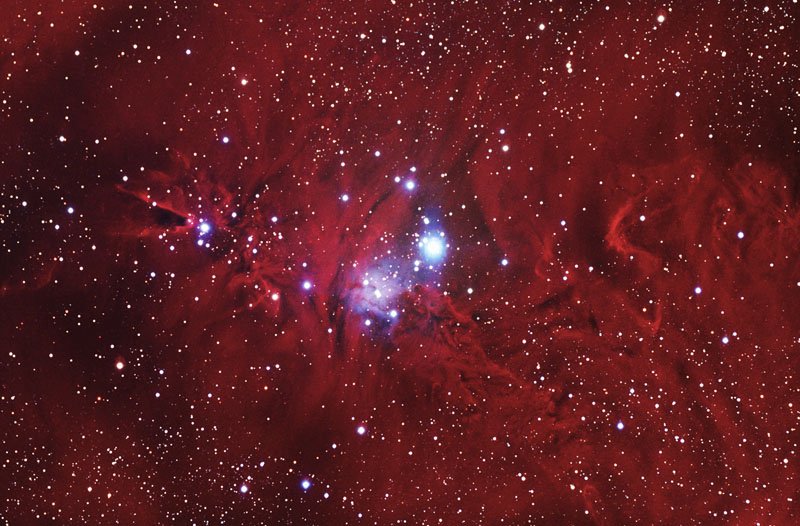
The Christmas Tree Cluster lies on its side in Russell Croman’s photograph. The bright star S Mon sits near the base, and the dark tip of the Cone Nebula marks the top. Take away the caption and a reader might spend a while looking for the tree. The open-source program Astrometry.net uses this very photograph in its documentation. It can recover where the camera pointed, which way it was turned and how much sky it captured, all without knowing what a Christmas tree looks like. [1][2][3]
What survives a quarter turn
Imagine printing the photograph twice, turning one print sideways and enlarging it on a copier. Choose four stars you can find on both sheets. Lay a ruler between the two farthest apart and use that distance as your unit. You can describe the other two by how far each sits along that baseline and how far to one side. The enlarged print gives the same measurements in its own units. Turning the sheet carries the ruler and the stars around together. [3][4]
That small piece of geometry makes a search of the whole sky practical. Astrometry.net has already done the ruler work on groups of catalogued stars. Its index stores a numerical description of each group’s shape, along with a way to recover the identities of the stars. On the photograph side, the command solve-field extracts points of light and records their pixel positions in a file ending in .axy. A caller who already has a table of measured positions can enter the process there. The red gas that makes Croman’s picture so distinctive to the eye need never reach the search engine. [2][4]
The engine forms groups of four detected stars and looks up close shapes in the index. A little tolerance matters. Shifting the measured centre of one faint star by a fraction of a pixel changes the shape slightly. A nearby index entry supplies four possible star identities, enough to fit a first mapping between the photograph and the sky. Given enough stars in enough fields, though, some quite unrelated groups will look alike. [3][4]
The stars that get a vote
Suppose the proposed mapping puts S Mon in the right place. It also predicts where a catalogue star near the opposite edge should land, even if that star played no part in choosing the four. The solver can check for a detected point there. Several close agreements across the frame are much harder to explain by chance than one more agreement in a crowded patch. The verification step weighs the detections under two explanations, one in which the proposed alignment is real and one in which the apparent matches are accidents. Its allowance for stray detections gives a genuine alignment room to survive a blemish on the image. [3][4]
An old observing note saying roughly how wide the field was can save time. The catalogue indexes come in bands according to the angular size of their star groups. A narrow crop needs smaller groups than a whole-constellation exposure. The --scale-low and --scale-high options let the engine skip implausible scales. Give it an overly confident range and it can skip the true one as well. That is one reason a failed search tells you as much about the supplied bounds and installed indexes as it does about the photograph. [2]
A successful run leaves two especially legible pieces of evidence. The .corr file pairs measured stars with their proposed catalogue counterparts. The .wcs file holds the World Coordinate System solution, a mapping that software such as Astropy can use in either direction. Pick a pixel at the tip of the dark cone and you can ask for its celestial coordinates, even though the solver worked from stars and the cone is dust. Or start with those coordinates and ask where to look in a second calibrated exposure. The value of finding those first four stars extends to every pixel between them. [1][2][5]
Sources
- NASA and Michigan Technological University, Astronomy Picture of the Day, “Fox Fur, the Unicorn, and a Christmas Tree,” photograph by Russell Croman, February 28, 2003.
- Astrometry.net, code README, including the NGC 2264 example, index selection, scale limits and output files.
- Dustin Lang and colleagues, “Astrometry.net: Blind astrometric calibration of arbitrary astronomical images,” The Astronomical Journal, 2010.
- Astrometry.net, code structure, tracing a field from source extraction through verification.
- Astropy, World Coordinate System documentation, including pixel-to-world and world-to-pixel transformations.