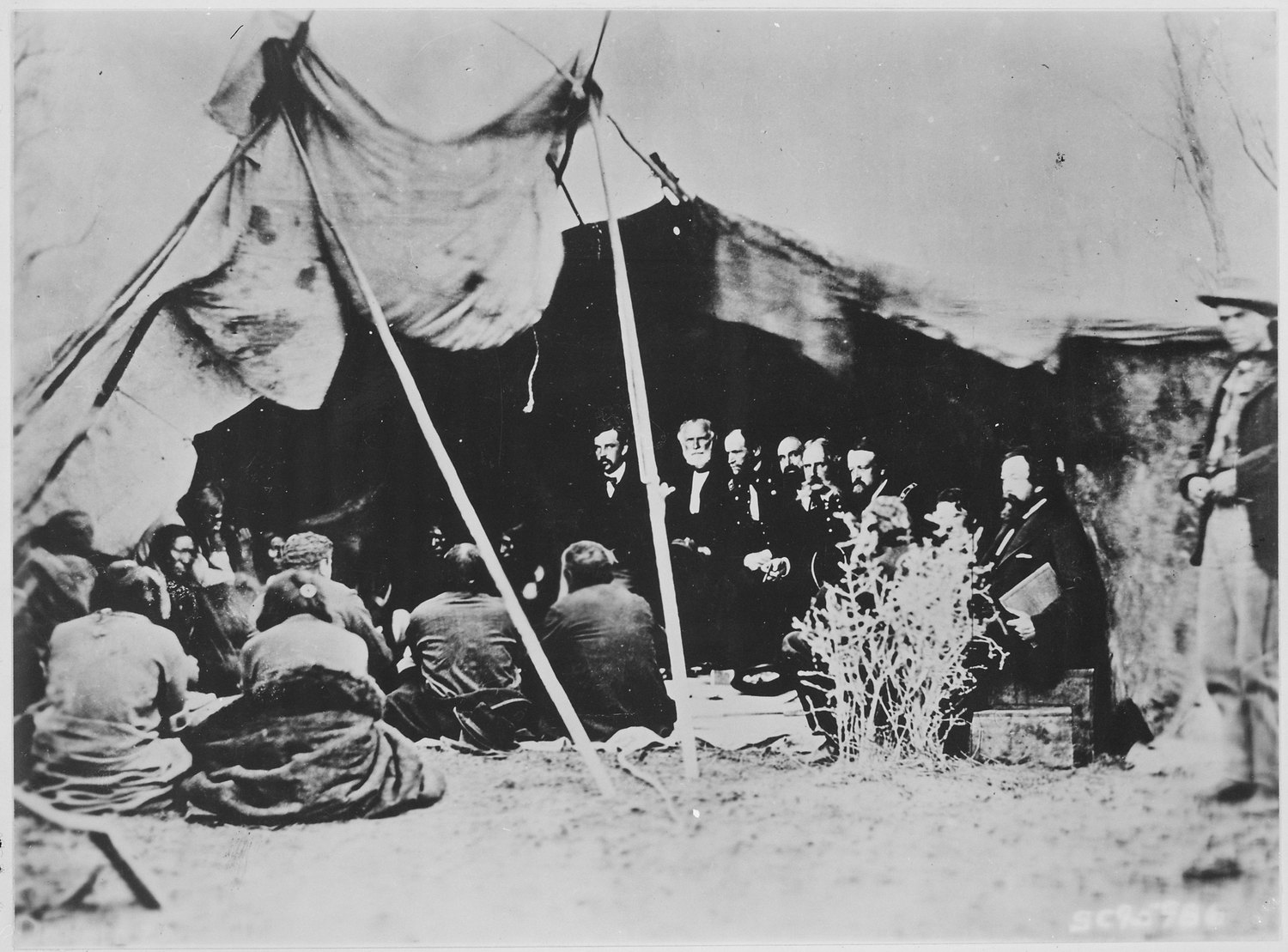
Near the end of the 1868 Treaty of Fort Laramie, a clerk recorded Red Cloud’s name, his mark and the date he signed, November 6. Eight years later, federal commissioners again sought the marks of Sioux leaders. This time the United States wanted the Black Hills. Could a chief who had signed the treaty also sign away land it reserved? The answer was already on the page, several articles above Red Cloud’s name. [1][2]
Who counted under Article XII
Article II drew the boundaries of the Great Sioux Reservation, including the Black Hills, and committed the United States to keeping unauthorized settlers out. Article XII looked ahead to the day somebody might want to redraw those boundaries. For a treaty ceding land held in common, it required the signatures of at least three-fourths of the adult men “occupying or interested in the same.” [1]
The word that does the most work is all. Imagine a council at which every man present put his mark on a proposal. Before anyone could say the proposal carried, someone would have to count the eligible men who stayed home. Holding a council, hearing speeches and gathering a page of names could establish what happened at the meeting. The treaty asked a further question about the people beyond it. Women had no place in this particular count, a limit the treaty itself imposed. [1]
Halfway through the sentence the scale shifts again. Article VI allowed a tribal member to select a tract for cultivation. Article XII said that even a cession approved by the tribe could not deprive him of his rights to that tract without his own consent. A reader following one sentence thus has to picture both the reservation held in common and a particular piece of ground somebody has chosen to farm. Each had its own protection. [1]
What Congress put on the page
By August 1876 gold seekers had entered the Black Hills, and many Sioux families depended on food distributed at federal agencies. Congress wrote a condition into that summer’s appropriations act. Future appropriations for subsistence would depend on surrendering land and hunting rights. When George Manypenny’s commission arrived in September, its members brought the proposed terms with them. A family could object to the cession and still have to reckon with what it would eat if Congress carried out its threat. [2][4]
The commissioners presented the agreement to chiefs and leading men. According to the Supreme Court’s later reconstruction, about one adult Sioux man in ten signed. Open the law Congress passed on February 28, 1877, and the shortfall is hard to see. The agreement introduces the chiefs and headmen as “duly authorized.” In its first article a reader can follow the new western boundary up a meridian, down a fork of the Cheyenne River and back to the meridian. The survey language is exact. The assertion about authority comes with no comparable accounting of who had signed. [2][5]
Congress even picked through the terms for evidence of assent. In ratifying the agreement it excepted a provision about a delegation going south to select a new home, recording that the Sioux Nation had withheld agreement. Congress could recognize a refusal on the question of removal. On the question of the Black Hills, it gave the new boundary the force of law with the three-fourths requirement still unmet. [1][5]
In 1980 the Supreme Court upheld an award of compensation for the taking of the Black Hills, with interest running from 1877. That remedy put a value and a date on what the United States had taken. Article XII preserves another way of reading the signatures. Beside each name on the later agreement, it asks the reader to reckon with the people whose marks federal commissioners never sought. [1][2]
Sources
- National Archives, Treaty of Fort Laramie (1868), especially Articles II, VI and XII and the dated signature pages.
- U.S. Supreme Court, United States v. Sioux Nation of Indians (1980), opinion and account of the Manypenny commission.
- National Archives, General William T. Sherman and Commissioners in Council with Indian Chiefs at Fort Laramie, Wyoming, April 1868, photograph 531079.
- U.S. Congress, Indian appropriations act of August 15, 1876, subsistence provision on page 192.
- U.S. Congress, act of February 28, 1877, chapter 72, ratification language and text of the agreement.