In August 1919, Congress overrode President Woodrow Wilson’s veto and abolished the federal daylight-saving rule. Anyone who learned the news and promptly put a clock back an hour risked missing the train. The repeal took effect on October 26, the Sunday when Americans would have turned their clocks back anyway. The first scheduled clock change that the repeal actually canceled lay on the other side of winter. [1][2]
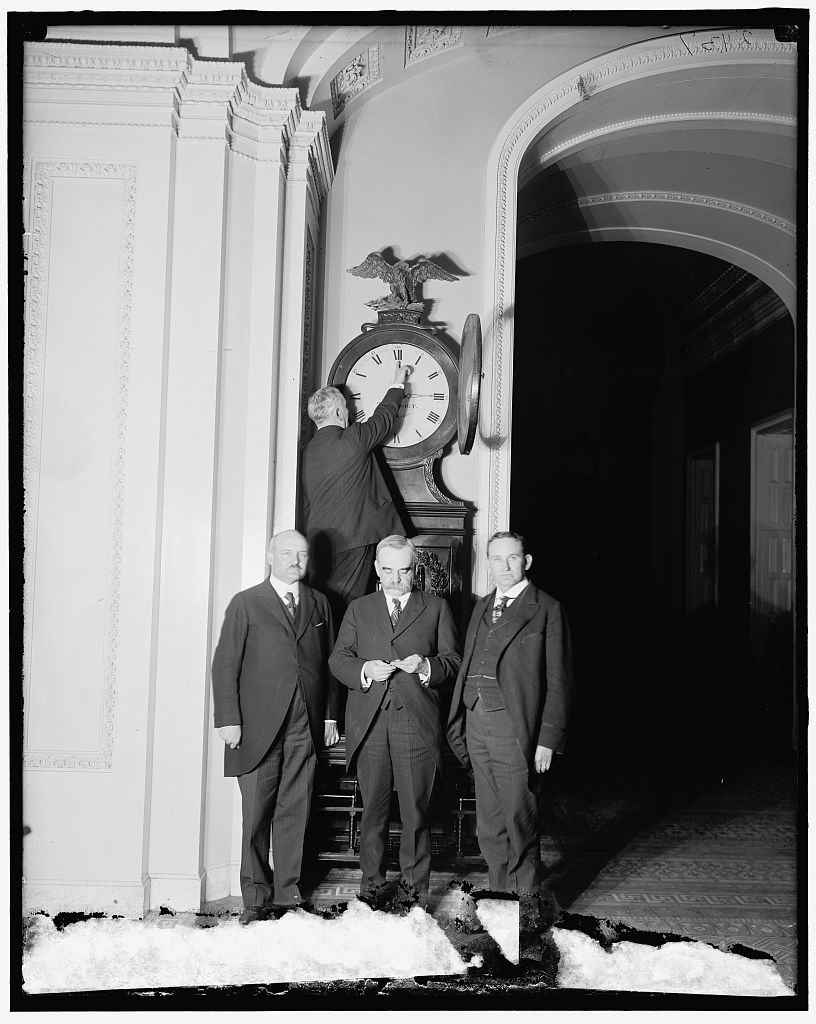
Which clock did the train follow?
The March 1918 law gave a clock at a railway station two instructions. Its location supplied the first. Congress named five time zones, including one for Alaska. Each took its hour from a specified longitude, and the Interstate Commerce Commission drew the boundaries. In placing a town on one side of a line or the other, commissioners had to consider where carriers met and where their operating divisions ended. A railway junction mattered enough to appear alongside longitude in the statute. [2]
The date supplied the second instruction. At two in the morning on the last Sunday in March, each zone advanced an hour. Suppose a train left at eight both the Saturday before the change and the Monday after it. The passenger could keep consulting the same printed timetable. On Monday, though, the passenger had to reach the station an hour earlier by the sun. The law applied that shift to interstate carriers and to federal business, including the calculation of deadlines. [2]
Whose evening was it?
In the House debate on June 18, a patch of wet ground figured on both sides. Opponents of summer hours described farmhands arriving while the crop was still heavy with dew, then quitting by the clock with dry working time left in the field. Representative Thetus Sims of Tennessee asked members to consider a wage earner growing vegetables after work. The gardener, too, had reason to keep off wet ground in the morning. Getting home an hour earlier by the sun made more of the dry evening available for the garden. [4]
Both arguments depended on who could set the end of a shift. A farmer whose hired crew went home by the clock could lose the use of an hour that a factory worker gained for a backyard plot. Even agreement about the best time to work the soil gave the two little reason to agree about the clock. [4]
The cost of changing on a third Sunday
An early version of the repeal bill would have put the clocks back on the third Sunday after approval. Representative Edward Denison of Illinois personally wanted a quick repeal. On the House floor he nevertheless defended the committee amendment that postponed it. New York had written the federal summer schedule into its own law. Its legislature, he explained, would ordinarily meet again in winter. Congress could change the hour for an interstate train with a vote in Washington. Only Albany could make the corresponding change to New York law. [4]
Imagine arranging to meet that train. During the gap, eight by the station clock could be nine by a clock following state law. Both parties might set their watches carefully and still miss each other. Denison also foresaw litigation over which hour governed an obligation. He offered these as reasons to wait. The conflicting summer clocks were a consequence legislators anticipated when choosing a date. [2][4]
The last Sunday in October gave both laws a common exit. New York’s summer hour would run its course, and the federal clocks would make their usual autumn turn. The repeal singled out section three, the seasonal instruction. A stationmaster opening up the following Monday still had a federally defined zone, with the same neighboring zone across the line. The difference would come in March, when the station clock could pass through two in the morning and keep going. [1][2][4]
Sources
- U.S. Congress, act repealing the daylight-saving provision, August 20, 1919, 41 Stat. 280.
- U.S. Congress, Standard Time Act, March 19, 1918, operative provisions on zones, carriers and seasonal time, 40 Stat. 451.
- Harris & Ewing, photograph of Charles Higgins adjusting the Ohio Clock, 1918. Library of Congress, Harris & Ewing collection, image hec.13949.
- U.S. House of Representatives, debate on the daylight-saving repeal, Congressional Record, June 18, 1919.