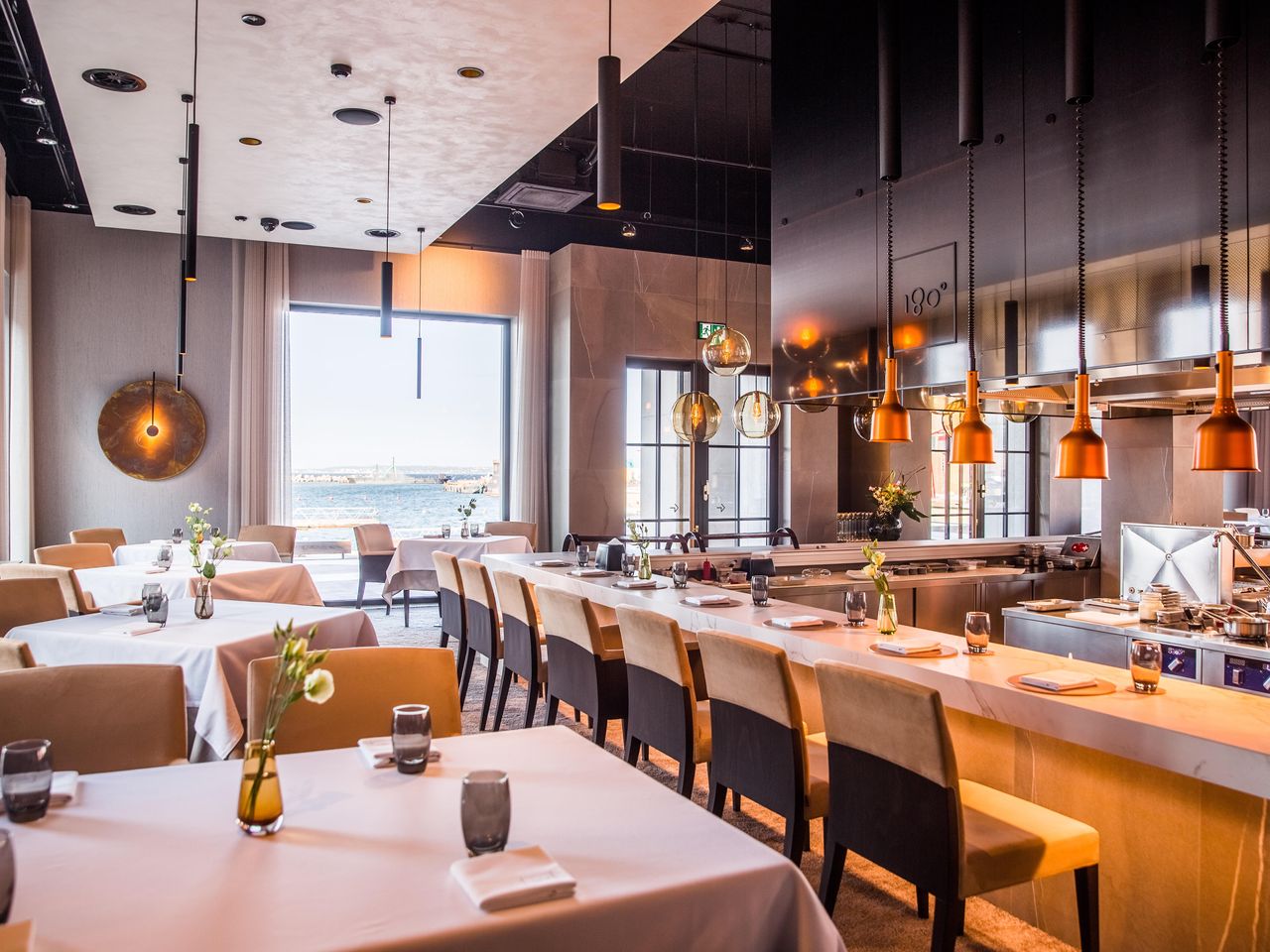
At 180° in Tallinn, the view belongs to the kitchen too. The restaurant takes its name from the panorama at its U-shaped kitchen counter, where guests can watch the cooks at work. Elsewhere in the room, individual tables face the harbour. The arrangement gives dinner two attractions: the water beyond the glass and the concentrated activity that will eventually reach the plate.[1]
That is an apt introduction to Matthias Diether, a German chef who has made his home in Estonia while keeping his cooking open to the world. His restaurant's own description puts Estonian and international produce together, with classical technique underneath the contemporary presentation.[4] The interesting part is how firmly that outward-looking kitchen belongs to this particular waterfront.
This profile draws on published reporting and the restaurant's own materials. Historical dishes are identified by their source dates; the online menu was checked on October 19, 2026.
A chef arrives before the neighbourhood is finished
Diether opened 180° in 2018. By then, he had accumulated a substantial German kitchen education: spells with Lothar Eiermann, Harald Wohlfahrt and Sven Elverfeld, followed by international experience and several years at Berlin's First Floor. Verena Kassubek's March 2024 profile in Der Feinschmecker traces his move to Estonia in 2016 and an initial posting on the Baltic island of Muhu.[2]
Michelin identifies that island restaurant as Pädaste Manor. After two years there, Diether moved to Tallinn to establish his own place.[6] The journey gives the harbour restaurant a useful double perspective: a chef trained in demanding European kitchens, choosing a smaller capital in which to build a life.
The setting was still taking shape. White Guide's 2020 account remembers 180° amid construction in Noblessner, a former submarine shipyard becoming a new urban quarter. Its polished dining room stood against a backdrop of unfinished development.[3] Fine dining arrived while the neighbourhood was visibly being made.
The room makes the work visible
In that early account, dinner began with drinks and snacks in a bar with a fireplace, before guests moved into the main room around the open kitchen.[3] It is an appealing sequence: settle in, take a first bite, then move closer to the making of the meal.
The restaurant still distinguishes between individual tables with sea views and a chef's-table experience for up to ten guests.[4] The layout invites different kinds of attention. At the counter, a guest can follow a plate through its last stages; at a separate table, the harbour and one's companions can occupy more of the evening. Choosing a seat becomes a way of choosing the dinner's focus.
Lauri Laan's photograph makes the arrangement tangible: cream chairs line the counter beneath copper-coloured lamps, while white-clothed tables carry the dining room towards the water.[2] The kitchen occupies the same visual world as the guests. Its success as a room depends on making professional work interesting to watch without letting it swallow the social occasion.
A menu with several passports
Diether's stated interest in ingredients from Estonia and further afield helps explain the breadth of the cooking.[4] The kitchen has room for both a recognisable European dish and a combination that sends the imagination elsewhere.
In 2020, White Guide described halibut with Champagne sauerkraut and tuna paired with foie gras.[3] Those examples give the early restaurant a generous, emphatic character: fish, acidity, richness, and luxury ingredients allowed to be conspicuous. They also establish that the international repertoire was present near the beginning.
Michelin's March 2024 feature places classical French foundations and sauces at the centre of Diether's work. Among the inspectors' remembered dishes were Atlantic mackerel with nettles and quince, and burnt banana with miso and tarragon.[6] Read together, those combinations suggest a cook interested in what happens around a principal ingredient. A fish gets an herbal and fruity setting; a familiar dessert ingredient acquires a savoury seasoning and an aromatic leaf. The supporting ingredients give each dish a direction.
Cabbage keeps a place beside the luxury
The restaurant's online menu supplies a revealing continuation. As checked on October 19, it lists Iberico pork with Champagne-caraway cabbage and horseradish. Cabbage has stayed in the vocabulary, now accompanied by caraway and a root with a forceful bite. On paper, the pleasure lies in the relationship between rich meat and assertive accompaniments.[5]
The same menu pairs seafood raviolo with spinach and saffron, and Wagyu with sugar snap peas, miso and black garlic. Its short ingredient lists move easily between culinary traditions. They give a prospective diner something more useful than a broad claim of creativity: particular combinations to anticipate, question or discuss with the team.[5]
These are examples from a live page, whose dishes can change. Their value for this profile is the continuity they reveal. Across the dated accounts, Diether keeps returning to substantial central ingredients surrounded by carefully chosen contrasts.
A chosen home, an open repertoire
On the restaurant's team page, Diether calls produce “the true star on the plate” and describes his interest in textures and unexpected combinations.[7] That puts a useful demand on an elaborate kitchen. Each technique has to leave the diner with something enjoyable to eat; an impressive construction still needs a persuasive mouthful.
180° became Estonia's first two-Michelin-star restaurant in 2023. In Michelin's subsequent interview, Diether said the recognition brought international attention and described a clientele combining local celebrations with visitors accustomed to destination dining.[6]
That mixture suits the room. A special evening for someone who lives nearby and a journey for someone arriving from abroad can meet at the same counter. Diether's restaurant offers a version of belonging built through work and hospitality: an international repertoire, prepared in public, with Tallinn's harbour just beyond the glass.
Sources
- MICHELIN Guide, “180° by Matthias Diether” — restaurant listing, the name's connection to the kitchen counter, seating and harbour setting; accessed October 19, 2026.
- Verena Kassubek, “Matthias Diether: Deutscher Spitzenkoch in Estland,” Der Feinschmecker, March 19, 2024 — training, move to Estonia, 2018 opening and restaurant photographs by Lauri Laan.
- White Guide, “180 degrees by Matthias Diether,” 2020 review — the developing Noblessner district, dining-room sequence and historical dish examples.
- 180° by Matthias Diether, “Restaurant” — the restaurant's account of its culinary approach and seating arrangements; accessed October 19, 2026.
- 180° by Matthias Diether, “Menu” — published dish combinations, checked October 19, 2026; a changing online menu rather than a guarantee for a future visit.
- Elizabeth Winter, “Estonia's First Two Michelin Star Restaurant,” MICHELIN Guide, March 21, 2024 — Pädaste Manor, culinary foundations, inspectors' dish examples and Diether's comments on recognition and guests.
- 180° by Matthias Diether, “Team” — the chef's statement about ingredients, texture and combinations; accessed October 19, 2026.