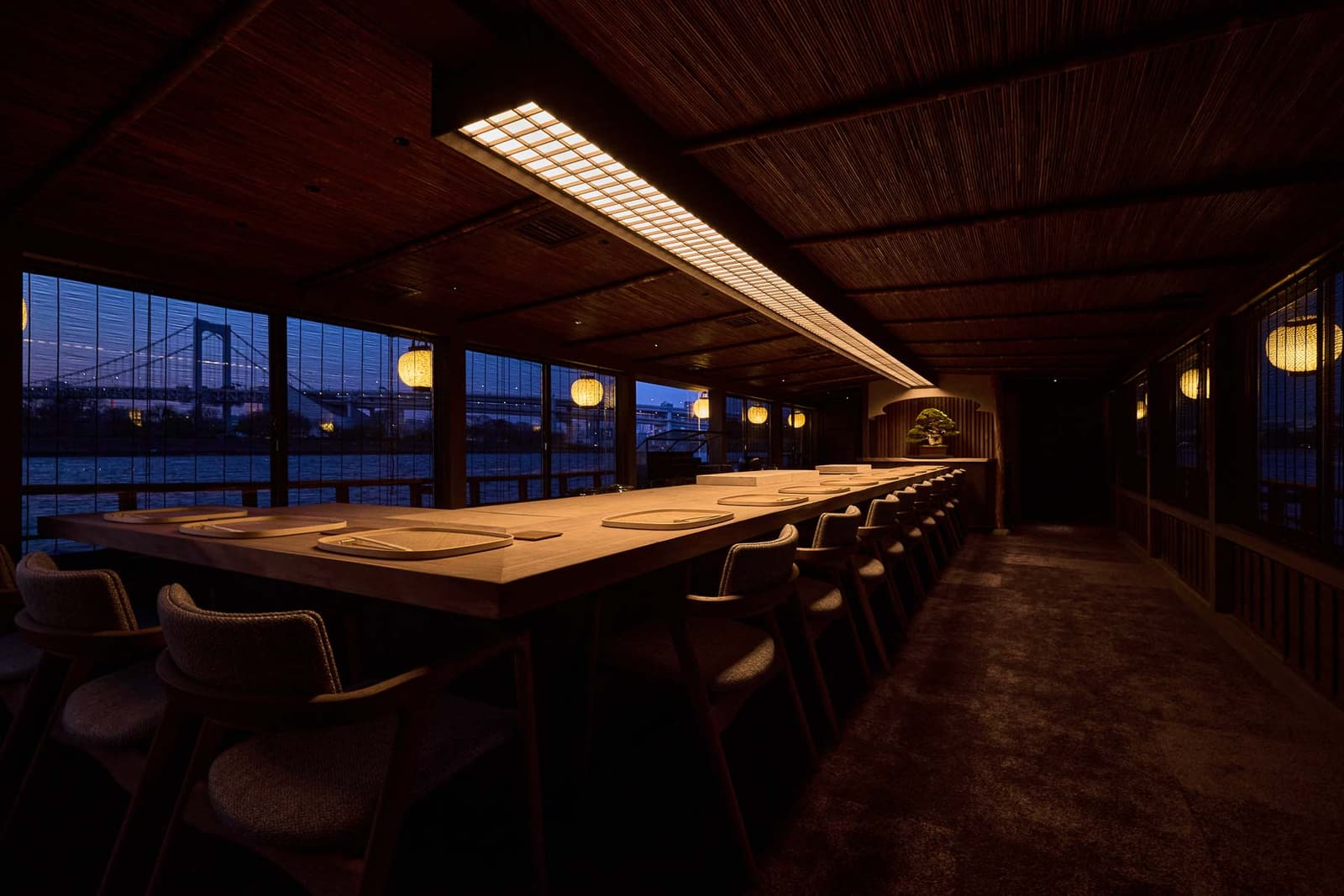
Yakatabune Izanagi sounds, at first, like a luxury gimmick: put a wagyu omakase on a traditional Tokyo houseboat, sell the skyline, let the room do the marketing. The more interesting reading is operational. This is not a restaurant with a view. It is a restaurant whose view, route, counter, kitchen equipment, weather exposure, and seating limit all have to behave as one service system.
That makes it useful in 2026, when high-end dining is still trying to escape two stale formats: the sealed chef's counter and the destination room that treats place as decor. Izanagi uses an older Tokyo leisure form, the yakatabune, but strips away the casual party-boat expectation. TABLEALL describes a 2025 launch produced by Funayado Hirai and NIX, built around chef Tatsuro Hirakubo of Yakiniku Ushimatsu, with a 12-person counter, sukiya-style details, Kyoto lanterns, bonsai, large windows, and a course that moves through seared wagyu sushi, charcoal-grilled chateaubriand, yakiniku, steak, and sukiyaki.[1] The point is not just that the boat is pretty. The boat gives the meal a clock.
The room is narrow on purpose
Fine dining often talks about intimacy while quietly preserving a normal restaurant footprint. Izanagi makes intimacy physical. Condé Nast Traveler calls the interior a 12-seat, all-timber room that honors traditional Japanese architecture while the boat glides through Tokyo Bay, with the omakase centered on premium Japanese Black beef, especially Tajima cattle from Hyogo.[2] GQ Japan's launch coverage points to the same fusion of sukiya-style space, craft objects, charcoal cooking, and bay scenery, while Vogue Japan gives the practical seat count from the launch side: a counter-style dining room with 11 seats, expandable to 12, plus a deck for viewing the bay.[3][4]
That limit changes service. A 12-seat counter does not allow much hiding. If pacing slips, everyone feels it. If smoke lingers, it becomes the room. If the kitchen misjudges the cruise rhythm, the window view and the food begin competing instead of supporting each other. On land, a chef's counter can reset itself between courses by lighting, music, and server choreography. On a boat, the reset is partly exterior: bridge, water, darkening sky, wind, docking, the invitation to step outside.
This is where Izanagi's service idea becomes stronger than its novelty. The counter is not merely a row of expensive seats. It is a fixed audience around a moving stage. Guests remove shoes, face the cooking line, and keep the bay in peripheral vision.[1] The room asks them to understand the meal through intervals: departure, first movement, pause, main grill sequence, deck, return. That is a different kind of luxury from silence and linen. It is luxury as controlled exposure.
The cruise sets the cooking tempo
The smartest detail in TABLEALL's profile is the sequencing. During the first 30 minutes, while the yakatabune is still moving, guests receive smaller dishes such as soup, seared beef sushi, and a chateaubriand steak sandwich; once the boat rests, main dishes such as yakiniku, steak, and sukiyaki become the center of the meal.[1] That is not just menu writing. It is risk management.
Early courses have to survive motion and attention drift. People are entering the space, watching the windows, adjusting to the novelty of eating at counter height on water. Smaller bites work because they create immediate focus without demanding a heavy table commitment. The main beef courses then arrive when the boat can become more restaurant than ride. The guest is no longer simply boarding; the guest is in service.
Vogue Japan adds the crucial equipment point: the boat is fitted with a charcoal grill unusual for a yakatabune, and Hirakubo cooks in front of guests rather than treating the boat as a catered dining shell.[4] That matters because wagyu can become passive luxury very quickly. A piece of expensive beef placed before a diner is not yet a fine-dining argument. Izanagi's argument is that the beef is watched under changing conditions: smoke, heat, water, night, and the counter's narrow social field.
The chateaubriand detail reinforces that structure. TABLEALL says the steak is slow-cooked from departure, with roughly an hour of transformation visible to diners before it becomes a bite-size sandwich on bread from Hirakubo's own recipe.[1] This turns waiting into evidence. The boat is moving, the meat is changing, and the guest can connect time with texture. That is the kind of operational storytelling many tasting menus try to fake with speeches.
Price has to buy constraint, not just romance
The numbers are blunt enough to keep the romance honest. TABLEALL lists the Izanagi omakase at JPY 89,500 including its booking fee, with lunch at 1 p.m. and dinner at 6 p.m.[1] Tokyo Calendar's listing gives a dinner budget around JPY 78,650, departure times of 6 p.m. through August and 5:30 p.m. from September, a roughly three-hour ride, and access from Tennozu Isle station in three to five minutes depending on the line.[5] Vogue's launch note gives an earlier frame of JPY 65,000 before tax, service, and drinks, with a 150- to 180-minute duration and weather-dependent sailing.[4]
Those figures show what the diner is actually buying: scarcity of seats, a private-ish moving room, specialized kitchen installation, premium beef sourcing, a crewed route, and the chance that weather will sharpen or soften the whole evening. The price is not defensible if the boat is treated as a backdrop. It is only defensible if the boat changes what service can do.
That is also the danger. A moving venue can seduce diners into forgiving ordinary cooking because the environment is memorable. Izanagi seems designed to resist that trap by narrowing the food proposition. It is not trying to be all of Tokyo cuisine on water. It is a wagyu room, with Hirakubo's beef discipline as the center of gravity.[1][2] Vogue notes that the project can host special voyages with other top chefs because the boat has equipment adaptable beyond charcoal grilling, but the regular identity is still built around Uramatsu-style wagyu service.[4] The platform can flex; the core has to stay legible.
Weather is part of hospitality
Most restaurants try to remove weather from the guest experience. Izanagi cannot, and should not. TABLEALL says each meal is shaped by the day's weather, wind, sky color, Rainbow Bridge views, Odaiba landmarks, and a rooftop-deck dessert moment.[1] Tokyo Calendar also emphasizes the chance to go up to the tatami deck before and after the meal to feel the breeze and look over Tokyo Bay.[5]
That makes the service contract unusual. A perfect land restaurant promises consistency. Izanagi promises a controlled encounter with inconsistency. The same counter will feel different in April light, late-summer humidity, autumn dusk, or winter darkness. Weather can cancel or alter the outing; Vogue explicitly notes that departures are weather-dependent.[4] For a guest, that adds risk. For the restaurant, it adds meaning. The meal is not simply themed around Tokyo Bay. It is vulnerable to Tokyo Bay.
Good service in that setting is not only the usual choreography of greeting, pouring, explaining, clearing, and timing courses. It is also weather reading. When should guests be encouraged to step out? When should a course arrive before attention drifts to a bridge? How much explanation belongs at the counter before it breaks the spell of movement? How should the team pace drinks when the evening includes deck time? These are not decorative questions. They are the dining room.
A useful model, not an easy one
Yakatabune Izanagi matters because it makes a familiar fine-dining promise harder to fake. Many restaurants say they are site-specific. This one has to prove it minute by minute. The site moves. The view changes. The counter is small. The kitchen has to cook at luxury precision in a vessel whose purpose used to be leisure, sightseeing, and group entertainment. If the meal works, it is because every constraint has been turned into service logic.
That does not mean every city needs a floating omakase. The model is too specific for easy copying. Tokyo has the bay, the yakatabune memory, the appetite for counter dining, the wagyu culture, and the reservation economy to make the format legible. Copy it without those conditions and the idea collapses into spectacle.
But as a fine-dining signal, Izanagi is sharp. It suggests that the next interesting room may not be bigger, quieter, or more theatrical. It may be more constrained. A counter can move. A view can become timing. A chef can make a luxury ingredient feel less like a static trophy by cooking it inside a route. The boat is not the garnish. It is the pacing device.
Sources
- TABLEALL, "Yakatabune Izanagi" - reservation profile covering the 2025 launch, 12-seat counter, Tokyo Bay cruise sequence, chef Tatsuro Hirakubo, wagyu sourcing, pricing, and the article image.
- Joanna Kawecki, "Yakatabune Izanagi." Condé Nast Traveler Hot List 2026 - review framing Izanagi as a 12-seat Tokyo Bay wagyu omakase and identifying its premium beef and moving-room appeal.
- GQ Japan, "Luxury yakatabune IZANAGI sets sail" (May 9, 2025) - Japanese launch coverage of the boat's luxury positioning, sukiya-inspired interior, craft details, and charcoal-grill wagyu format.
- Vogue Japan, "A luxury onboard experience combining yakatabune culture and Japanese food culture" (April 16, 2025) - launch note with seat count, deck, charcoal-grill setup, sailing times, duration, weather caveat, and starting price.
- Tokyo Calendar, "Yakatabune Izanagi" - local listing with Tennozu Isle access, seasonal departure times, approximate three-hour ride, dinner budget, and deck-experience note.