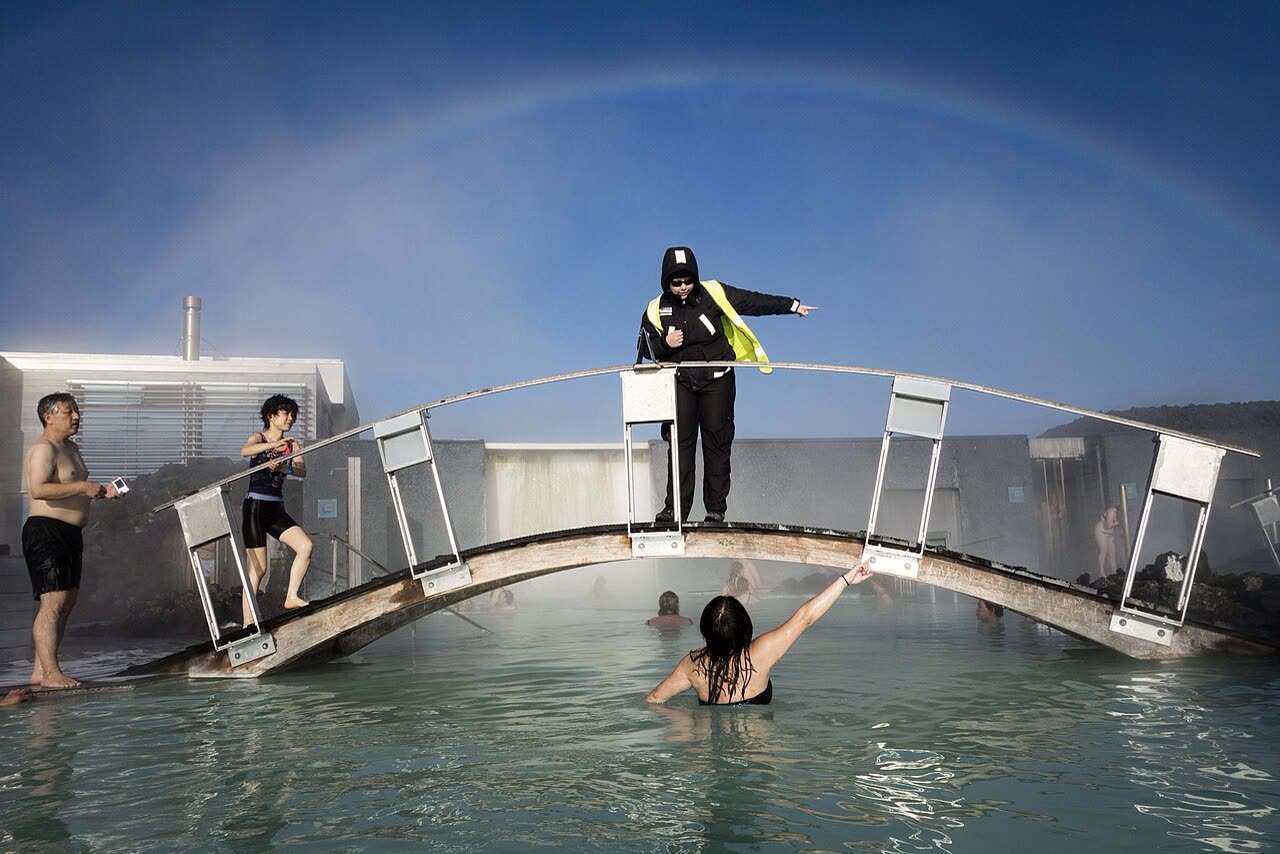
Moss is easy to misread if it is treated as the luxury dining room attached to a famous spa. The Blue Lagoon setting is so visually dominant that the restaurant could almost coast on scenery: black lava, milky mineral water, a resort rhythm, and guests already primed for geothermal spectacle. The stronger reading is that Moss works when it refuses to let the view remain passive. Its best idea is to make the lava field, the cellar, the Icelandic pantry, and the service sequence feel like one controlled environment.
That matters because Icelandic fine dining now has more than one international register. DILL gives Reykjavik a preservation-and-weather lineage; OX gives counter intimacy and domestic memory. Moss sits differently. It is not in the city. It is embedded in Blue Lagoon Iceland near Grindavik, where the official page frames the restaurant around a seasonal tasting menu, a subterranean wine cellar, views, and a design language tied to the surrounding landscape.[1] Visit Reykjanes describes the same premise more plainly: guests travel across Iceland through dishes that move from mountains to farmland to oceans, while the restaurant looks onto a volcanic landscape and keeps a chef's table, lounge, and wine cellar deep in old lava.[2]
That is the profile worth paying attention to in 2026: Moss is a resort restaurant trying to behave like a site-specific Icelandic room, not a generic hotel flagship with Nordic styling.
The room starts below ground
Many destination restaurants have cellars. Moss has a cellar that explains the room before the menu does. The official description asks guests to descend into a volcanic chamber of centuries-old lava, with once-molten walls lined by bottles from around the world.[1] Star Wine List is more specific, describing Moss as housing a cellar built by frozen lava from a volcano that erupted in 1226, with vertical vintages from France, Spain, and the United States.[3] Food & Wine gives the sensory version: the cellar is built into 800-year-old volcanic rock, and guests can arrange a pre-dinner tour among rare and vintage bottles.[4]
This is not just a dramatic storage detail. It changes the restaurant's luxury grammar. In many high-end rooms, the wine program signals collection power: rare labels, old vintages, cellar depth, trophy bottles. At Moss, the cellar does that too, but it also gives the list a geological frame. The bottles are not floating in an abstract luxury universe. They sit inside rock that makes time physical before dinner begins.
That time scale is useful because the food has to be more agile. The official menu changes with the seasons and is priced as a tasting menu at ISK 39,900, with classic, prestige, and non-alcoholic pairing options.[1] The Kitchen Table, offered Thursday and Friday at 17:45 for up to six guests, begins in the Retreat wine cellar and folds wine into the chef-led experience at a much higher all-in price.[1] In other words, Moss sells two kinds of time at once: long geological time below ground and perishable seasonal time on the plate.
The interesting tension is whether the kitchen can keep those two clocks from turning into theater. The cellar can easily overpower the meal if the food becomes a secondary performance after the descent. Moss avoids that, at least conceptually, by making the menu's geography explicit. The restaurant says the tasting menu moves from mountains to rivers to seas, highlighting seasonal ingredients and familiar flavors with fresh perspectives.[1] Visit Reykjanes echoes that mountain-farmland-ocean path.[2] The route matters because it turns the meal into a controlled map rather than a loose parade of local products.
Aggi Sverrisson gives the kitchen a second language
Chef identity can be overused in restaurant profiles, but here it clarifies the concept. The official page says Aggi Sverrisson was born in Iceland, raised in Reykjavik, and returned in 2020 after running London's Texture Restaurant & Champagne Bar, which received a Michelin star in 2010 and held it for a decade.[1] At Moss, the site says, he integrates Asian flavors with seasonal Icelandic ingredients.[1] Visit Reykjanes uses almost the same framing, emphasizing local ingredients pushed through an Icelandic-Asian lens.[2]
That detail matters because Moss would be weaker if it simply plated an austere idea of Iceland. The landscape is already severe enough. The food needs a way to move: acidity, salinity, broth logic, raw seafood, fermented dairy, sweet lamb fat, seaweed, greenhouse herbs, and enough aromatic lift to keep a long menu from becoming monochrome. Robert Parker's early Wine Journal look at Moss, written in the restaurant's first year, describes a daily-changing menu shaped by availability and seasonality, with examples such as langoustines from nearby Grindavik, arctic char from Kirkjubaejarklaustur, wild garlic, sorrel, cucumber, roe, and vegetables from organic farms or geothermal greenhouses.[5]
Those examples help explain why the Asian-inflected claim is not decorative. Icelandic ingredients can be extremely clear but also narrow in range if handled only through purity. A little broth discipline, fermentation logic, herb brightness, or seafood-acid architecture can make the local pantry feel larger without pretending it is somewhere else. Moss is most compelling when the Icelandic product remains legible and the technique gives it motion.
The butter story shows this at a small scale. Food & Wine identifies Moss's signature butter as a skyr-whipped butter finished with Atlantic dulse seaweed and sea salt, served with house bread and crisp cod skin.[4] The point is not that butter alone makes a restaurant. It is that the opening gesture compresses the whole house argument: dairy culture, seaweed, geothermal salt, harbor byproduct, black stone, and a polished service object. That is exactly what resort fine dining often struggles to do. It makes the place tangible before the expensive ingredients arrive.
The risk is resort insulation
Moss's strength is also its danger. A restaurant inside a destination resort can become too buffered from ordinary place. Guests arrive already inside a luxury system. The road, the weather, the spa, the hotel, the wine cellar, and the dining room can all start to protect the diner from the very Iceland the restaurant claims to translate.
The better version of Moss resists that insulation by keeping constraints visible. The location near Grindavik matters because it is not a neutral luxury address. It sits in the Reykjanes volcanic landscape, close to a working fishing town and inside a region whose geology is part of the public imagination.[2] Food & Wine's ingredient examples point back toward that world: local sea urchin from a west-coast diver, Icelandic wasabi grown in advanced greenhouse conditions, lamb, skyr, dulse, geothermal salt, and cod skin from the nearby harbor.[4] These details do not automatically make a meal authentic. They do make it harder for the restaurant to pretend place is only a postcard.
The same is true of the wine program. Star Wine List notes Moss's international verticals and its 2026 wine-list updates, but the restaurant's identity does not rest only on importing prestige into Iceland.[3] Its cellar works because imported bottles are staged inside Icelandic stone. That gives the list a useful humility. Burgundy, Champagne, and Spanish or American vintages may carry status, but the rock gets the first word.
That is why Moss's non-alcoholic pairing matters more than it might in another room. The official page prices it alongside classic and prestige wine pairings rather than hiding it as a courtesy option.[1] In a restaurant whose core appeal includes cellar drama, a serious non-alcoholic track is a test of hospitality discipline. It asks whether the kitchen and beverage team can deliver the same landscape logic through acidity, herbs, fermentation, dairy, berries, roasted notes, mineral textures, and temperature without leaning on rare bottles as the main emotional lift.
Why Moss matters now
Moss received its Michelin star in 2023, and both Blue Lagoon and Visit Reykjanes still foreground that recognition.[1][2] The star explains why diners notice the restaurant, but it is not the most interesting thing about it. The more durable question is how a high-end room can belong to a hyper-famous attraction without becoming attraction food.
Moss's answer is architectural and edible at the same time. It uses the Blue Lagoon not as a soft-focus backdrop but as an operating context: lava under the cellar, mineral water outside the windows, a tasting menu that moves across Icelandic terrain, and a chef whose returning-expat perspective gives the pantry a second language.[1][2][3] When those pieces line up, the meal has a reason to exist where it is. Move the same menu into a generic capital-city dining room and the argument would thin out.
That does not make Moss a simple recommendation for every Iceland trip. The price, resort setting, and pairing ladders mean the restaurant is clearly built for a high-commitment evening.[1] The guest who wants a loose Reykjavik night, a casual fish dinner, or a direct encounter with everyday Icelandic eating should go elsewhere. Moss is for a different question: can a luxury resort restaurant make its landscape feel authored rather than consumed?
The best version of the answer is yes, but only because the room keeps returning to material facts. Lava is not a motif. Skyr is not nostalgia. Seaweed is not garnish. The cellar is not just storage. At Moss, the successful bite is the one that makes the setting harder to treat as scenery. Dinner begins to work when the guest senses that the black rock outside, the volcanic chamber below, and the Icelandic ingredients on the table are all part of the same sentence.
Sources
- Blue Lagoon Iceland, "Moss Restaurant" - official page for current tasting-menu structure, pairing prices, chef biography, Kitchen Table format, lava-cellar description, hours, and location.
- Visit Reykjanes, "Moss Restaurant at the Blue Lagoon" - regional tourism listing covering Michelin-star status, landscape setting, chef Aggi Sverrisson, mountain-to-ocean menu framing, and cellar-in-lava context.
- Star Wine List, "Moss Restaurant, Blue Lagoon" - wine-list profile with 2026 update marker, cellar description, wine-team information, opening hours, address, and list positioning.
- Food & Wine, "Iceland Is Home to a Rare Butter You'll Only Find Here" - reporting on Moss's skyr-and-dulse butter, local ingredients, volcanic cellar, and opening bread service.
- Robert Parker Wine Journal, "First Look: Moss at The Retreat at The Blue Lagoon" - early profile of Moss's daily-changing Icelandic menu, ingredient sourcing, and sample dishes.
- Wikimedia Commons, "File:The Blue Lagoon, Iceland (22111273209).jpg" - Bryan Ledgard's 2015 photographic image of the Blue Lagoon used as the article image.