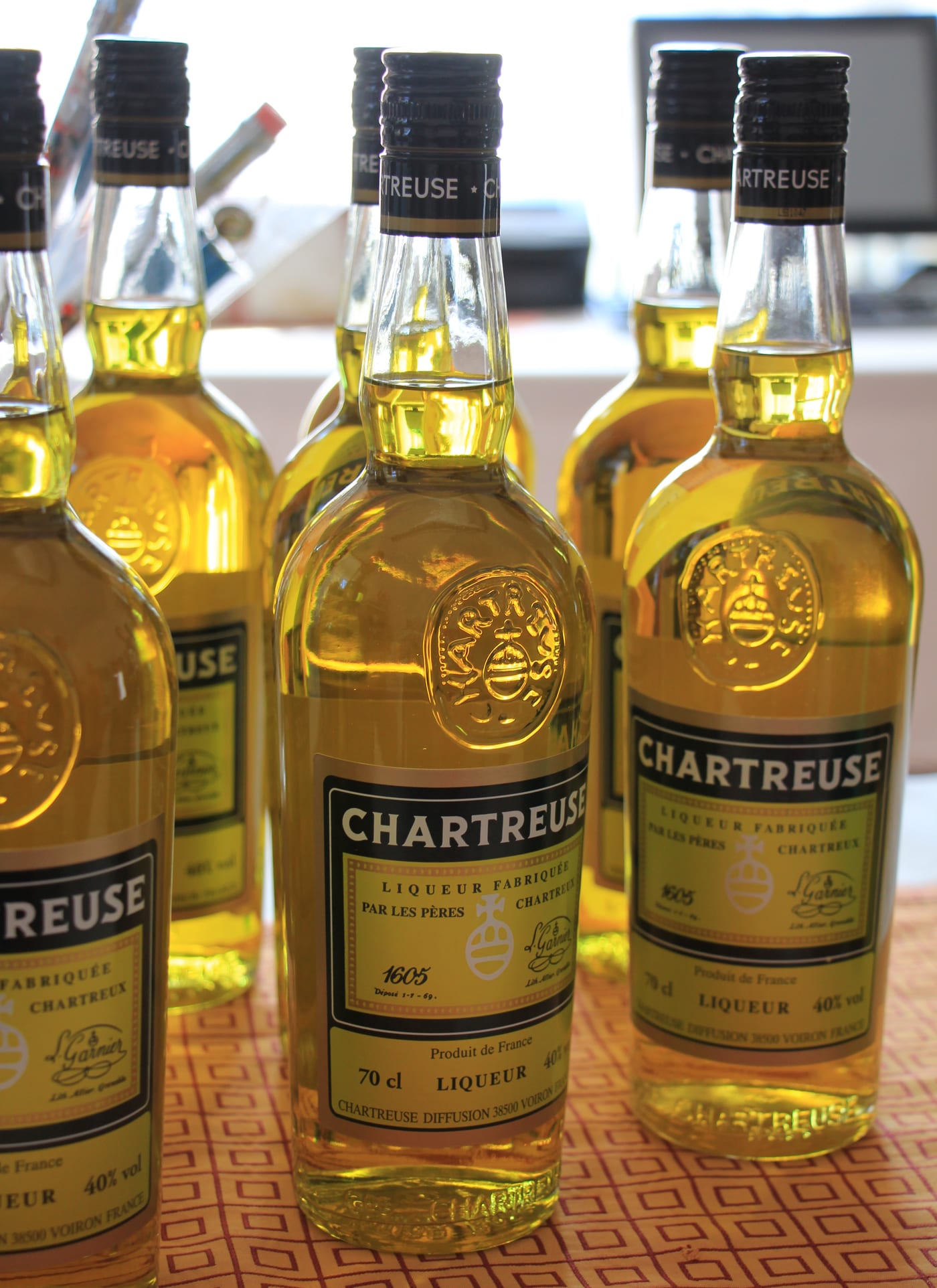
Chartreuse is easy to mishandle in a dining room because its story is almost too good. A secret formula. Carthusian monks. A mountain range. A color that escaped the bottle and became a word. Put that mythology at the table too loudly and the pour turns into souvenir theater. Use it well, and Chartreuse can do something more precise: it can make the end of a meal taste less like a sweet full stop and more like a return to herbs, cold air, bitterness, and appetite.
That is why its fine-dining role is not simply "digestif." The official Chartreuse history states the one public number everyone repeats: the liqueur is made with 130 plants, while the recipe remains mysterious and tied to the Chartreuse Order and the mountain range that gave the drink its name.[1] The useful service question begins there. If a kitchen has spent three hours moving a diner through fish, roots, sauces, cheese, fruit, chocolate, and small sweets, the final glass should not flatten all of that work into sugar or alcohol heat. It should reopen the palate.
The pour is an aromatic course
Green Chartreuse has the more dramatic reputation: high proof, electric color, a blast of alpine bitterness and sweetness that can feel medicinal in the best sense. Yellow Chartreuse is softer, sweeter, and easier to land after dessert. GuildSomm summarizes the two as part of the same monastic family but with different table behavior: green is intensely aromatic, while the 86-proof yellow version is milder and sweeter.[3] For a sommelier or captain, that difference matters more than the legend.
The correct question is not "Do you want Chartreuse?" It is "What has the table just eaten?" After a citrus dessert, green can make the finish feel sharper and more botanical. After chocolate, yellow can read as honey, saffron warmth, and a slow herbal echo rather than as another layer of bitterness. After cheese, either version can work, but the measure has to be disciplined: enough to perfume the last stretch, not enough to turn the table heavy.
The regional tourism page for Chartreuse makes this dining logic plain rather than precious. It says green Chartreuse can be enjoyed on its own as a digestif, in cocktails, or used to enhance a dish, chocolate, or cheese.[2] That is the bridge a fine-dining room should care about. Chartreuse is not only an after-dinner drink parked beside the check. It is an ingredient, a pairing tool, and a service rhythm.
Scarcity should make service quieter
The modern complication is availability. GuildSomm notes that recent demand has grown beyond supply.[3] Drinks International, reporting on Chartreuse devotees seeking alternatives, quotes the production decision that began tightening the market: in 2021, the Carthusian monks decided not to increase production, limiting volume so they could protect monastic life and devote time to solitude and prayer.[4] In ordinary luxury culture, scarcity often becomes the whole sales pitch. Chartreuse deserves better than that.
At the table, scarcity should make service smaller, not more theatrical. A restaurant with an allocation problem does not need to turn every remaining bottle into a flex. It can pour less, pour colder, and explain more carefully. That restraint fits the product. The liqueur's force comes partly from refusing normal growth logic: a cult object whose makers do not appear interested in behaving like a lifestyle brand.
This is also why Chartreuse belongs most naturally in restaurants that already understand place. Flocons de Sel in Megève describes a cellar built around nearly 1,200 wines, with Savoie forming the cornerstone of a list anchored in terroir; the same page notes an extraordinary Chartreuse collection that includes bottles from before 1900, green and yellow versions, MOF cuvées, Episcopale, Anisette, and a rare "Queen of Liqueurs" yellow cuvée.[5] That collection is impressive, but the important point is not hoarding. It is context. In an Alpine dining room, Chartreuse can behave like a liquid continuation of the surrounding weather, herbs, dairy, and mountain appetite.
Pairing it means managing the finish
The best Chartreuse pairing is often less about matching flavors than about managing the final ten minutes of the meal. Fine dining has a dessert problem: the end can become a pileup of sugar, cream, chocolate, mignardises, and fortified wine. Chartreuse cuts through that pileup because bitterness and botanicals push against sweetness. But push too hard and green Chartreuse can dominate a delicate pastry course. Pour yellow too warm and it can feel syrupy instead of lucid.
Temperature helps. A chilled pour tightens the aroma, keeps the sweetness from swelling, and makes the glass feel like a clean last gesture rather than an alcoholic dessert. Glass size helps too. Chartreuse does not need a generous brandy balloon. A smaller glass protects the measure and concentrates the nose without encouraging the diner to warm it lazily in the hand.
With chocolate, the pairing works because bitter cocoa and herbal bitterness can meet without requiring more sugar. With aged cheese, Chartreuse can replace the expected sweet wine by bringing honeyed, resinous, and bitter notes to salt and fat. With fruit desserts, especially citrus, pear, apple, or alpine berry profiles, the pour can behave like an invisible herb garden beside the plate. The mistake is to treat it as a universal trophy. A precise restaurant should sometimes choose not to pour it.
That refusal matters. If the final dessert is already built around fennel, anise, pine, menthol, or bitter herbs, Chartreuse may blur the architecture instead of clarifying it. If the table has chosen a long wine pairing, the better move may be a single shared taste, or no digestif at all. Hospitality is not the maximum number of rare liquids a diner can be made to encounter. It is the order in which the right ones arrive.
The bottle should not outrun the meal
The photograph used here shows a bottle of yellow Chartreuse in a glass cabinet.[6] It is a useful image precisely because it is not glamorous. The bottle is upright, labeled, and contained. That is how the liqueur should enter fine dining: as a real object with a history and a job, not as a glowing green badge of insider taste.
Handled well, Chartreuse gives a meal one last change of altitude. It moves the mouth away from pastry and back toward plants. It reminds the table that sweetness can carry bitterness, that a digestif can be aromatic rather than blunt, and that rarity is only meaningful when service knows what to do with it. The final pour should not announce that the restaurant owns Chartreuse. It should make the diner understand why this meal, this measure, and this moment needed it.
Sources
- Chartreuse Diffusion, "History of Chartreuse" - official history page covering the 130-plant formula, the Chartreuse Order, and the mountain-range origin of the liqueur's identity.
- Chartreuse Tourisme, "Green Chartreuse liqueur" - regional tourism page noting Aiguenoire production context and green Chartreuse's use as digestif, cocktail ingredient, and enhancement for dishes, chocolate, and cheese.
- Virginie Boone, "What You Should Know About Chartreuse." GuildSomm, 2025 - spirits feature on Chartreuse history, green/yellow differences, digestif use, cocktail afterlife, and demand exceeding supply.
- Oli Dodd, "Chartreuse devotees find alternatives." Drinks International, 2024 - trade report on Chartreuse allocation pressure and the monks' stated decision not to increase production volume.
- Flocons de Sel, "Gourmet Restaurant Megève, Haute-Savoie" - official restaurant page describing the cellar's Savoie focus, nearly 1,200 wines, and extensive Chartreuse collection including pre-1900 bottles and rare cuvées.
- Wikimedia Commons, "File:Chartreuse-Liqueur 7586 (cropped).JPG" - 2016 real photograph by Karl Gruber of a Chartreuse bottle, used as this article's image.