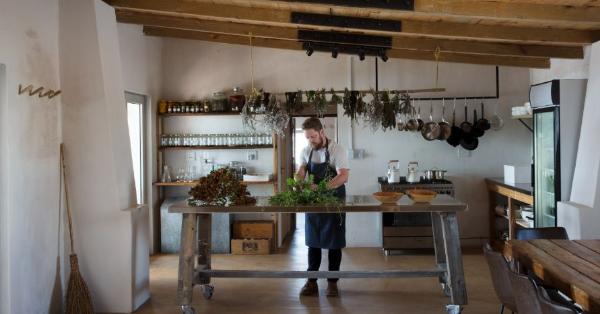
Wolfgat becomes easier to understand once you stop reading it as a remote trophy reservation and start reading it as a headcount machine. The restaurant's public material keeps repeating the same operational idea in different forms: the menu is coastal, seasonal, and specific to Paternoster, but it only works because the room stays tiny enough for the kitchen to gather, prepare, and plate against a known number of people.[1][2][3]
That is why Wolfgat still matters. The room's mythology is already established: a tiny restaurant in Paternoster, named for the cave beneath the building, once ranked No. 50 on The World's 50 Best Restaurants list and named Best Restaurant in Africa in 2021.[5] The more useful question in 2026 is narrower. What exactly is the restaurant selling now that the headline recognition is old news? The answer is not just "foraging" or "West Coast atmosphere." It is a tightly controlled strandveld pantry, matched to exact bookings, in a place where scale has been kept small enough for the landscape to stay legible.[1][2][3][5]
1. The pantry is built from coastal specificity, not generalized locality
Wolfgat's menu page says the restaurant offers a "unique dining experience" built around indigenous ingredients specific to its coastal location.[2] That phrase matters because the menu does not describe itself in the broad language of South African seasonality alone. It gets much more precise. Sustainable seafood, local lamb and venison, seasonal veldkos, wild herbs, seaweeds from local rock pools, and produce from the garden all sit inside the same seven-course structure.[2]
That list is the core of the restaurant's sourcing logic. It does not rely on one prestige product. It relies on a narrow ecological strip: shoreline, rock pools, veld, and nearby agricultural life. The strandveld identity is therefore not decorative branding attached after the dishes are conceived. It is the operating boundary that decides what counts as product in the first place.[1][2]
This is also where Wolfgat separates itself from many restaurants that use "hyperlocal" as an atmospheric word. Hyperlocal often means a handful of symbolic ingredients in an otherwise conventional luxury format. Here the pantry sounds much stricter. Seaweed, succulents, shellfish, wild herbs, and small-scale meat inputs are not embellishments around a standard tasting-menu grammar. They are the grammar.[2][5]
2. Exact bookings shape the food before service begins
The single most revealing sentence on Wolfgat's menu page is not about flavor. It is the line explaining that some elements take weeks of preparation, while other ingredients are handpicked on the day for the exact number of bookings received.[2] That sentence is more informative than most chef interviews because it tells you what the restaurant believes luxury should protect.
Many fine-dining rooms use scale to absorb uncertainty. They buy more product than they need, hold broader mise en place, and smooth over volatility through purchasing power. Wolfgat goes the other way. It only books 20 diners per sitting, explicitly saying that by keeping the room small, it keeps the model sustainable.[2] In practice, that means reservation count is part of procurement.
The booking page reinforces the same logic with hard numbers:
- seven courses at R1450 per person,[3]
- lunch from Wednesday to Saturday at 12:30 and Sunday at 12:00,[3]
- dinner only on Friday and Saturday at 19:00,[3]
- deposits non-refundable for changes or cancellations made within 72 hours.[3]
Those are not administrative details. They are sourcing controls. If ingredients are being picked and prepared against exact covers, late churn is not merely inconvenient; it interferes with how the pantry is assembled.
3. Small scale lets the strandveld remain readable
The 50 Best Discovery profile supplies the broader frame: Wolfgat is a 20-seater two hours north of Cape Town, renowned for indigenous ingredients, with a seven-course strandveld tasting menu that emphasizes seafood, meat and game, wild herbs, seaweed from local rock pools, and homegrown vegetables.[5] What matters in that description is not only the ingredient list. It is the connection between room size and ingredient readability.
Once a restaurant grows too large, coastal specificity tends to blur into generic seafood luxury. The fish may still be excellent, but the place starts to feel interchangeable. Wolfgat's scale resists that. A tiny dining room means the kitchen can hold onto odd textures, small harvests, and ingredients whose value depends on timing rather than bulk. The menu can stay close to the weather and the shoreline because the business model has accepted narrow throughput.[2][3][5]
That is why the vegetarian note on the booking page matters too. Wolfgat will offer an optional vegetarian tasting menu only if booked in advance, and it says that vegetarian version tries to mirror the flavor profile of the signature seafood menu through seaweeds, succulents, and wild herbs.[3] Even the exception stays inside the same pantry logic. The restaurant is not stepping outside its coastal frame to satisfy preference; it is translating that frame through a second route.
4. The cave and old house keep time in the room
Wolfgat's strongest atmospheric move is also one of its strongest sourcing cues. The building dates back roughly 130 years, and the restaurant's own cave page emphasizes that the Wolfgat cave on the premises is archaeologically and geologically significant, with finds including ceramics, sheep bones, marine shell, ostrich eggshell, beads, stone artefacts, and traces of bedding and hearths from the last 2000 years.[4]
This matters because the cave prevents the restaurant's locality from feeling merely scenic. Paternoster is not being used as a pretty fishing-village backdrop for contemporary plating. The site introduces a much longer timescale of habitation, food, shell, fire, and coast.[4] When a restaurant then builds its menu around wild herbs, seaweeds, seafood, and veldkos, that deep-time context sharpens the story instead of sentimentalizing it.
In other words, Wolfgat's room does not only tell diners where they are. It suggests how long people have been negotiating this coast as a place to gather, cook, preserve, and eat.[4] That does not make the food "archaeological," nor should it. It makes the restaurant's restraint feel grounded. The house is small, the cave is older than the business, and the menu sounds as if it is trying to remain accountable to that asymmetry.
5. What Wolfgat is actually selling now
The lazy reading of Wolfgat is that it sells remoteness, prestige, and West Coast romance.[5] The sharper reading is that it sells precision under natural constraint:
- a pantry narrow enough to stay coastal and strandveld-specific,[2][5]
- a room small enough for exact-cover procurement to matter,[2][3]
- a schedule strict enough to protect handpicked and long-prepped elements,[2][3]
- and a site whose cave-house history keeps the landscape from becoming a generic luxury mood board.[1][4]
That does not make Wolfgat universally right for every fine-dining diner. If you want broad choice, multiple pairings, and the reassurance of metropolitan abundance, other restaurants will feel more comfortable. Wolfgat is built around a different pleasure. It asks whether a meal gets more luxurious when the room becomes smaller, the pantry gets narrower, and the booking ledger starts determining what can responsibly be gathered.
That is why the restaurant remains interesting in 2026. The seven-course structure is simple on paper, the price is explicit, the seating cap is firm, and the sourcing language stays close to the sea rather than to imported grandeur.[2][3][5] Wolfgat's luxury is not expansion. It is the confidence to let a very small number of diners encounter a very small slice of coast under conditions tight enough for the place to stay in charge.
Sources
- Wolfgat, homepage. Official framing of the restaurant as a strandveld eatery in Paternoster.
- Wolfgat, "A Seasonal Tasting Menu." Official description of the seven-course strandveld menu, indigenous coastal ingredients, weeks-long preparation, handpicked day-of ingredients, and the 20-diner cap.
- Wolfgat, "Book Online." Official menu price, lunch and dinner schedule, vegetarian and vegan policy, deposit requirement, and 72-hour cancellation terms.
- Wolfgat, "A Cave Called Wolfgat." Official background on the 130-year-old building and the cave's archaeological finds and chronology.
- 50 Best Discovery, "Wolfgat." Independent profile covering the 20-seat scale, two-hours-from-Cape-Town location, 2021 Africa recognition, and strandveld tasting-menu character.